

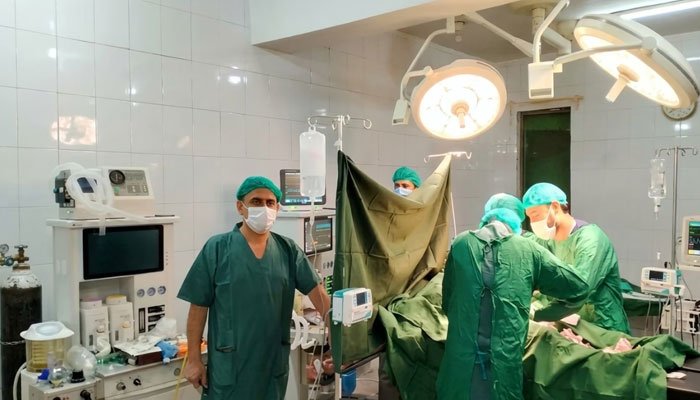
Public-Private Partnerships Improve Healthcare Services Across KP
KP Hospitals Show Improved Performance Through Public-Private Healthcare Partnerships

PESHAWAR: (Staff Reporter) – Public-private partnerships (PPPs) between the Medical Emergency Resilience Foundation (MERF) and the Khyber Pakhtunkhwa Health Foundation (KPHF) are contributing to improvements in public healthcare across the province by expanding access to affordable medical services, strengthening specialised treatment and raising healthcare standards.
The District Headquarters (DHQ) Hospital Wana in South Waziristan is among the key examples of this collaboration, having recorded significant improvements in service delivery since MERF assumed its management in 2022.
According to the provincial government’s Independent Monitoring Unit (IMU), the hospital’s performance score has increased from 37 per cent to between 80 and 84 per cent over the past several quarters, making it one of the most improved secondary healthcare facilities in Khyber Pakhtunkhwa.
The hospital currently treats an average of 780 patients daily and provides a range of services, including specialist consultations, emergency treatment, dialysis, surgical procedures, laboratory testing and inpatient care.
Fourteen specialist consultants are delivering medical services across 11 disciplines, with specialists handling 93 per cent of outpatient department (OPD) consultations. Efforts are also under way to recruit doctors for the remaining vacant positions in certain specialised fields, MERF Provincial Manager KP Dr Abdul Basit said.
Another example of the partnership’s impact is DHQ Hospital Mishti Mela in Orakzai, which is also being managed by MERF in collaboration with the provincial government and KPHF.
Dr Abdul Basit said the hospital had consistently secured a place among Khyber Pakhtunkhwa’s top-performing secondary healthcare facilities in IMU assessments over several years. Its performance reflects improvements in medical services, patient care, healthcare standards and hospital administration despite operating in a geographically challenging district.
Similarly, Government General Hospital (GGH) Nishterabad in Peshawar has demonstrated the contribution of the PPP model towards strengthening public healthcare. The facility is helping reduce the workload on tertiary-care hospitals by providing accessible and affordable treatment to urban communities.
The hospital serves thousands of patients through its expanded outpatient, emergency and specialist services, improving access to medical facilities while supporting the wider provincial healthcare system.
Dr Abdul Basit said MERF remained committed to supporting the Khyber Pakhtunkhwa government in upgrading public health facilities through innovative approaches, improved service standards, efficient management and patient-focused healthcare.
He maintained that the public-private partnership model had demonstrated the potential of collaboration between government institutions and development organisations to improve healthcare delivery and ensure wider access to quality medical services.
MERF currently manages several public healthcare institutions across Khyber Pakhtunkhwa in partnership with the provincial government and KPHF under the PPP for Health programme.
Through this arrangement, the organisation aims to improve patient satisfaction, operational efficiency and service delivery while ensuring that vulnerable communities receive timely, affordable and quality healthcare close to their homes.
MERF reiterated its commitment to working alongside KPHF and the provincial government to provide reliable and quality healthcare services to residents throughout Khyber Pakhtunkhwa.
Comments are closed, but trackbacks and pingbacks are open.