
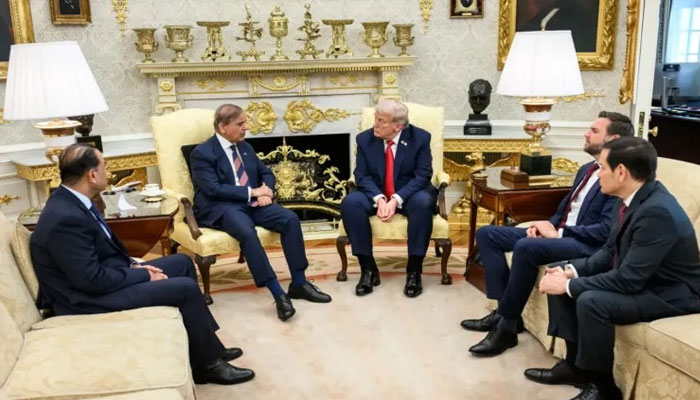

President Donald Trump has claimed that negotiations with Iran are ongoing and he is hopeful for a comprehensive agreement. He says that Vice President JD Vance, Secretary of State Marco Rubio, and Jared Kushner are involved in the process.
According to the report, the US has sent a 15-point peace plan to Iran through Pakistan to end the war. Pakistan has also offered to host these talks. Pakistan’s role in the current diplomacy is a testament to the combination of relationships built over time. It may be recalled that in June 2025, when Field Marshal Asim Munir visited the White House for an unusual lunch meeting with Trump, it was the first time a US president had hosted a Pakistani military chief who was not also the president. Trump had openly said that Pakistan “knows Iran very well, the best of the best”. The meeting, which lasted for more than two hours, discussed Israel-Iran tensions. On March 3, Foreign Minister Dar told parliament that Pakistan was “ready to facilitate talks between Washington and Tehran in Islamabad”. In the same address, Dar revealed that Pakistan had pushed back on Washington’s demand for zero uranium enrichment, instead of proposing a monitoring framework. He said it was agreed that two to three countries should be monitored, and Iran was happy with that. Pakistan is the only Muslim-majority country that has nuclear weapons and does not host US military bases. It has maintained long-standing ties with Saudi Arabia, dating back to 1947, strengthened by a strategic defense agreement signed in September 2025. Iran’s new Supreme Leader, Mojtaba Khamenei, recently referred to Pakistan in a message on the occasion of Nowruz, saying he has “special feelings” for its people. “Pakistan’s importance also stems from its position as a major Islamic country with a credible reputation. It has relations with the Gulf countries, Saudi Arabia, and Iran; everyone is open to Pakistan playing a mediating role.” Iranian officials and military spokesmen have rejected US claims, saying that the US is “negotiating with itself”. Iran has so far denied any direct talks and called it “cowardice” on the part of the US.
The US is sending thousands of additional troops to strengthen its presence in the Middle East. Iran has expressed serious concerns over US military deployments in the Middle East and has given a strong and categorical response.
The speaker of the Iranian parliament has warned that US troops could be targeted by Israeli Prime Minister Netanyahu’s policies amid rising tensions in the region. Iran has strongly reacted to US military deployments in the Middle East, saying it is keeping a close eye on all US activities in the region, especially military movements.
Iranian Parliament Speaker Mohammad Baqer Qalibaf stated in a social media post that Tehran is constantly monitoring US actions and is fully prepared to defend its territory. Qalibaf harshly criticized the US and Israel, saying that what the generals have damaged, the soldiers cannot fix, but will fall victim to Netanyahu’s illusions.
He warned against testing Iran’s resolve. This statement came at a time when, according to news agencies, the US is considering sending an additional 1,000 to 2,000 troops to the Middle East, while more than 1,000 personnel from the 82nd Airborne Division are also expected to be deployed. In addition, two Marine units are also being sent to the region, which will increase the presence of about 5,000 Marines and thousands of Sailors. Currently, about 50,000 US troops are already in the Middle East, while another 4,500 Marines have been sent to the region. Defense experts say that these deployments could further increase tensions in the region, where tensions between Iran, the United States, and Israel are already at an all-time high.
The Iranian military spokesman, Iranian Ambassador to Pakistan Reza Amiri Moqadam, also denied any direct or indirect talks with the United States.
In his statement, Iranian Ambassador Reza Amiri Moqadam said that friendly countries like Pakistan want to lay the foundation for talks between Tehran and Washington, and he hopes that the efforts of friendly countries will be successful.
Reza Amiri Moqadam says that friendly countries are in contact with the parties to end the aggression, but according to my information, there have been no direct or indirect talks between the US and Iran regarding a ceasefire.
On the other hand, Iranian Foreign Ministry spokesman Esmail Baghai says that various countries are offering to mediate between Iran and the US, Iran is responding to messages from various countries, and Iran’s position is clear that it will continue to defend itself.

Esmail Baghai says that talks about negotiations during the US and Israeli attacks are not credible. Abbas Araqchi is in contact with his Pakistani counterpart and diplomats from other countries.
It should be remembered that earlier, the spokesman for Iran’s Supreme Joint Military Command, while reacting to news of negotiations with the US, said that the US should not call its defeat an agreement, and that there will be no traces of American investment in the region.
Airborne Division: The Pentagon is preparing to deploy about 2,000 to 4,000 soldiers of this elite division to the region. Marines and naval forces: About 2,500 Marines, along with warships, are being deployed near Iran to meet any potential ground operations or defense needs. Although a final decision on a regular ground operation inside Iran has not yet been made, the deployment is being made to protect the Strait of Hormuz and possible future operations against Iran. While diplomatic efforts are being made to broker a ceasefire, especially through Pakistan, the US is continuously sending ground and naval forces to the Middle East to increase military pressure. President Donald Trump has approved the deployment of troops from the 82nd Airborne Division to the Middle East. Indicating progress in peace talks, President Trump said he received a “very big gift” from Iran, but at the same time, he is preparing to deploy ground troops on a large scale. President Trump is reportedly considering capturing Kharg Island to break the blockade of the Strait of Hormuz, from where 90% of Iran’s oil exports are made.Earlier, the New York Times reported that the Saudi leader had asked Donald Trump to send ground troops to Iran. He believes that this war is a ‘historic opportunity’ for regime change. Sources told the New York Times that Mohammed bin Salman (MBS) urged Trump in several calls last week to continue the war against Iran, and tried to convince the president that it was not right to leave the job half done. The US Central Command said on the 14th that it had targeted more than 90 military sites on the island. On the 19th, President Trump said that we can destroy the island at any time if we want. However, there are assessments that if Iran proceeds to destroy the runway of the airport on Kharg Island using short-range ballistic missiles, the US military may face difficulties, because the US would have to retaliate with portable surface-to-air missiles, which are difficult to intercept. If the United States were to attempt to dismantle military installations along Iran’s coastline to fundamentally weaken Iran’s threat capabilities in the Gulf, it would require significantly more troops than those currently deployed or scheduled to be deployed in the Middle East, and the threat level would also be much higher. The British daily The Times quoted a military analyst as saying that “it is practically impossible to capture the entire Iranian coast, and it would require hundreds of thousands of troops to control the coastal areas.” The US Army’s establishment ceremony was held at Pike Field, Fort Bragg, North Carolina, US. The 82nd Airborne Division, Joint Special Operations Command, and other units are stationed at Fort Bragg. The media reported that President Donald Trump has approved a plan to deploy more than 1,000 troops from the 82nd Airborne Division to the Middle East. Citing sources, that “President Trump has approved the deployment of more than 1,000 soldiers from the 82nd Airborne Division to the Middle East.” CNN reported, citing sources, that the deployment includes a battalion of the Stryker Brigade Combat Team, which is part of the 82nd Airborne Division led by Maj. Gen. Brandon Tate May is currently serving as the Army’s quick response force. The quick response force is a unit that can be deployed to an operational site within hours of an order and is likely to be the first ground force among the US troops to be transferred to the Middle East. According to sources familiar with the matter, the deployment was approved last night. Currently, the division headquarters, staff, and some ground force orders are being finalized. However, the entire brigade will not be deployed. While the entire brigade of the 82nd Airborne Division consists of more than 3,000 soldiers, the number deployed this time is expected to be less than half that. The soldiers have not yet left the United States but are expected to be sent to the Middle East in the next few days. The New York Times reported that US military officials are considering deploying some combat brigades and division headquarters personnel from the 82nd Airborne Division, one of the most elite units, for operations in Iran. About 5,000 soldiers from two Marine expeditionary units are currently heading to the Middle East by ship. In addition, an advanced force of 3,000 soldiers from the 82nd Airborne Division has been deployed. CNN noted that the 82nd Airborne Division showed similar movements shortly after the US military killed Qassem Soleimani, the commander of Iran’s Islamic Revolutionary Guard Corps, during President Trump’s first term in 2020. The division was also deployed for the evacuation operation from Afghanistan in 2021. Kharg Island, a major hub for Iranian oil exports, is being considered as a potential location for the 82nd Airborne Division’s air incursion. It is worth noting that this pressure came after Trump announced a five-day pause in US attacks on Iranian energy infrastructure while Washington pursued back-channel talks with Tehran through mediators, indicating that it was finding a way out. The Daily Mail has contacted the White House for comment. Despite the talks with Tehran, US generals are deploying 3,000 troops from the Army’s 82nd Airborne Division for a possible ground invasion, joining thousands of Marines already deployed to the Middle East. Officials say the Saudi crown prince made the case that if the Iranian regime is not completely wiped out, it will pose a long-term threat to the region. The sources added that the Saudi crown prince urged Trump to send troops to Iran to take over the country’s energy infrastructure and remove the current government from power. Trump had expressed concerns that further increases could lead to further increases in oil prices, with the national average price of gas reaching $4.00 per gallon on Monday, up from $2.90 when the war began on February 28.The Daily Mail said the Saudi crown prince’s private views contradicted Saudi public statements that highlighted the kingdom’s desire for a diplomatic end to the war, which has led to retaliatory attacks on its energy facilities and a stranglehold on its oil exports.
Saudi Crown Prince Mohammed bin Salman reportedly urged Trump to send ground troops to Iran. The prince has advocated regime change in Iran, noting that if the current government remains in place, it will continue to destabilize the Gulf region. Iran has been targeting Saudi Arabia with missiles and drones since the US and Israel first attacked the Islamic Republic on February 28. It is worth noting that the Saudi monarchy has always supported a peaceful resolution to the conflict, a Saudi spokesman said in a statement, adding that its officials are “in close contact with the Trump administration and our commitment remains unchanged.” “Our primary concern today is to defend ourselves from the daily attacks on our people and our civilian infrastructure,” the spokesman added. “Iran has chosen a dangerous path over a serious diplomatic solution. It hurts every stakeholder, but no one but Iran itself.”
According to the Times, senior Saudi and American officials fear that if the fighting continues, Iran could retaliate with further attacks on Riyadh’s oil facilities and drag the United States into “an endless war.” While the kingdom maintains a stockpile of Patriot missile interceptors to defend against Iranian drone and missile attacks, Saudi air defenses have intercepted several. Saudi oil fields, refineries, and cities have all been hit by Iranian weapons. So has the US embassy in Riyadh, prompting the US to evacuate the mission. But Trump signaled on Monday that a war could be nearing a conclusion, noting that talks with Iran have begun, a claim Iran has denied. An Iranian official, who is affiliated with the Islamic Revolutionary Guard Corps, said Saudi Crown Prince Mohammed bin Salman had reportedly urged Trump to send ground troops to Iran. The prince has advocated regime change in Iran, noting that if the current government remains in place, it will continue to destabilize the Gulf region. Iran has been targeting Saudi Arabia with missiles and drones since the US and Israel first attacked the Islamic Republic on February 28. It is worth noting that the Kingdom of Saudi Arabia has always supported a peaceful resolution to the conflict, a Saudi spokesman said in a statement, adding that its officials are “in close contact with the Trump administration and our commitment remains unchanged.” “Our primary concern today is to defend ourselves from the daily attacks on our people and our civilian infrastructure,” the spokesman added. “Iran has chosen a dangerous path over a serious diplomatic solution. This harms every stakeholder, but no one but Iran itself.”
According to the Times, senior Saudi and US officials fear that if the fighting continues, Iran could retaliate with further attacks on Riyadh’s oil facilities and drag the US into “an endless war.” While the kingdom maintains a stockpile of Patriot missile interceptors to defend against Iranian drone and missile attacks, Saudi air defences have been hit by several. Saudi oil fields, refineries, and cities have all been hit by Iranian weapons. So has the US embassy in Riyadh, prompting the US to evacuate the mission. But Trump signalled on Monday that a war could be nearing a conclusion, noting that talks with Iran have begun, although Iran has denied that talks are taking place. “There is no direct or indirect contact with Trump,” said an Iranian official affiliated with the Islamic Revolutionary Guard Corps. If the talks go nowhere and Iran does not cooperate, Trump said US forces will “continue to bomb our little hearts.” Thousands of US Marines have been deployed to the Middle East in recent weeks, with at least two units of more than 4,500 personnel ordered to head towards Iran. The San Diego Union-Tribune reported that about 2,500 Marines aboard three ships were deployed to the Middle East over the weekend. The US is deploying thousands of additional Marines and other naval personnel to the Middle East, three weeks into its war with Israel against Iran.
According to the British news agency Reuters, three US officials said on Friday that no decision has yet been made to land troops directly inside the Iranian border, but that capacity is being increased for future operations in the region. According to these US officials, the Navy warship ‘USS Boxer’ and its accompanying ‘Marine Expeditionary Unit’ and other warships are also being sent. US President Donald Trump has said he is not sending troops “anywhere” for now, but he would not tell reporters if he did. The troops are leaving the US West Coast about three weeks ahead of schedule, an official said.
The White House and the Pentagon immediately declined to comment. It should be noted that there are already about 50,000 US troops in the Middle East and now the number of US Marine Expeditionary Units in the region will also increase to two.
A ‘Marine Expeditionary Unit’ usually consists of about 2,500 Marines, who can be used for various purposes, such as carrying out attacks from ships with warplanes or participating in ground operations. The US military is already preparing for the possible next steps in its campaign against Iran, which began on February 28. Meanwhile, Israeli Prime Minister Benjamin Netanyahu has said that Israel and the US are “winning” the war against Iran, while Iran is “destroyed” and has neither the ability to enrich uranium nor build ballistic missiles.
An Israel Defense Forces spokesman said on Friday that “the IDF has launched a new wave of attacks against the infrastructure of the Iranian terrorist regime located in the heart of Tehran.”
However, he did not provide further details about the attacks. On Friday, Iran threatened to target entertainment and tourist destinations around the world and stressed that it is still developing missiles. Iran has shown by its actions that it is still capable of carrying out attacks that affect international oil shipments. The Iranian attacks are weighing on the global economy and are also pushing up food and fuel prices beyond the Middle East.
Iran has categorically denied that it is engaged in any talks with the United States, but several American and Israeli media outlets have reported that Pakistan, Egypt, and Turkey are acting as messengers between the United States and Iran, hoping to broker an off-ramp in the war that has caused the largest energy crisis in modern history. Some of these reports have suggested that Islamabad could emerge as a host city for talks this weekend. According to American outlet Axios, two possible formats for the meeting in Islamabad are being discussed. One would involve Iranian Foreign Minister Abbas Araqchi, US envoy Steve Witkoff, and Trump’s son-in-law Jared Kushner. In another scenario, US Vice President JD Vance met with Iranian Parliament Speaker Mohammad Baqer Ghalib, who dismissed Trump’s claims of talks as “an attempt to escape the quagmire in which the US and Israel are stuck.” Still, some facts are confirmed: Pakistani Army Chief Field Marshal Asim Munir spoke to President Trump on Sunday. Prime Minister Shahbaz Sharif called Iranian President Masoud Peshmerga a day later, and Foreign Minister Ishaq Dar held separate meetings with his Iranian and Turkish counterparts. The picture emerging from analysts and officials is one of a tentative but fragile diplomatic move, significant enough to halt some military activity but not yet for substantive negotiations. Trump claimed that the US and Iran had already reached “key points,” which an Iranian Foreign Ministry spokesman said were temporary measures to ease tensions in the US-Israel war. Baghaei confirmed that the messages came through “friendly countries,” including the U.S. request for talks, but said Iran had responded in accordance with the “country’s principled position.” An Iranian official, quoted by state-affiliated Press TV, outlined Tehran’s conditions for ending the war on Monday. They include guarantees against future military action, the closure of all U.S. military bases in the Gulf region, full compensation from Washington and Tel Aviv, an end to regional disputes involving Iran-aligned groups, and a new legal framework governing the Strait of Hormuz.
The White House has declined to provide details of the talks that Trump claimed were taking place. “These are sensitive diplomatic discussions, and the United States will not discuss them through the press,” press secretary Caroline Levitt said in a statement. Mehran Kamraw, director of the Iranian Studies Unit at the Arab Center for Research and Policy Studies and a professor at Georgetown University in Qatar, said Trump’s approach follows a familiar pattern.
He said Washington has relied on sustained military and economic pressure to force Tehran to negotiate on US terms, a strategy that has not yet succeeded. “This is consistent with Trump’s gunboat diplomacy and his assumption that he can continue to pressure and threaten the Iranians to negotiate,” he told Al Jazeera. “However, we have seen resistance from Iran to such pressure tactics, and the Iranians have not responded to the threats in the way the Americans expected.” Analysts say part of the explanation for Iran’s refusal to bow to Trump’s pressure is structural. Trita Parsi, executive vice president of the Quincy Institute for Responsible Statecraft, argued that the war has – paradoxically – strengthened Iran’s position on the key issue of sanctions.

Comments are closed, but trackbacks and pingbacks are open.