
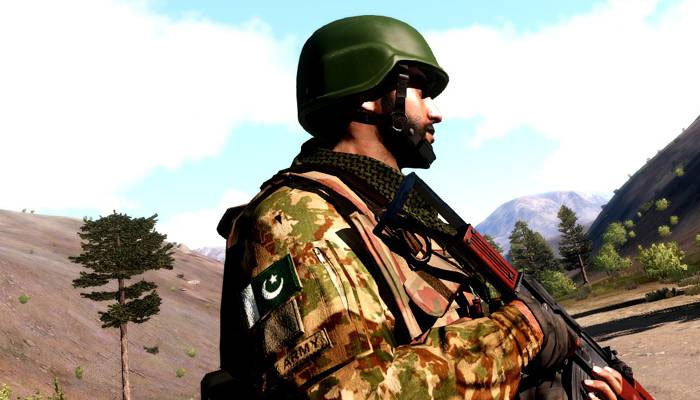
Pakistan’s Armed Forces’ Operation Ghazab Lil-Haq against terrorists
By: Asghar Ali Mubarak

The clear effects of Operation Ghazab Lil-Haq have started to emerge, terrorist attacks are decreasing significantly.
The Pakistan Armed Forces’ “Operation Ghazab Lil-Haq” against terrorist networks and their facilitators in Afghanistan is continuing with full force and determination. This operation was launched in February 2026 in various sectors of the Pak-Afghan border (such as the Garsal sector of Mohmand and the Nangarhar area).
Operation Ghazab Lil-Haq should actually be considered a continuation, intellectual expansion and inevitable next step of “Operation Bunyan Al-Marsoos”. In a military and strategic perspective, these two are not separate campaigns, but links of the same larger security ideology:
1. Ideological and strategic nexus;
Bunyan al-Marsoos (Strong Wall): The basic philosophy of this operation was focused on internal defense, securing the borders and uprooting terrorists and their networks hiding inside the country.
This was a defensive and consolidation phase. Ghazab Lil-Haq (Wrath of Truth): When attacks from across the border (Afghanistan) intensified and the results achieved by “Bunyan al-Marsoos” were threatened by external sanctuaries, the military leadership turned the same mission into an offensive. Ghazab lil-Haq is actually an extended action to protect this strong wall (Bunyan al-Marsoos) from external enemy attacks.2. Completion of the unfinished mission;
Safe havens across the border:
Through Bunyan al-Marsoos, the back of the terrorists inside Pakistan was broken, but their command line was safe in Afghanistan. According to military experts, the mission of Bunyan al-Marsoos would have remained “unfinished” until these external sanctuaries were targeted.
Role of Ghazab lil-Haq:
This operation completed this unfinished part. It crossed the border and targeted the masterminds and their logistical supply lines in Kandahar, Paktia and Nangarhar, giving final impetus to the objectives of the Bunyan-e-Marsoos.
3. Continuity of Writing and History;
Whenever Pakistan’s recent military history is written, “Operation Ghazab Lil-Haq” will be read as a sub-chapter or Phase 2 of “Operation Bunyan-e-Marsoos”.
Both operations target the same enemy (Fitna al-Kharij and their facilitators), only their geographical scope has changed. Prime Minister Shehbaz Sharif recently made it clear during his visit to Quetta that Pakistan is ready to pay any price to defend its sovereignty and territorial integrity and this operation will continue uninterrupted until terrorism is completely eradicated.
According to official figures and military experts, the most important details of the operations so far are as follows:
Background of the operation and reason for its launch:
The operation was launched in response to unprovoked firing by the Afghan Taliban on the Pak-Afghan border, border encroachments and increasing cross-border attacks by the Fitna al-Khawarij (TTP) from Afghan soil.
Primary objective:
The primary objective of this campaign is to completely destroy the terrorist sanctuaries, logistical bases and command and control networks on Afghan soil in order to ensure a secure environment in Pakistan.
Casualties and military losses;
According to the Pakistani Ministry of Information, the enemy has suffered significant losses so far during this operation: Killed and injured terrorists: A total of 796 terrorists have been killed and more than 1,043 have been seriously injured so far.
Capture of Outposts:
286 border posts and hideouts of the Afghan Taliban and militants have been completely destroyed, while Pakistani forces have taken formal control of 44 strategic outposts.
Destruction of military equipment
249 enemy tanks, armored vehicles, cannons and spy drones have been reduced to rubble during air and ground operations
Air operations and bombing of strategic targets:
The Pakistan Air Force has targeted more than 81 terrorist hideouts in different areas of Afghanistan, including Kandahar, Kabul, Paktia and Nangarhar.
Destruction of secret tunnels:
A very important underground tunnel was successfully destroyed in Kandahar, which was used by the Afghan Taliban and the Khawarij to store their most sensitive technical equipment and weapons.
Protection of Civilian Population:
According to the ISPR, all air strikes are being carried out only on recognized military and terrorist installations and no harm has been done to the civilian population.
A categorical message from the Pakistani government;
Prime Minister Shahbaz Sharif and the military leadership have given a categorical message to the Afghan interim government to prevent its Afghan lands from being used against Pakistan and take practical action against terrorists.
Pakistan is constantly proving to the international community that it is a Net Regional Stabilizer and wants peace in the region, but there will be no compromise on the defense of the homeland. Prime Minister Shehbaz Sharif has said that Operation Ghazab Lil-Haq against terrorists in Afghanistan is continuing with full force and determination, operations against terrorist proxies will continue, Afghanistan will take action against terrorists, protect the lives and property of the people at all costs, and Pakistan is ready to pay any price to defend its sovereignty and territorial integrity. While chairing the meeting of the Provincial Apex Committee of the National Action Plan and addressing the officers under training at the Command and Staff College, Prime Minister Shehbaz Sharif said that Pakistan is ready to pay any price to defend its sovereignty and territorial integrity, Operation Ghazab Lil-Haq will continue.The Prime Minister appreciated the professionalism, operational preparedness and sacrifices of the Pakistani armed forces for national security. Referring to the Battle of Haq, Shahbaz Sharif praised Pakistan’s historic victory under the leadership of Field Marshal Asim Munir and said that Pakistan demonstrated responsible behavior, restraint and wisdom in the face of India’s unprovoked and aggressive actions, which was also recognized by the international community. He further said that Operation Ghazab Lil-Haq is continuing with full determination against the terrorist proxies present in the Afghan Taliban and to protect the lives and property of innocent civilians, under which terrorist hideouts and support structures are being targeted.
The Prime Minister also reiterated Pakistan’s unwavering support for the people of occupied Jammu and Kashmir and Palestine and mentioned the presence of officers from friendly countries. He said that Pakistan will always raise its voice for the rights of the Palestinians, an independent Palestinian state is the only solution to this problem. Shahbaz Sharif stressed the importance of military diplomacy and defense cooperation and said that Pakistan is playing its role as a “net regional stabilizer” for peace, stability and development in the region and the world. Earlier, a meeting of the Provincial Apex Committee of the National Action Plan was held in Quetta under the chairmanship of Prime Minister Shahbaz Sharif, in which a briefing was given on security in Balochistan, progress of development projects, planning and other issues. The Prime Minister directed the deployment of Frontier Corps in Rakhshan Division of Balochistan, which will establish a corridor for the protection of minerals in Balochistan. This security corridor will include additional wings of the Frontier Corps, security check posts on highways, surveillance grids, posts on borders, etc. Shahbaz Sharif further said that Pakistan is rich in natural resources, especially minerals, providing a safe environment in Balochistan is essential to maintain the confidence of local and international companies working on mineral-related projects in the country. He said that excellent training and new technology of the police and other forces are very important for the complete eradication of the menace of terrorism. The meeting was informed that not a single polio case has been reported in Balochistan since November 2024, currently 99% of schools in Balochistan are open and educational activities are ongoing.Operation Ghazab Lil-Haq is a credible guarantee of the complete elimination of the Afghan Taliban regime’s sponsorship of terrorism.
The Afghan Taliban regime is acting as a central “proxy master” of terrorism in the region. This regime has become a threat to regional peace and stability by facilitating several terrorist organizations. Operation Ghazab Lil-Haq is a continuation of Pakistan’s ongoing war on terrorism. The Khawarij are promoting a distorted and self-made Islamic ideology of Islam. Islam has nothing to do with terrorism and suicide attacks. The massacre of innocent human lives, atrocities on women, attacks on mosques and their use for terrorist acts are against our religious and social traditions. The Khawarij who propagate such self-made religious beliefs have nothing to do with Islam. Scholars of all schools of thought have declared the war against these Khawarij and their sponsors as the best jihad.
Pakistan is targeting the hideouts, facilitation centers, and border-adjacent launching pads of Fitna al-Kharij and Fitna al-Hindustan involved in terrorism. Pakistan is conducting all operations based on intelligence only against the hideouts and facilitation centers of terrorists. Reports based on the impression of targeting civilian populations in these operations are not only contrary to the facts but also tantamount to avoiding the loss of innocent Pakistani lives as a result of terrorism. In view of the requirements of transparent reporting, the Ministry of Information and Security Agencies is regularly informing the media and the public about the progress of Operation Ghadb-ul-Haqq. Authentic video reports of these operations are also being released. The oppressed sections of the Afghan Taliban regime are calling Operation Ghazab Lil-Haq a welcome development. During Operation Ghazab Lil-Haq, Afghan official social media accounts and their Indian patron media are spreading false and fabricated rumors. Mutual unity and full implementation of the National Action Plan are indispensable for the eradication of terrorism. In the context of Iran and the regional situation, those who call Pakistan’s security a threat live in a fool’s paradise. Pakistan believes in constructive and positive relations with all powers and countries and is always ready to defend its integrity and sovereignty. According to senior Pakistani analyst Asghar Ali Mubarak, the military operation launched by Pakistan during the Pak-Afghan war was named Operation Ghazab Lil-Haq.
Most of the operations carried out by the Pakistan Army in the last two decades were named after religious or Arabic words, which also aimed to give a moral or ideological background to the operation. However, during this Pakistan also carried out an operation whose name was taken from the English language.
The operation carried out against militants in the North Waziristan tribal area bordering Afghanistan on June 15, 2014, was named ‘Zarb-e-Azb’, which is an Arabic word. Zarb-e-Azb is a combination of two words, Zarb which means strike and the second word is Azb which means the sword of the Holy Prophet (peace and blessings of Allah be upon him). Thus, Zarb-e-Azb means the strike of the sword of truth.
In February 2017, the Pakistan Army conducted search operations in all four provinces of the country to completely eradicate terrorism and detained several people. This operation was named Radd-ul-Fasaad, which means rejection of corruption or corruption, i.e. the end of terrorism. During the Indo-Pakistan tension, Pakistan had announced Operation Swift Retaliation in response to the Indian air strike in 2019, as a result of which the Indian pilot Abhinandan was also arrested. This name is taken from the English language, Swift means fast and Retort means response or reaction, i.e. Swift Retort means immediate response. Last May, Pakistan had announced Operation Banyan Marsus against India, as a result of which Indian Rafale aircraft were shot down and several Indian military installations were also attacked. The word Banyan Marsus was also taken from a verse of the Quran, which means a lead-lined wall.
Similarly, this month, the Pakistan Army killed hundreds of Taliban while conducting operations against Afghanistan, destroyed several Afghan posts and captured several checkpoints and hoisted the Pakistani flag.
This operation against Afghanistan was named Operation Ghazab Lil-Haq, Ghazab Lil-Haq is a combination of three words, namely anger which means anger or reaction, the second word is lil which means for, or for the sake of, while the third word is haq which means truth. That is, Ghazab Lil-Haq means anger or reaction for the truth or truth and it is not just emotional anger but a reaction done in defense of the truth.
Operation Ghazab Lil-Haq was launched in response to the unprovoked aggression by Afghanistan. On the night of February 21 and 22, the Pakistan Army targeted the hideouts of Fitna al-Khawarij in Afghanistan. The Afghan regime used this as a base and opened fire on 53 locations in Sector 15 of the Pak-Afghan border in Khyber Pakhtunkhwa, in response to which the Pakistan Army launched Operation Ghazab Lil-Haq in defense of the truth.According to the data, terrorist attacks in April decreased by 42 percent compared to March. In April, 85 terrorist attacks were recorded across the country, while in March this number of attacks was 146.
The security forces killed 224 terrorists in April, 67 people died as a result of the attacks in April, while the number of deaths in March was 106.
Pakistan has shown patience and forbearance many times in the past, but as a result, terrorist incidents increased. This time, the state has made it clear that the desire for peace should not be considered weakness. Pakistan’s policy has always been that it wants to maintain brotherly relations with the Afghan people, however, the problem is with those elements who use Afghan soil against Pakistan. This is the main point that has caused tension between the two countries. The only demand made by Pakistan is that Afghan soil should not be used for terrorism against Pakistan. This demand is very reasonable and the Afghan government should pay attention to it. But the sad thing is that the Afghan government has not made any significant progress in this regard. Here an important question arises that what are the factors that prevent the Afghan Taliban from taking clear and effective steps in this matter? A possible answer to this could be that the Taliban government itself is not taking action against internal and external terrorists, on the other hand, their relations with various militant groups are also a reality. However, this situation cannot last long, because as a state, Afghanistan must take responsibility for the peaceful use of its territory. The claim of targeting a military and drone storage base in Kabul is an important development. This is proof that the terrorist network is not only organized but also equipped with modern technology. In this situation, it becomes necessary for Pakistan to make its security policy more effective and address such threats in a timely manner. The Afghan Taliban’s denial of these claims is in order, but Pakistan’s claim that it has evidence makes it clear that Afghanistan has become a haven for terrorists. In this context, India’s role also comes into question.
This is a dangerous situation not only for Pakistan but also for the entire region. This heinous role of India is not new, but in the past too, such evidence has been coming to light that indicates its destructive role. In this context, India’s accusations against Pakistan show a clear contradiction. The Afghan Taliban must understand that a stable and peaceful Afghanistan is in their own interest, and for this it is necessary that they do not allow their territory to be used for any kind of terrorism. Pakistan has been of the view that India has a hand in using Afghan territory against Pakistan.
Comments are closed, but trackbacks and pingbacks are open.