

Pakistan Pushes for Middle East Ceasefire
FO Highlights Pakistan’s Active Role in Regional Peace Diplomacy

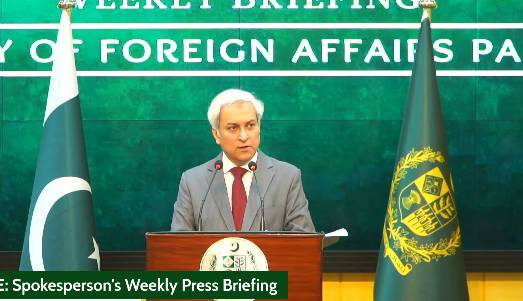
Islamabad: (Mudassar Iqbal) – Pakistan has intensified its diplomatic efforts to promote peace and de-escalation in the Middle East, including developments involving Iran, the Foreign Office Spokesperson said during the weekly press briefing on April 2, 2026.
The spokesperson highlighted that Prime Minister Shehbaz Sharif and Deputy Prime Minister/Foreign Minister Ishaq Dar remained actively engaged throughout the week, holding numerous telephonic conversations with global counterparts to push for a ceasefire and diplomatic resolution of ongoing conflicts in West Asia.
Islamabad witnessed significant diplomatic activity as the Foreign Ministers of Saudi Arabia, Türkiye, and Egypt visited Pakistan to participate in the second round of four-party consultations. The first meeting of this format had taken place in Riyadh on March 19, 2026.
During the consultations, the Foreign Ministers reviewed the evolving situation in the Middle East and the Gulf region. They emphasized the urgent need for an early and lasting end to hostilities, expressing deep concern over the devastating humanitarian and economic consequences of the ongoing conflict. The ministers underscored the importance of unity among the Muslim world during this critical time.
Pakistan also briefed participants on the prospects of facilitating potential talks between United States and Iran in Islamabad. The initiative received strong endorsement from the participating countries, reflecting confidence in Pakistan’s role as a mediator.
The four countries reaffirmed their commitment to preventing further escalation, promoting dialogue, and ensuring adherence to the principles of the United Nations Charter, including respect for sovereignty and territorial integrity. They also explored avenues to strengthen mutual cooperation across various sectors.
A major diplomatic milestone of the week was Deputy Prime Minister Ishaq Dar’s visit to China on March 31, undertaken at the invitation of Chinese Foreign Minister Wang Yi. Despite medical advice to rest following a minor shoulder injury, the visit underscored Pakistan’s strong commitment to its strategic partnership with China.
During the visit, Pakistan and China agreed on a five-point initiative aimed at restoring peace and stability in the Gulf and Middle East region. The initiative called for an immediate cessation of hostilities, the commencement of peace talks, protection of civilians and non-military targets, safeguarding maritime security including shipping lanes in the Strait of Hormuz, and reaffirming the primacy of the United Nations Charter and international law.
Meanwhile, Prime Minister Shehbaz Sharif held key telephonic conversations with several world leaders. On March 27, he spoke with the Crown Prince of Kuwait, condemning attacks against the country and reiterating Pakistan’s commitment to diplomatic efforts for regional peace. The Kuwaiti leadership expressed appreciation for Pakistan’s mediation efforts.
On March 28, the Prime Minister held a conversation with Iranian President Masoud Pezeshkian, discussing ongoing hostilities and the importance of building trust to facilitate dialogue. Both sides emphasized the need for collective efforts toward de-escalation.
On March 31, the Prime Minister also spoke with António Costa, exchanging views on Middle East developments and discussing Pakistan-European Union relations, including the importance of GSP Plus status and the upcoming Pakistan-EU Business Forum in Islamabad.
Deputy Prime Minister Ishaq Dar also engaged extensively with global counterparts. He held discussions with Chinese Foreign Minister Wang Yi, Egypt’s Foreign Minister, and Türkiye’s Foreign Minister Hakan Fidan. He also spoke with United Nations Secretary-General António Guterres, reaffirming Pakistan’s commitment to diplomacy as the only viable path to sustainable peace.
Additional conversations included engagements with leaders from Qatar, Indonesia, and Iran. These discussions focused on regional stability, de-escalation, and coordinated diplomatic efforts.
In a significant development, Iran agreed to allow 20 additional Pakistani-flagged ships to pass through the Strait of Hormuz, with two ships crossing daily. The spokesperson described this as a positive confidence-building measure that would contribute to regional stability and facilitate trade.
The spokesperson also highlighted a joint statement issued by the Foreign Ministers of Pakistan and several countries, including Egypt, Jordan, the United Arab Emirates, Indonesia, Türkiye, Saudi Arabia, and Qatar. The statement strongly condemned restrictions imposed by Israel on freedom of worship in occupied Jerusalem.
The ministers rejected measures preventing Muslim worshippers from accessing Al-Aqsa Mosque and restricting Christian access to the Church of the Holy Sepulchre. They reaffirmed that the legal and historical status quo of holy sites in Jerusalem must be respected and called on the international community to take a firm stance against violations.
Reiterating their position, the ministers stressed that the entire area of Al-Aqsa Mosque remains exclusively a Muslim place of worship and emphasized the role of the Jordanian Waqf authorities in administering the site.
Concluding the briefing, the spokesperson reaffirmed Pakistan’s unwavering commitment to promoting peace through dialogue, diplomacy, and international cooperation, stressing that sustainable peace in the region can only be achieved through collective efforts and adherence to international law.
.

Comments are closed, but trackbacks and pingbacks are open.