
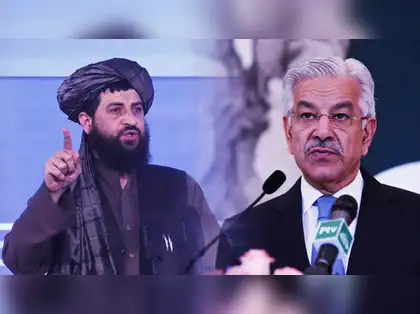
“Pakistan: Four-Day Talks with Afghan Taliban in Turkey Yield No Agreement”
Pakistan will continue “all possible measures” to “decimate terrorists, sanctuaries, abetters, and supporters” Tarar

ISLAMABAD:-Information Minister Attaullah Tarar confirmed on Wednesday that four days of talks between Pakistan and the Afghan Taliban in Istanbul concluded without any progress, despite Islamabad presenting what it described as evidence-based counterterrorism proposals.
“The dialogue failed to yield any workable outcome,” Tarar said in a post on X following the negotiations, which aimed to address cross-border militant activity.
Tarar accused the Afghan Taliban of engaging in “blame games, deflection, and ruses,” saying Pakistan’s repeated diplomatic outreach had brought no results.
He noted that Islamabad had consistently urged Kabul to act against the Tehreek-e-Taliban Pakistan (TTP) and the Balochistan Liberation Army (BLA), groups that Pakistan says are operating from Afghan soil.
“Since the Taliban’s takeover in Kabul, Pakistan has sought cooperation to curb cross-border terrorism by Indian-backed elements,” he said, referencing the TTP as Fitna al-Khwarij and the BLA as Fitna al-Hindustan.
He added that Pakistan’s “fervent efforts proved futile” as the Taliban regime “continues to shelter anti-Pakistan terrorists.”
Tarar accused the Taliban administration of sustaining itself on a “war economy” and of having “no sense of responsibility toward the Afghan people,” saying it was intent on dragging Afghanistan into further conflict.
In the same spirit, Pakistan has held countless rounds of talks and parleys with the Afghan Taliban Regime, but unfortunately, they have always remained indifferent to Pakistan’s losses.
“Sadly, after sustaining such huge losses of men and material for four long years, Pakistan’s patience has run its course.”
He said Pakistan joined the talks in Doha and later Istanbul “to give peace a chance,” acting on the request of “brotherly countries of Qatar and Turkiye.”
The minister said Pakistan presented “sufficient and irrefutable evidence” of terrorist activity, which “was acknowledged by Afghan Taliban and the hosts,” but “regrettably, the Afghan side gave no assurances.”
“The Afghan side kept deviating from the core issue, evading the key point upon which the dialogue process was initiated. Instead of accepting any responsibility, the Afghan Taliban resorted to a blame game, deflection, and ruses,” Tarar said.
He thanked Qatar, Turkiye, and other friendly nations “for their support and sincere efforts to bring about a peaceful solution to the problem of terrorism.”
Tarar reaffirmed that Pakistan’s security comes first. “The security of its people is of paramount importance to Pakistan,” he said.
“We will continue to take all possible measures necessary to protect our people from the menace of terrorism and assure them that the Government of Pakistan will continue to employ all the resources which are required in this regard to decimate the terrorists, their sanctuaries, their abetters and supporters.”
Pakistan Confronts Afghan Taliban Over Terror Support in Istanbul Talks
The Pakistani delegation and Turkiye have been making a last-ditch effort to resolve the issue of cross-border terrorism through dialogue with the interim Taliban rulers in Istanbul, sources said.

Over the course of the week-long talks, the Afghan delegation repeatedly shifted its stance under instructions from Kabul, slowing progress.
On Monday, Pakistan and Afghanistan held 18 hours of discussions, moving the negotiations toward the final day.
Security sources said Pakistan had laid out clear, evidence-based counterterrorism demands, but the Taliban’s rigid refusal to cooperate and acknowledge ground realities continued to stall meaningful progress.
They said that the Afghan Taliban delegation acknowledged Pakistan’s demand for action against militants and terrorists operating from their soil. Still, they (Taliban) continued to change their stance on instructions from Kabul, the sources added.
Both agreed to a ceasefire brokered in Doha on October 19, but could not find common ground in a second round of talks mediated by Turkiye and Qatar in Istanbul, Afghan and Pakistani sources briefed on the issue said, according to Reuters.
A Pakistani security source said the Taliban had been unwilling to commit to rein in the TTP, which operates with impunity inside Afghanistan.
The sources added that the third day of the Istanbul talks held on Monday was marred by disagreements, with Pakistan insisting on its proposals while the Afghan delegation remained constrained by instructions from Kabul.
Mediators Deem Pakistan’s Counterterror Demands Justified; Kabul’s Influence Over Talks Noted
Sources familiar with the Istanbul talks said the mediators acknowledged Pakistan’s counterterrorism demands as “reasonable and legitimate.” Interestingly, members of the Afghan delegation themselves were said to agree that Islamabad’s proposals were justified and in the region’s collective interest.
However, the Afghan negotiators repeatedly sought direction from Kabul throughout the dialogue, security sources told reporters.
“The delegation appeared to be under tight control from the Afghan capital, which caused repeated delays and hampered progress,” one official noted.
According to the sources, Pakistan has consistently maintained that accepting its counterterrorism conditions would benefit both nations and regional stability — a stance reportedly supported by the host countries facilitating the talks.
Rising Islamabad–Kabul Tensions
Relations between Pakistan and Afghanistan have deteriorated in recent weeks amid what Islamabad describes as the Afghan Taliban regime’s reluctance to act against militant groups operating from Afghan territory. The strain deepened following an October 12 incident, when Taliban forces and the India-backed Tehreek-e-Taliban Pakistan (TTP), referred to by Islamabad as Fitna al-Khawarij, launched what Pakistan called an unprovoked attack across the border.
In response, the Pakistan Armed Forces carried out defensive operations, killing more than 200 Taliban fighters and affiliated militants.
The military’s media wing, Inter-Services Public Relations (ISPR), said 23 Pakistani soldiers were martyred during the clashes.
Security forces later conducted precision strikes targeting militant strongholds in Afghanistan’s Kandahar province, the capital Kabul, and Pakistan’s border regions of North and South Waziristan, successfully neutralizing multiple hideouts.
Following those confrontations, both sides agreed to a temporary ceasefire during the Doha talks on October 19, with plans to hold additional meetings aimed at establishing a permanent peace mechanism.


Comments are closed, but trackbacks and pingbacks are open.