
Nobel-Winning Optogenetics Opens New Paths for Brain Research
How Nobel-Winning Optogenetics Could Transform Brain and Nerve Research

Paris: (News Desk) – Scientists are increasingly using light to control nerve cells in a technique known as optogenetics, a breakthrough approach that could advance research into conditions ranging from dementia and depression to blindness.
The field was recognised with the Nobel Prize in Medicine on Monday, awarded to US neurologist Karl Deisseroth and German scientists Peter Hegemann and Georg Nagel for their pioneering work.
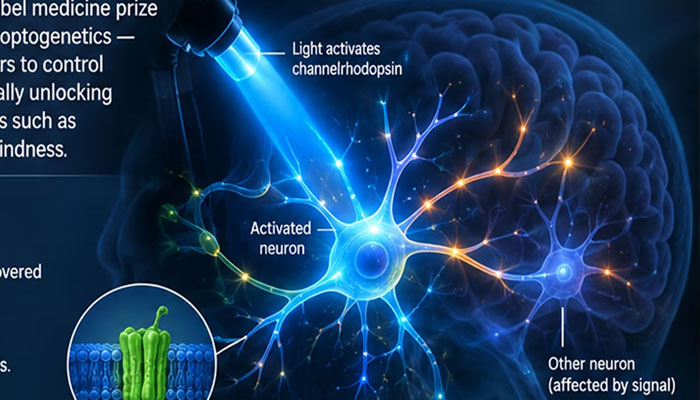
Optogenetics combines genetics and light to precisely control the activity of individual neurones. Scientists can effectively switch selected nerve cells on or off and observe how they influence specific brain functions.
Simon Schultz, a neurotechnology professor at Imperial College London, described the ability to manipulate cells using light and genetics as transformational for biological research.
The breakthrough began with research into green algae, where Hegemann and Nagel identified a light-sensitive protein known as channelrhodopsin.
Deisseroth subsequently introduced the protein into nerve cells through genetic techniques. When exposed to light, the modified cells produced nerve signals in laboratory animals.
By controlling the timing and intensity of the light, researchers can manipulate neurones with extremely high precision. This allows them to study how specific groups of cells influence behaviours and physiological functions.
Nobel medicine committee member and neuroscientist Abdel El Manira said the research had helped scientists investigate brain functions linked to parental behaviour, aggression, anxiety and fear, as well as basic drives such as thirst and water intake.
Memory Research
Researchers are also exploring optogenetics as a potential tool for understanding and treating memory disorders.
Schultz said his teams had used the technique in experimental closed-loop approaches aimed at memory disorders, including work involving the timing of pulses associated with memory formation.
He said the next step would be demonstrating whether the approach can improve learning and memory during complex tasks.
Potential Treatment for Blindness
Optogenetics has also shown promise in efforts to restore vision.

Jose-Alain Sahel, founder of the Vision Institute in Paris, said his team had conducted promising trials involving a degenerative eye disease.
Researchers used gene therapy to introduce a light-sensitive protein into defective retinal cells and then used specialised goggles to project light into the eye, successfully activating the modified cells.
Marco Tripodi, a senior molecular biologist at Cambridge University, said vision restoration could be among the areas where optogenetics produces relatively rapid medical advances.
Neurological Diseases
Beyond direct treatments, scientists say optogenetics could serve as an important research tool for identifying new targets for neurological and psychiatric diseases.
Epilepsy and Parkinson’s disease are among the conditions being studied because the technology allows researchers to control defined populations of neurones with high precision.
Researchers also believe the Nobel-winning work could improve understanding of what happens in disorders such as Alzheimer’s disease and epilepsy.
Depression and Mental Health
Scientists are investigating whether optogenetics could eventually contribute to treatments for depression, anxiety and other psychiatric conditions.
Christopher Rowlands, an associate professor in bioengineering at Imperial College London, said early-stage trials were exploring potential applications involving conditions such as post-traumatic stress disorder and addiction.
However, much of this work remains experimental, and significant research is still required before many of these approaches could become routine medical treatments.
Could It Explain Consciousness?
The research has also raised questions about whether manipulating individual nerve cells could eventually help scientists understand consciousness and the differences between biological and artificial brains.
El Manira cautioned that optogenetics currently does not explain subjective consciousness.
The technique nevertheless provides scientists with an increasingly precise way to investigate how individual neurones and neural networks contribute to behaviour, memory and other brain functions.
Comments are closed, but trackbacks and pingbacks are open.