
Maritime Borders and Beyond:Pakistan Navy’s Environmental Commitment
How Pakistan Navy's Environmental Commitment Is Protecting the Coast

By Sanobar Nadir
When people think of the Pakistan Navy, they think of ships, of maritime borders, of a force that keeps watch over the country’s coastal waters. What they may not think of is a group of naval personnel planting mangrove saplings on a Balochistan shoreline or a wetland facility quietly filtering hundreds of thousands of gallons of wastewater in Karachi before it can reach the sea or sailors participating in beach clean-ups and awareness campaigns aimed at reducing plastic pollution along the coastline. But this is also Pakistan Navy and on World Environment Day, it is a story worth telling in full.
This year, the United Nations observes World Environment Day on 5 June under the theme: Inspired by Nature. For Climate. For Our Future. hosted by the Republic of Azerbaijan in Baku. The day carries the UN Environment Programme’s campaign hashtag #NowForClimate a signal that the time for incremental steps has passed. The World Meteorological Organization confirmed that 2024 was the hottest year on record, with global temperatures temporarily exceeding 1.5°C above pre-industrial levels. To avoid the worst consequences of climate change, global greenhouse gas emissions must decline substantially this decade. The Intergovernmental Panel on Climate Change (IPCC) estimates that emissions need to fall by approximately 43 percent by 2030 to keep the 1.5°C goal within reach. It is a deadline that demands more than pledges. It demands action from every institution with the capacity to make a difference.
For Pakistan, the consequences of a warming climate are not hypothetical. They arrive as floods that submerge entire districts, as cyclones that batter the Balochistan coast, as fishing communities that find their catches shrinking year by year. Pakistan contributes less than one percent of global carbon emissions and yet it consistently ranks among the countries most exposed to climate impacts. Pakistan’s coastal belt, home to some of the country’s most vulnerable communities, is both Pakistan’s greatest natural asset and its most threatened frontier. Protecting it is not just an environmental obligation, it is a matter of national resilience.
Against this backdrop, Pakistan Navy has emerged as one of several institutions engaged in environmental initiatives along Pakistan’s coastline. Its activities range from mangrove plantation programmes to coastal clean-up campaigns and wastewater management projects. In a country where environmental commitments often begin and end with a press release, Navy has built something far more durable and their commitments are not just on paper. Over the years, Pakistan Navy initiatives have reflected an unwavering commitment to environmental stewardship through practical action.
Pakistan Navy’s environmental initiatives reflect recognition that coastal degradation can have implications not only for ecosystems but also for economic and maritime security and that protecting the environment is not separate from protecting the nation.
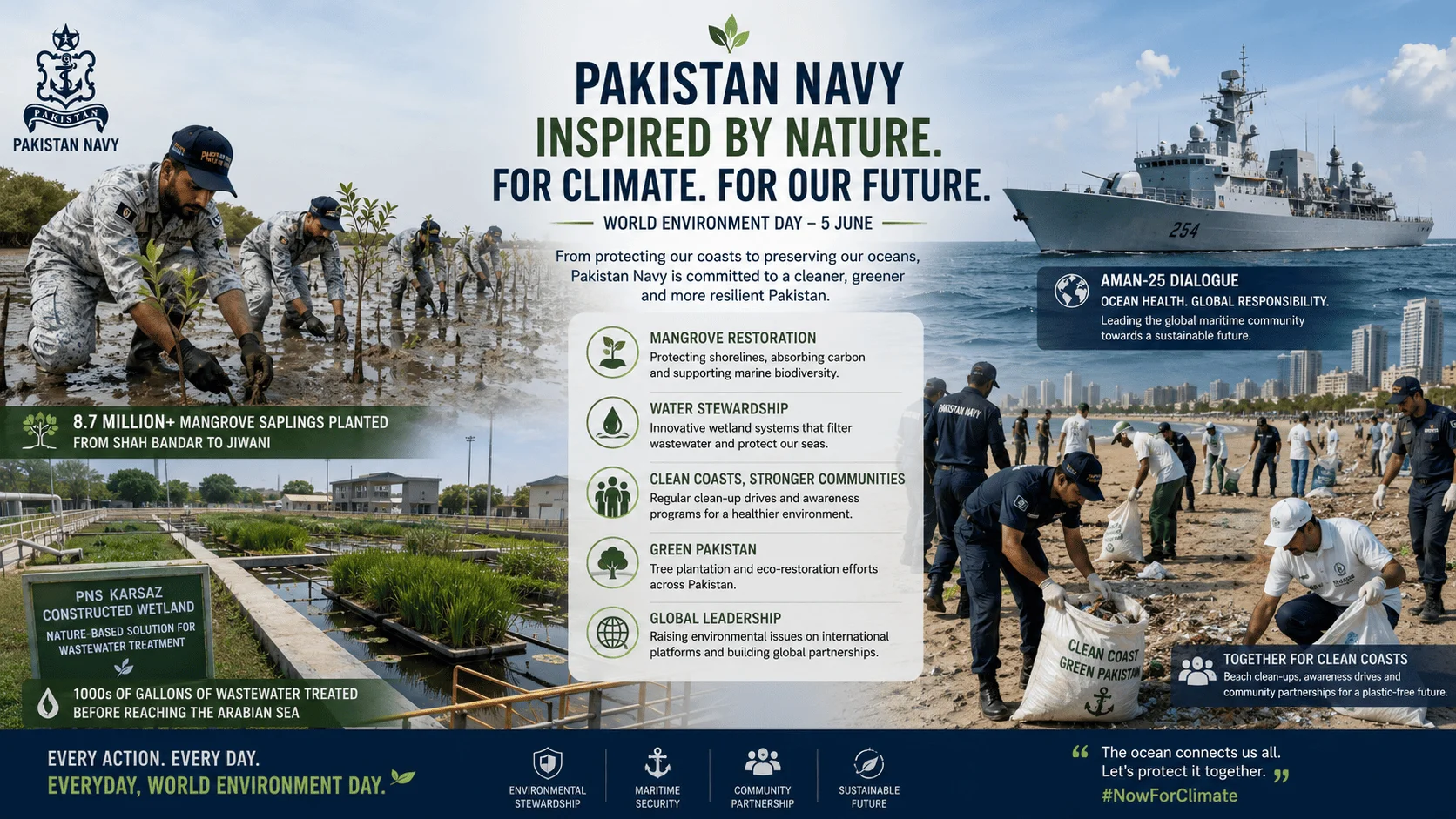
The clearest expression of this commitment is Pakistan Navy’s mangrove plantation programme. Working alongside the International Union for Conservation of Nature (IUCN) and the Forest Departments of Sindh and Balochistan, Pakistan Navy has contributed to the plantation of more than 8.7 million mangroves from Shah Bandar to Jiwani under its environmental protection programme. From the estuaries near Karachi to the beaches of Ormara, these mangrove plantations represent one of Pakistan Navy’s most significant contributions to coastal environmental restoration. Mangroves absorb carbon far more efficiently than many land-based forests, protect coastlines from storm surges and flooding, filter pollutants from the water, and provide breeding grounds for marine life and the fishing communities that depend on it. Through this initiative, Pakistan Navy has contributed to strengthening a natural coastal defence system along some of Pakistan’s most vulnerable shorelines, one sapling at a time.
Beyond the mangroves, Pakistan Navy’s environmental work is consistent and wide-ranging because the work doesn’t just end at the coastline, but it also extends to the inner infrastructure of the city. At PNS Karsaz in Karachi, a constructed wetland system, built on the same principles as nature’s own filtration, helps treat wastewater before it reaches the Arabian Sea. Throughout the year, Pakistan Navy organizes beach clean-up drives, harbor maintenance campaigns and awareness programs in coastal schools and communities. Plastic removal operations at Ormara, tree planting on the Margalla Hills and regular harbor-cleaning activities form part of Navy’s broader environmental programme. They are part of a routine that continues whether or not anyone is watching.
One of the more encouraging developments in recent years has been the growing involvement of Pakistan’s corporate sector in these efforts. Pakistan Navy’s beach clean-up campaigns along Karachi’s coastline, at Clifton, Seaview, and beyond, have drawn participation from companies fulfilling their corporate social responsibility commitments, alongside NGOs and community groups. Pakistan’s coastal tourism is dramatically underdeveloped relative to its potential. A clean, accessible, well-maintained beach is not just an aesthetic pleasure, it is an economic asset. Every company that joins a clean-up is, in a real sense, investing in the tourism infrastructure of the future and Pakistan Navy, by anchoring these campaigns with institutional credibility and organizational reach, has created a platform that the private sector can genuinely rally around.
Moreover, Pakistan Navy has also carried this environmental mission into the international arena. At AMAN-25, the multinational naval exercise hosted in February 2025 that brought together over 60 nations, Pakistan Navy used accompanying AMAN Dialogue to put ocean pollution, marine waste management and coastal protection at the centre of global maritime conversation. In a forum traditionally dominated by security and tactical concerns, the decision to dedicate an entire session to environmental issues was both bold and deliberate. It sent a message to the world’s naval community: environmental responsibility is not a soft issue. It is a core dimension of maritime leadership.
World Environment Day 2026 calls on all of us to take our cue from nature to look at what the natural world is telling us about the state of the planet and to respond with the urgency and commitment that the moment demands. In Pakistan, Navy has been doing exactly that, year after year, with little fanfare and considerable effect. It has planted forests where there were none, cleaned beaches that were slowly disappearing under plastic, filtered water that would otherwise have polluted the sea and convened the world’s navies around a shared environmental purpose. For Pakistan Navy, every day is World Environment Day and in that quiet, consistent dedication, there is a lesson for all of us.
[…] (News Desk) – Pakistan Navy Ship Yarmook (F-271), while deployed in the Arabian Sea, conducted two successful […]