
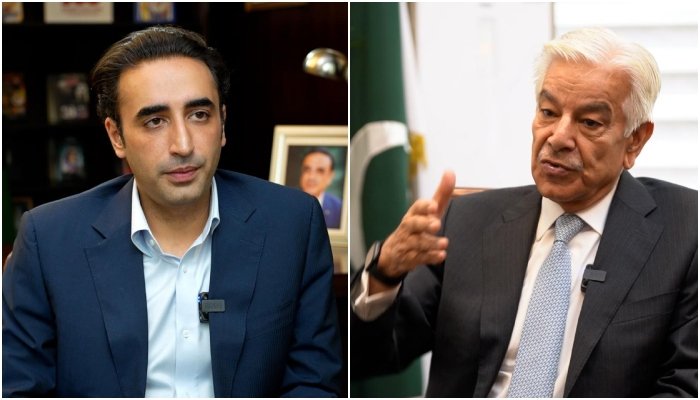
Khawaja Asif Challenges Bilawal Over Sindh Governance Record
Defence Minister Says Public Participation Essential for Legitimate Governance

In a statement posted on social media platform X, Khawaja Asif said no political system could be reset without public support, responding to Bilawal’s call for political and systemic changes.
“Mr Bilawal, you spoke of a ‘system reset,’ but no system can be reset unless it has the backing of the public,” the defence minister remarked.
He said that if the debate concerned a possible collapse of the existing system, all political stakeholders needed to examine their own responsibilities, as they were part of the same system. He added that political accountability was not a new concept in Pakistan and no politician was above it.
Khawaja Asif acknowledged that Bilawal’s press conference was strongly worded and focused on criticism of the incumbent government and the existing system. However, he argued that politicians’ engagement with the public should not be dismissed as a “backdoor” process.
He maintained that public opinion was the foundation of political legitimacy and that parliamentary debate could continue alongside public participation. While the proposed system reset could be discussed in Parliament, he said, the public must not be deprived of its fundamental rights.
The defence minister also questioned the PPP’s governance record in Sindh, pointing out that the party had been in power in the province for 18 years.
“You have held power in Sindh for 18 years—has Sindh turned into a paradise? Does the world look with envy at the state of Karachi?” he asked.
He further questioned Bilawal’s criticism of the federal government, noting that the PPP had been a coalition partner of the Pakistan Muslim League-Nawaz (PML-N) since 2022.
“Do you claim the gains, while the losses fall upon the PML-N or Pakistan? Are your own hands clean? Do you truly have the right to lecture or issue threats?” Khawaja Asif asked.
He stressed that public participation in governance must become a reality, adding that authority was a trust bestowed by the people rather than a personal inheritance.
The defence minister said citizens’ rights should not remain confined to the pages of the Constitution, arguing that governance was not the monopoly of any individual or political group but a right belonging to the country’s 250 million people.
Comments are closed, but trackbacks and pingbacks are open.