

Japan Prepares Mars Moon Mission to Search for Life Clues
Japan’s MMX Mission to Collect Samples From Mars Moon Phobos

TOKYO: (News Desk) – Japanese scientists are preparing to launch a groundbreaking mission to Mars’ moons that could provide important clues about the origins of the Solar System and the emergence of life on Earth.
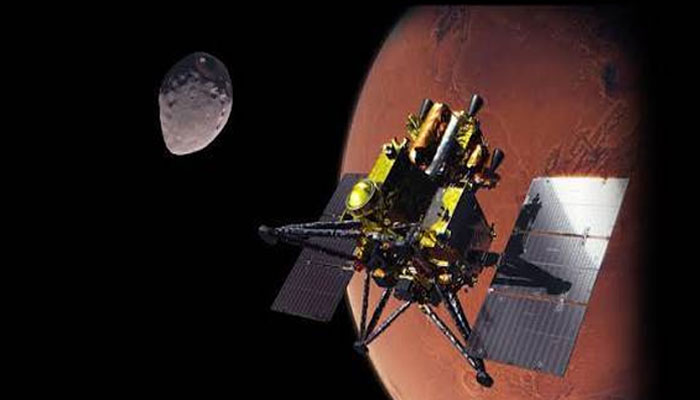
The Martian Moons eXploration (MMX) mission, led by the Japan Aerospace Exploration Agency (JAXA), is scheduled to launch from the Tanegashima Space Center in the coming months. The spacecraft will spend about three years in the Mars system and attempt to land on Phobos, where it will collect at least 10 grams of surface material.
The mission will also deploy the French-built IDEFIX rover to study Phobos’ surface and observe Deimos, Mars’ second moon, from orbit. A return capsule is expected to bring the collected samples back to Earth, with a planned landing in Australia around 2031.
Scientists hope the samples will help determine whether Phobos and Deimos formed from debris created by a massive collision with Mars or are asteroids captured by the planet’s gravity. Solving that mystery could improve understanding of how water, organic compounds and other materials reached the inner Solar System.

French astrophysicist Patrick Michel said the moons could preserve evidence about the processes that transported key ingredients for life toward the rocky planets.
MMX could also serve as a technological stepping stone toward future human missions to Mars. JAXA is studying whether Phobos could eventually be used as a kind of natural space station for Mars exploration.
The mission is being developed with international partners including France’s CNES, Germany’s DLR, NASA and the European Space Agency, along with universities and technology companies.
Japan is drawing on its previous sample-return success with Hayabusa-2, which delivered material from an asteroid to Earth in 2020. Meanwhile, China’s Tianwen-3 mission is expected to launch around 2028 and could return Martian samples around 2031, potentially beating Japan’s MMX mission to the finish line.
Comments are closed, but trackbacks and pingbacks are open.