
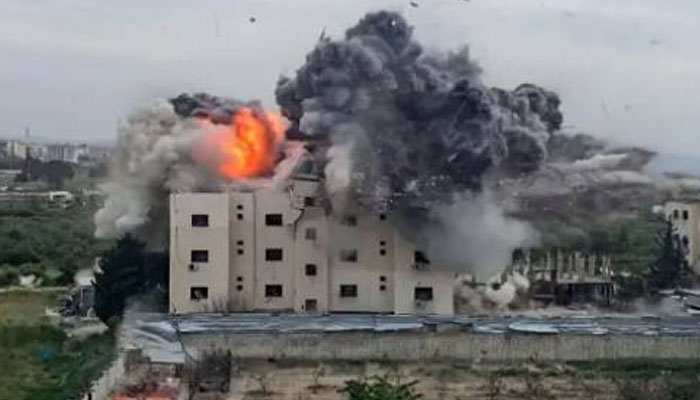

The Middle East once again stands at a delicate moment in history, where conflict is no longer limited to the thunder of missiles and drones. It has become a struggle of geography, strategy, and political pride. On the surface, the confrontation appears to be between Iran, Israel, and the United States, but in reality its shadow has spread across global powers. In this crisis, the most difficult question is no longer who will win the war, but rather who possesses a path to emerge from it without defeat.
If the United States and Israel truly intend to take this conflict to a decisive stage, their first strategic objective would be the Strait of Hormuz. This narrow maritime passage carries a significant portion of the world’s energy supplies, and Iran has established a strong strategic grip over it. Yet controlling this route cannot be achieved through naval power alone. It may require intervention inside Iran itself, and that is precisely the point where Washington faces a series of difficult questions.
At present, American policymakers appear to be considering several possible options, but each of them carries risks that make it almost impractical.
One idea involves a covert military operation. According to this concept, U.S. special forces could infiltrate Iran and seize enriched uranium from nuclear facilities. However, such scenarios appear more realistic in films than in real life. According to media reports, Iran has dispersed its nuclear facilities and materials across underground tunnels and multiple locations rather than keeping them concentrated in large centers. In such circumstances, not only is identifying the exact locations extremely difficult, but conducting a secret operation hundreds of kilometers inside Iranian territory would also be nearly impossible. History also recalls the failed American operation in 1980, when an attempt to rescue hostages in Tehran ended in disaster.
Another option would be to target Iran’s economy. Kharg Island in the Persian Gulf serves as the largest hub for Iran’s oil exports. Disrupting the supply from this location could send shockwaves through global energy markets. For that reason, destroying such infrastructure is not an easy decision for Washington, because the consequences would extend far beyond Iran and could destabilize global energy markets.
A third option could involve military intervention along Iran’s coastline near the Strait of Hormuz in order to stop missile attacks and ensure the safe passage of oil tankers. Yet this plan also carries significant risks. Controlling coastal regions would require a long-term military presence, and Iran’s missiles, drones, and naval mines could turn such an operation into an extremely costly and dangerous undertaking.
The fourth and most significant option would be a full-scale ground invasion. But this is precisely where Iran’s geography becomes America’s greatest challenge. Iran is, in many ways, a natural fortress. Its borders are surrounded by towering mountain ranges. The Zagros Mountains in the west, the Alborz range in the north, and rugged terrain in the east make large-scale military movement extremely difficult. Even if an invading force managed to cross these obstacles, it would still have to confront Iran’s vast interior plains, salt deserts, and harsh terrain.

All these factors indicate that a major ground war against Iran would not only be costly but also prolonged and uncertain. Even if a military operation were temporarily successful, maintaining forces on the ground, ensuring logistical supply lines, and securing a safe exit strategy could become another enormous challenge.
The American military leadership is well aware of these realities. Yet Washington’s politics appear to be standing at a difficult crossroads. Its close commitment to Israel does not allow an easy path of retreat. As a result, the United States is searching for a way to exit this crisis while still preserving its global credibility something that seems increasingly difficult.
On the other hand, Iran has achieved an important psychological advantage during this crisis. It has attempted to convey to the world that it is not merely in a defensive position but also capable of responding forcefully. Its strategy is not based on immediate victory but on creating sustained pressure so that the opposing side eventually becomes exhausted and politically constrained. In that sense, launching an attack on Iran may prove to have been a major strategic miscalculation by its adversaries.
Israel’s military power remains formidable, even though its air superiority is no longer as unquestioned as before. But wars are not won by weapons alone. They are also won through nerves, patience, and political strategy. This is precisely the arena where the tensions in the Middle East are now unfolding.
Another important aspect of this crisis lies in its global implications. Energy markets, international trade routes, and strategic corridors have all come under the shadow of rising tensions. Every spark in the Middle East now sends tremors through the global economy.
During the U.S. presidential elections, Donald Trump repeatedly claimed that he would keep America out of new wars and would work to end the era of “endless wars.” Yet the current situation illustrates that such promises in global politics are often difficult to sustain in practice.
Today, the Middle East has entered a phase where power, pride, and reality are colliding. Israel’s image of being invincible has, for the first time, faced a serious challenge, while long-held assumptions about Iran’s weakness are also being questioned.
The path ahead remains uncertain. One possibility is a long and exhausting conflict that could push the entire region toward instability. Another is a wider regional confrontation involving additional powers. And the third path is the one history often chooses: wars eventually end at the negotiating table.
Yet one reality is becoming increasingly clear: the politics of the Middle East are entering a new era an era in which the balance of power is shifting, alliances are being reshaped, and old assumptions are beginning to crumble.
And it is in moments like these that history is written.

Comments are closed, but trackbacks and pingbacks are open.