
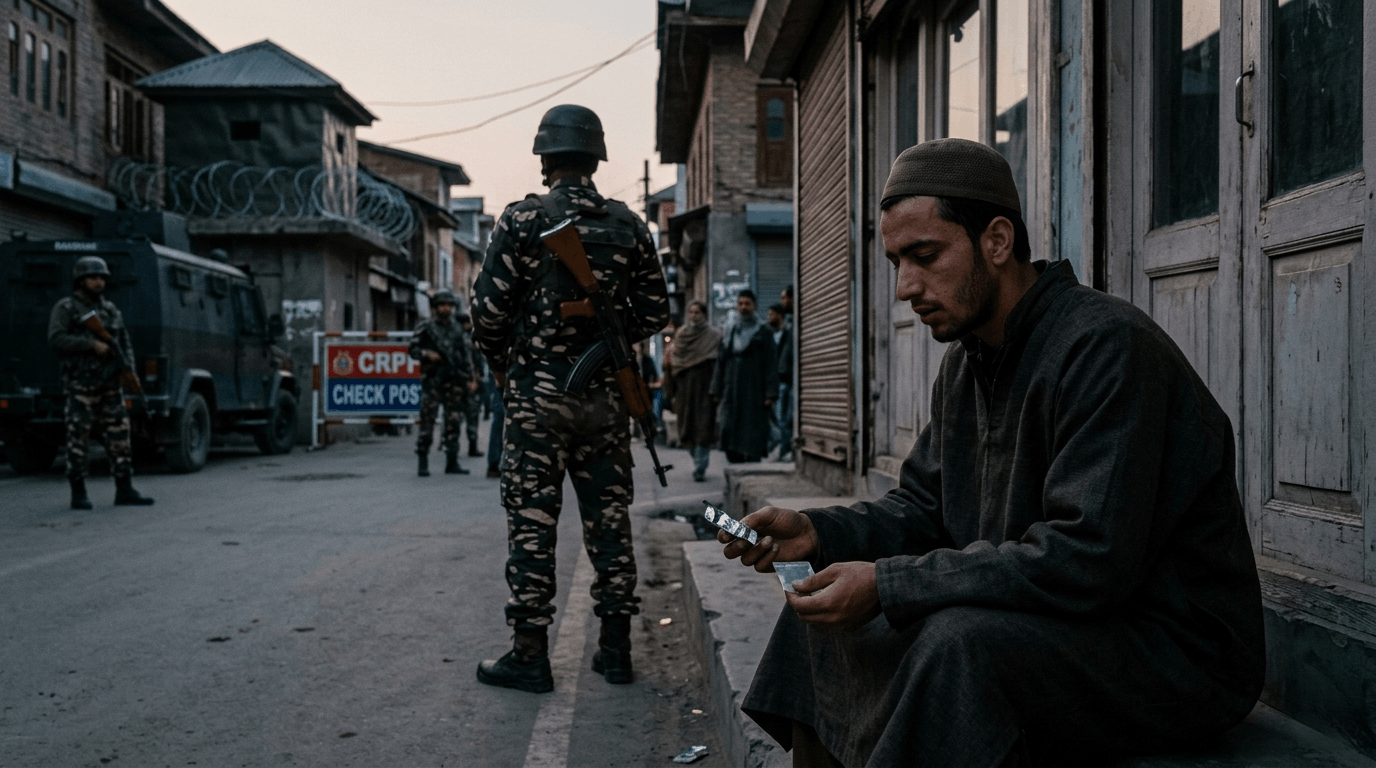

The Kashmir issue, as the world has known it, has now snowballed into a highly complex conflict. It not only threatens the peace and security of the entire South Asian region but also continues to take a heavy toll on the lives of millions of Kashmiris who have remained trapped in this deadly conflict for several decades. This complexity has been further compounded by a vast yet sophisticated network of spin doctors and opinion managers operating both within and outside the realm of the Indian political and security establishment. They have transformed what was once a relatively simple issue into a complex and confusing jigsaw puzzle by weaving a cobweb of confusion around it.
It is not merely a sweeping statement on the subject; rather, it is a considered view shared by many scholars of international repute. There is no denying the fact that the Indian narrative surrounding the events of 1947 in Kashmir was shaped by political “spin” aimed at lending credence to its intervention and subsequent incursion into the State. Let us unpack this carefully and factually, drawing on historical evidence and scholarly interpretations, while maintaining objective precision.
Following the partition of British India in 1947, the princely state of Jammu and Kashmir was also engulfed in political turmoil marked by communal violence. Amid the broader upheaval accompanying the partition of the Indian subcontinent, the Jammu region of the erstwhile state, in particular, witnessed severe communal violence, resulting in widespread death, displacement, and destruction. Muslim subjects of the state, regardless of gender or age, were brutally killed, maimed, and mutilated. Nearly half a million Kashmiri Muslims were driven out from their homes and forced to migrate to Pakistan.
So against this very turbulent backdrop, competing claims over the future of the State were advanced by the leadership on both sides. In the Indian official narrative, the Tribal fighters’ attempt to assist their Kashmiri brethren in their struggle against the despotic Maharaja in October 1947 is portrayed as an invasion and, consequently, as the raison d’être that compelled India to intervene militarily. According to this account, the intervention followed the Maharaja’s request for military assistance and his execution of the Instrument of Accession to India. However, a number of historians and scholars—including Alastair Lamb, Victoria Schofield, Christopher Snedden, and A. G. Noorani—have challenged aspects of this narrative and drawn attention to the complex political, military, and humanitarian circumstances that preceded and accompanied India’s military intervention.
Their works have raised serious questions about the veracity of the claims made by the Indian leaders, chronology of events, the circumstances surrounding the Maharaja’s accession, the nature and extent of external involvement, and the manner in which the events of October 1947 were subsequently presented in competing national narratives.
India’s pre-planned designs to integrate Kashmir
While the Indian government presented the Kashmiri resistance movement, supported by tribal brethren, as an unprovoked invasion of sovereign territory, it portrayed itself as the defender of rule of law. As it kept harping incessantly on the so-called “raid,” the macabre dance of death continued in Jammu, where the blood of Muslims was spilled with impunity by armed goons aided and abetted by the Maharaja’s administration.
Alastair Lamb and Christopher Snedden both noted that the word “raid” was used as a political pretext to justify India’s pre-planned designs to integrate Kashmir. Secondly, the speed and scale with which India airlifted its military forces to Srinagar on 27 October 1947 suggest that preparations for intervention had been underway even before the formal accession was signed.
By beating the drum of the so-called “tribal invasion” India launched a systematic propaganda campaign to downplay the mass resistance that was going on against the Maharaja since the mid-1930s, obscure the carnage taking place on the streets of Jammu, and frame its entry into Kashmir as an act of rescue rather than occupation.
So, under the charade of the so-called “tribal invasion,” India has largely been able to hide the atrocities or at least downplay magnitude of the massacre of Muslims in Jammu during October–November 1947—a tragedy reported by Horace Alexander in “The Spectator” on 16 January 1948 and by “The Times (London)” on 10 August 1948.

These reports described the massacre of between 200,000 and 237,000 Muslims, often with the complicity of Dogra state forces, as well as the forced migration of hundreds of thousands more to Pakistan.
Controversies surrounding the Instrument of Accession (IoA)
The Indian government claims that the IoA was signed on 26 October 1947. However, Alastair Lamb and A. G. Noorani question this claim, arguing that the “original signed copy” has never been made public and that the timeline suggests Indian troops entered Kashmir before the accession was formally executed.
Thus, the portrayal of the accession as an immediate and legally valid act became a crucial element of political spin, providing a legal justification for India’s military intervention and its imperialistic presence in Kashmir.
At the United Nations, India presented itself as a victim of external aggression and as the protector of law and order in a threatened princely state. This framing largely omitted internal causes, including the suppression of Kashmiri political aspirations and the communal reprisals in Jammu.
Controlling narrative
In essence, India’s early communication strategy and narrative-building in 1947–48 enabled it to recast complex and inconvenient realities into a simplified moral binary of “aggression versus defence.” By controlling the narrative at an early stage, India established a diplomatic “moral high ground” that shaped much of the global discourse on the Kashmir dispute.
On the diplomatic front, the alleged “tribal raid” was used by Indians as the fig leaf for premeditated political objectives, while the mass killings in Jammu, Kashmiris quest for political emancipation and questions surrounding the Instrument of Accession were subsequently suppressed or distorted.
This stratagem of excluding or minimizing the magnitude of a historical tragedy, including the ethnic cleansing of a particular community that ultimately resulted in a significant demographic shift in the Jammu province, reflects the same Machiavellian mindset that has long characterized India’s approach to Kashmir. By constructing narratives that portray Kashmiri dissent as a security threat while simultaneously delegitimizing the indigenous struggle for self-determination and political emancipation, Indian policymakers and opinion-makers have sought to reshape the historical and political narrative surrounding Kashmir.
Sadly, eight decades down the line, Kashmiris continue to pay the price of this insidious game of negative framing and the distortion of historical facts by India. As Alastair Lamb has rightly observed, “history was written by those who took control of the archives and the airwaves,” allowing New Delhi to establish a narrative that remains dominant in official discourse even decades later.
The writer is Director media communications Kashmir Institute of International Relations and can be reached at . nissarthakur@gmail.com
Comments are closed, but trackbacks and pingbacks are open.