
Gilgit-Baltistan Cabinet Approves Key Decisions on Healthcare, Education, Employment and Development
Interest-Free Loans for Women and Youth Among GB Government Priorities

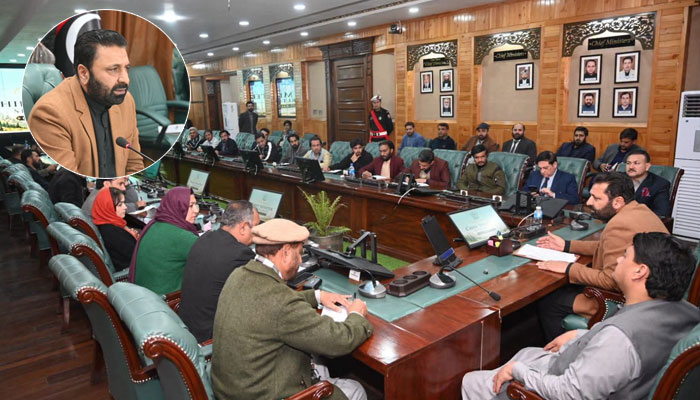
GILGIT: (Our Correspondent) – The fourth meeting of the Gilgit-Baltistan provincial cabinet, chaired by Chief Minister Amjad Hussain, was held to review and approve a range of measures concerning development, public welfare, healthcare, education, mining, agriculture, livestock, employment and administrative affairs.
Addressing the meeting, the chief minister said that promoting development across Gilgit-Baltistan, improving living standards and providing better opportunities to disadvantaged communities, women and youth—particularly in underdeveloped areas—remained among the provincial government’s top priorities.
Healthcare and Education Prioritised
The chief minister directed the authorities to ensure full implementation of the Health Endowment Policy and to contact the Sindh government to explore arrangements for providing free medical treatment to underprivileged patients from Gilgit-Baltistan.
He also directed the health secretary to take necessary steps to provide MRI facilities to the people of Diamer and Baltistan.
Regarding education, the chief minister said the provincial government was providing approximately Rs3 billion in grants to public schools across the region. He emphasised that improving educational standards must remain a priority and directed that future grants be linked to school performance and academic results.
He further called for a policy to promote the financial self-sufficiency and sustainability of public schools, reducing their long-term dependence on government grants.
The cabinet approved a grant of Rs220 million for Cadet College Skardu. It also approved the regularisation of teachers working under the School Education Programme (SEP), Basic Education and the National Commission for Human Development (NCHD).
The cabinet also approved declaring Gilgit Nupoh Basin a hard area for female teachers and endorsed an agreement to operate 10 government schools in Shigar district in collaboration with the private sector.
Reforms in the Mining and Livestock Sectors
Highlighting the importance of the mineral sector to the region’s economy, the chief minister announced that assistant directors of the Mines and Minerals Department would be granted magisterial powers to strengthen enforcement, prevent irregularities and take action against violations through summary trials.
The cabinet approved the measure as part of efforts to protect mineral resources and ensure compliance with relevant regulations.
The chief minister also stressed the need to strengthen agriculture and livestock, particularly in rural areas where a significant portion of the population depends on livestock for its livelihood.
The cabinet recommended the Gilgit-Baltistan Animals Bill 2026 for presentation before the provincial assembly. The proposed legislation aims to protect animal health and prevent the spread of diseases.
Interest-Free Loans for Women and Youth
The provincial government reiterated its commitment to creating better employment and economic opportunities for women and young people.
The chief minister formed a special committee to review the agreement with Akhuwat Islamic Microfinance for the provision of interest-free loans. The review aims to simplify lending conditions and make access to financing easier and more effective for women and youth.
Compensation for Property Losses
The chief minister directed the relevant authorities to assess damage to private property caused by the incidents of March 1, 2026, so that a decision could be made regarding possible financial assistance for affected individuals.
The cabinet also approved Rs271.1 million in compensation for damage to government property resulting from the incidents of March 1, 2026.
In another decision, the cabinet approved the transfer of alternative land ownership to the flood-affected people of Tali Das.
Financial Discipline and Project Approvals
Emphasising financial discipline, the chief minister took serious notice of projects initiated and financial liabilities incurred without approval from the relevant forums.
He directed all departments to obtain the required approvals before starting any project and to fulfil all legal and administrative requirements before implementation.
He made it clear that financial irregularities would not be tolerated and that all development projects must follow the prescribed approval procedures.
New Development Authorities and Policy Reforms
The provincial cabinet approved the establishment of the Policy Board and the notification of the Public-Private Partnership Unit Act and Risk Management Unit Act following necessary amendments.
It also approved amendments to the Gilgit-Baltistan Revenue Authority Act 2026 to establish an advisory council.
The cabinet approved the Gilgit-Baltistan Population Policy 2026–2036 and a memorandum of understanding between the Social Welfare Department and Community World Service Asia.
The establishment of the Diamer Development Authority and the District and Divisional Development Review Committee was also approved. In addition, the jurisdiction of the Gilgit Development Authority will be extended to suburban areas.
The cabinet approved amendments to the Gilgit-Baltistan Local Council Delimitation 2026 and recommended a one-year extension to the law concerning the regularisation of doctors, referring the matter to the Gilgit-Baltistan Assembly.
Digital Media, Irrigation and Other Decisions
The cabinet approved the revised Digital Media Policy 2025 and decided to refer the Water Users Association Rules 2026 and the Gilgit-Baltistan Flood Regulation Rules to the cabinet’s legislative committee for further review.
It also approved the release of funds for the restoration of the Gini Das and Gurekot irrigation channels in Astore district.
The cabinet recommended the Child Marriage Restraint Bill 2026 for presentation before the provincial assembly.
Furthermore, the cabinet rejected a proposal to discontinue the Chief Minister’s Assistance Package for the children of deceased government employees and directed that the package continue.
The decisions reflect the provincial government’s stated focus on improving public services, strengthening governance, expanding economic opportunities and accelerating development across Gilgit-Baltistan.
Comments are closed, but trackbacks and pingbacks are open.