

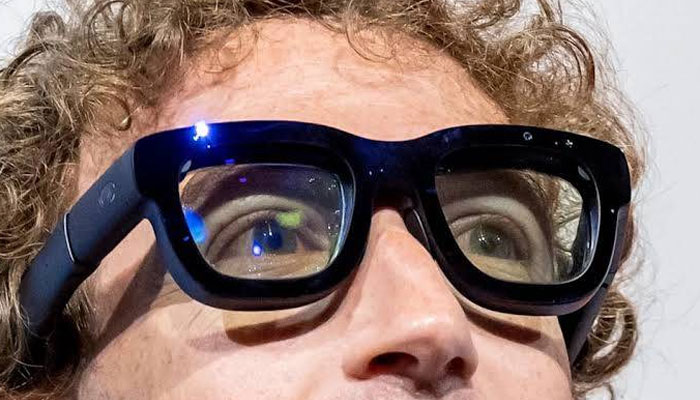
Europe Demands Action Against ‘Pervert’ Smart Glasses
Secret Recordings Fuel Backlash Against Smart Glasses

ISLAMABAD: (News Desk) – Growing concerns over privacy have sparked calls across Europe for action against smart glasses after secretly recorded footage of women and girls appeared online, with a campaign in Britain demanding a ban on their sale.
Smart glasses allow users to take photographs, record videos, listen to music, make phone calls, translate text and interact with artificial intelligence assistants. Sales of the devices have surged into the millions as technology companies increasingly view wearable devices as the next major growth area.
The glasses attracted widespread attention this summer following a marketing partnership between US pop star Kylie Jenner and Meta, highlighting their growing presence in mainstream culture.
Meta’s smart glasses, developed in partnership with Ray-Ban manufacturer EssilorLuxottica, have performed far better than Google’s earlier attempt to popularise smart glasses in 2013.
Meta reportedly sold around seven million pairs in 2025, compared with a combined two million sold during 2023 and 2024. Companies including Google and Snap are also preparing to expand their offerings of AI-powered eyewear.
However, the rapid growth of the technology has been accompanied by increasing concerns over privacy and consent.
Britain has seen particularly strong criticism, with media reports referring to the devices as “pervert glasses” following cases involving alleged covert recordings. Concerns have also intensified over reports that Meta is working on facial recognition capabilities for the glasses.
In one reported case, a 17-year-old girl told Channel 4 News in August that a man had approached her while secretly recording both her and their interaction.
Meta told AFP that it had introduced several measures to prevent users from tampering with the flashing LED indicator designed to signal when the glasses are recording. The company said these efforts were already creating a deterrent effect, claiming businesses offering to disable the indicator had subsequently closed.
EU Faces Pressure to Act
Authorities and lawmakers across Europe are increasingly calling for clearer rules governing the technology. Norway’s capital, Oslo, banned the glasses in schools this week as the government considers broader regulation, including possible restrictions on facial recognition features in public spaces.
In France, the data protection watchdog CNIL has urged greater vigilance, while campaigners are pressing the European Union to address privacy concerns surrounding the devices.

Swedish designer Mateusz Pozar launched the “Ban Ray” campaign earlier this year, offering signs and stickers calling for smart glasses to be prohibited at certain venues.
Pozar said he created the campaign after his girlfriend was allegedly recorded by two men wearing the glasses, an experience he described as deeply disturbing. He said the campaign was intended to encourage a wider discussion about privacy, personal rights and control over personal data before the technology becomes commonplace.
He also raised concerns about the handling of data captured through Meta’s AI glasses following reports involving Kenya-based workers who reviewed graphic material collected by the devices.
Slovak European Parliament member Veronika Cifrova Ostrihonova said she had raised concerns with the European Commission after cases of women allegedly being recorded without their knowledge emerged.
“We need clear EU rules to protect and strong enforcement to make sure new technologies don’t come at the expense of our fundamental rights,” she said.
The European Commission said national data protection authorities were responsible for monitoring and enforcing existing privacy regulations. Meanwhile, the European Data Protection Board has commissioned a report examining the “social acceptability” of smart glasses, with its findings expected in autumn.
Growing Concerns Over Consent
European Parliament member Alex Agius Saliba said concerns about smart glasses extended across the political spectrum and urged authorities to act quickly.
He described the devices as “pervert glasses” and argued that their use should be restricted until adequate safeguards demonstrate that they can be used safely.
In Britain and Ireland, the “Stop Smart Glasses” campaign has launched a petition calling for action against the sale of the devices and encouraging supporters to approach retailers.
The petition has gathered more than 9,100 signatures, with the British government required to respond if it reaches 10,000.
Campaign co-founder and teacher Guy Holder said the group was particularly concerned about the potential impact on women and girls, as well as what he described as a wider invasion of public spaces.
He warned that the technology could contribute to an environment where people feel they can be recorded without their knowledge or consent, raising broader questions about privacy and the possibility of increasingly pervasive surveillance.
Comments are closed, but trackbacks and pingbacks are open.