

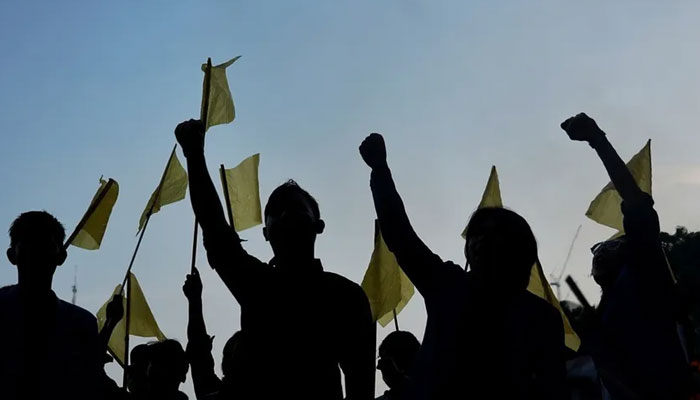

Democracy is not a perfect system. Criticising it is easy—and often justified. Yet, as Winston Churchill famously observed, humanity has not devised a better alternative. That, perhaps, is reason enough not just to preserve democracy in form, but to protect it in spirit.
In recent years, parts of the world have begun debating whether the voting age should be lowered to sixteen. On the surface, the idea feels progressive—even inspiring. It speaks of trust, inclusion, and empowerment. It suggests that the youth must be given a voice early, so they may grow into responsible citizens.
However, democracy, especially in fragile states like Pakistan, cannot afford to be guided by sentiment alone. It must be grounded in realism.
As a corporate communicator turned educationist, I engage with young minds every day. I listen to them, guide them, and, at times, worry about them. Their confidence is admirable—but the depth of their understanding often leaves much to be desired. Much of what they perceive as “knowledge” is, in fact, a reflection of the fast-moving, emotionally charged world of social media.
A few days ago, I encountered a moment that was both startling and revealing. One of my students was visibly upset because he was not allowed to bring a gun to the school’s farewell party. When I sat him down to counsel him, expecting hesitation or reflection, I instead encountered conviction. His reasoning was unsettlingly firm: “Weapons are the ornament of a believer.”
In that moment, I was not just speaking to a student—I was confronting a mindset shaped not by education, but by unchecked narratives.
This is precisely where the debate on voting rights must pause and reflect.
At its core, democracy is not about maximising numbers; it is about ensuring meaningful participation. A vote cast without awareness is not an act of freedom—it is often an echo of influence. And in today’s world, influence is rarely innocent.
The modern voter—particularly the young voter—lives in an ecosystem driven by algorithms, curated content, and constant stimulation. Social media platforms do not simply inform; they shape opinions, reinforce biases, and sometimes distort reality. In such an environment, independent thinking becomes a challenge rather than a norm.
Even in developed democracies, with strong institutions and education systems, misinformation continues to distort public opinion. In Pakistan, where civic education remains limited and critical thinking is not systematically nurtured, the risks are far greater.

Giving voting rights in such a context—without adequate preparation—raises a deeper concern. We are, at times, dealing with minds that are quick to detect the smallest flaw in others, yet remain blind to their own contradictions. Minds that are easily swayed by one-sided arguments, mistaking intensity for truth. In some cases, a misplaced sense of moral authority turns individuals into self-appointed arbiters of right and wrong, imposing rigid views that make collective life more difficult rather than more just. Even more concerning is the reluctance to acknowledge error—where justification replaces reflection, and accountability becomes either weak or entirely absent.
The question, therefore, is not whether young people deserve a voice. They absolutely do. The real question is whether that voice has been prepared—intellectually and emotionally—to carry the weight of national responsibility.
Democracy is not a ritual performed every few years; it is a responsibility that demands maturity. While age does not guarantee wisdom, it does provide a threshold of lived experience—an exposure to economic realities, social responsibilities, and the consequences of governance. Lowering that threshold, without strengthening awareness, risks turning democracy into a contest of slogans rather than a forum of reason.
Pakistan’s political landscape offers a sobering reality. Political loyalties are often inherited rather than examined. Emotional rhetoric frequently overshadows policy debate. Electability, not integrity, becomes the measure of success. In such an environment, expanding the voter base without strengthening the voter’s capacity for critical thinking may amplify existing distortions rather than correct them.
This is not an argument for exclusion—it is an argument for preparation.
If democracy is to flourish, our focus must shift from increasing participation to improving its quality. Our schools must become spaces where students are taught not just to read and write, but to question, to reflect, and to reason. Civic education must move beyond textbooks and become a lived experience. Public discourse must prioritise dialogue over division, and substance over spectacle.
Only then will extending voting rights become a meaningful step forward, rather than a premature leap.
A vote is not merely a mark on paper; it is a moral and intellectual act. It shapes governments, policies, and the direction of a nation. To place this responsibility in unprepared hands is not empowerment—it is abdication.
Democracy may be imperfect, but its strength lies in the wisdom of its participants. If we truly wish to protect it—especially in contexts as fragile as our own—we must remember a simple truth:
The future of democracy depends not on how many vote, but on how well they understand the weight of their choice.
The author is an educator, social awareness advocate, and the voice behind several impactful online campaigns aimed at reviving empathy and moral consciousness among youth. He writes regularly on issues of social decay, educational reform, and the urgent need for character-building in modern societies. He tweets at @ToleranceAdvocate.

Comments are closed, but trackbacks and pingbacks are open.