New York: (News Desk) – Astronomers have identified what they describe as the fastest known star in the Milky Way, racing around the supermassive black hole at the centre of our galaxy at about 25,000 kilometres per second.
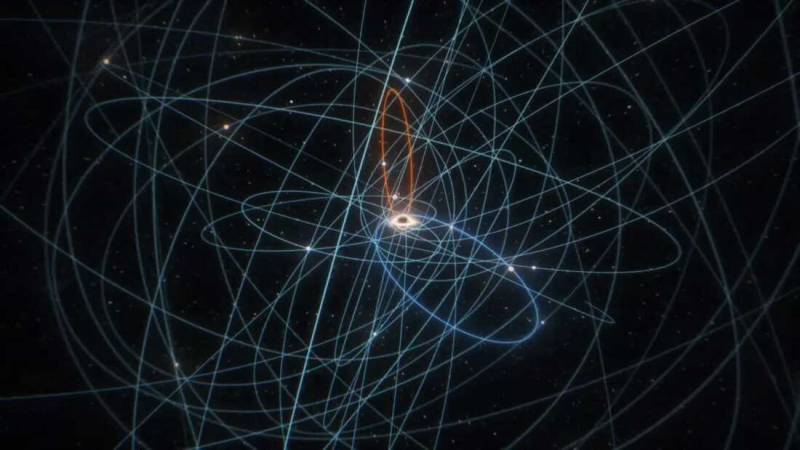
Named S301, the faint star follows an exceptionally tight orbit around Sagittarius A*, the black hole at the heart of the Milky Way. Researchers say its extreme journey could provide a rare opportunity to study the behaviour of spacetime in the strongest gravitational environment available to astronomers.
S301 completes one orbit in just 8.7 years and approaches Sagittarius A* to a distance comparable to Saturn’s distance from the Sun. Scientists first detected the star in 2023 and have since been carefully monitoring its movement.
At its closest approach, S301 reaches more than eight percent of the speed of light, making it around 100,000 times faster than a commercial aircraft.
Researchers believe the star may once have belonged to a binary system. The immense gravitational force of Sagittarius A* could have separated the pair, trapping S301 around the black hole while sending its former companion on a trajectory that may have carried it out of the galaxy.
The discovery was made using the European Southern Observatory’s Very Large Telescope in Chile. Because S301 is extremely faint, observing its motion required detailed measurements over several years.
Scientists expect another crucial opportunity to study the star in 2031, when it reaches its next closest point to Sagittarius A*. By combining observations from multiple orbits, researchers hope to determine the black hole’s rotation.
According to Einstein’s general theory of relativity, a rotating black hole should drag spacetime around it, influencing the paths of nearby stars. Researchers believe S301 could therefore provide an unprecedented way to investigate this prediction and potentially measure Sagittarius A*’s spin.


Comments are closed, but trackbacks and pingbacks are open.