
Anne Carson Nobel Prize Win Honors Bold Poet of Canada
The Swedish Academy praised the Canadian writer for creating new forms that talk with the classical tradition.

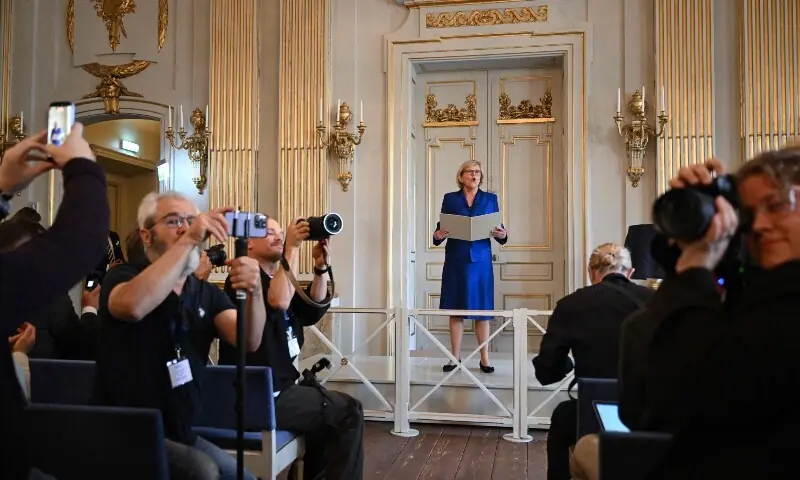
Canadian Writer – (Special Correspondent/Web Desk) – The Anne Carson Nobel announcement has brought joy to readers of poetry around the world. On Thursday, the Swedish Academy named the Canadian writer as the winner of the 2026 Nobel Prize in Literature.
The Academy called her work bold and inventive. It said she talks with the classical tradition in a playful way and, in doing so, creates new forms for modern writing.
The prize carries 12 million Swedish crowns, which is about $1.2 million.
Carson is a poet, essayist and translator. Her books often mix verse, prose, dialogue and translation in a single piece. Many readers say her writing is hard to place in just one category.
Ancient Greece sits at the heart of her work. She is widely known for her translations of classical Greek texts, and those old stories shape much of what she writes.
Her range is wide. She has written opera libretti, literary criticism and verse novels.
One of her best-known books is “Autobiography of Red,” a verse novel from 1998. It remains a favorite among readers who enjoy poetry that reads like a story.
Another key piece is “Norma Jeane Baker of Troy,” a performance work from 2019. It blends the story of Helen of Troy, from the play “Helen” by Euripides, with the life of Marilyn Monroe.
With this win, Carson joins a famous list of winners that includes Alexander Solzhenitsyn, Alice Munro and Ernest Hemingway.
The Nobel Prize in Literature has long divided opinion among book lovers. Critics say the Academy has ignored giants such as Leo Tolstoy, Virginia Woolf and Jorge Luis Borges.
Others say it has overlooked American authors, even though it honored singer-songwriter Bob Dylan in 2016. Some also feel its choices can be too obscure.
Defenders see it differently. They point to popular winners such as Gabriel Garcia Marquez in 1982 and Doris Lessing in 2007.
They also argue that part of the Academy’s job is to shine a light on lesser-known literary traditions. In their view, this helps readers broaden their horizons.
The prizes began in 1901 under the will of Alfred Nobel, the Swedish inventor of dynamite and a businessman. They honor achievements in literature, science and peace.
Last year, the literature prize went to Hungarian writer Laszlo Krasznahorkai. American critic Susan Sontag once called him the “master of the apocalypse.”
For many people, the Anne Carson Nobel news is also a chance to discover her books. Her work rewards curious readers who enjoy surprises, whether they love poetry, ancient myths or bold new forms.
Comments are closed, but trackbacks and pingbacks are open.