
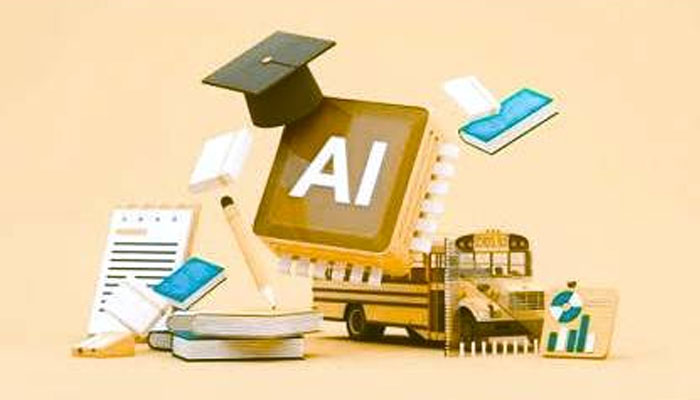
AI in Education: Teaching Students to Think Beyond Technology
Universities Should Teach Responsible AI, Not Ban It

ISLAMABAD: (News Desk0 – The purpose of education has never been to shield students from change. Instead, it has always been to prepare them for the future. Today, that future is increasingly shaped by artificial intelligence (AI), making universities face a critical question: should they ban AI tools like ChatGPT or teach students how to use them responsibly?
Many educational institutions worry that AI encourages plagiarism, weakens critical thinking, and undermines academic integrity. These concerns are legitimate. However, banning AI is unlikely to solve the problem. A more effective approach is to equip students with the knowledge and ethical understanding needed to use AI responsibly and transparently.
History shows that every major technological innovation has been met with skepticism. Calculators were once criticized for making students lazy. The internet was accused of destroying research skills, while Wikipedia was dismissed as an unreliable source. Rather than disappearing, these technologies became part of modern education. Schools adapted by redesigning teaching methods and helping students use new tools wisely.
Artificial intelligence deserves the same treatment.
Today’s students will graduate into workplaces where AI has become a standard professional tool. Lawyers use AI to review legal documents, doctors rely on AI-assisted diagnostic systems, businesses analyze data and improve customer service through AI, and researchers increasingly use it to summarize literature and organize ideas. Ignoring this reality risks preparing graduates for a world that no longer exists.
Instead of imposing blanket bans, several leading universities—including Oxford, Harvard, and the University of Sydney—have introduced policies that encourage transparent and responsible AI use. Their focus is no longer on whether students should use AI, but on when, how, and why they should use it ethically.
Like any technology, AI can certainly be misused. Students may rely on it to write essays or complete assignments without genuine understanding. However, academic dishonesty existed long before ChatGPT. Students previously copied from books, downloaded essays online, or plagiarized classmates’ work. The ethical challenge has remained the same even as technology has changed.
Simply banning AI will not guarantee academic integrity. Honesty is cultivated through education, not prohibition.
In fact, strict bans may create even greater challenges. Students are unlikely to stop using AI simply because universities prohibit it. Instead, they may use it secretly without understanding its limitations or recognizing inaccurate or biased responses. Education is most effective when it encourages openness rather than fear.
The more important question is not how to prevent students from using AI, but how to teach them to use it effectively.
Imagine a classroom where students compare AI-generated responses with academic research, identify factual errors, challenge assumptions, and improve the quality of AI-generated arguments. Such exercises promote critical thinking far more effectively than pretending AI does not exist.
Universities should also teach students that AI is far from perfect. It can generate false information, invent references, reflect societal biases, misinterpret complex situations, and present incorrect answers with confidence. Learning to question AI may be just as valuable as learning to use it.
This is why AI literacy should become an essential part of higher education. Students should understand issues such as algorithmic bias, privacy, copyright, transparency, responsible citation, and ethical decision-making. They should learn when AI can enhance learning and when independent human judgment must take priority.
Responsibility, however, does not rest solely with students. Universities must also rethink how they assess learning. If an assignment can be completed entirely by AI, the issue may lie with the assessment itself rather than the technology. Greater emphasis on presentations, research processes, reflective writing, project-based learning, and classroom discussions can better evaluate genuine understanding while allowing ethical AI use.
Pakistan has an opportunity to embrace this transition rather than resist it. AI is rapidly transforming education, business, healthcare, and public administration. Ignoring these developments will only widen the gap between classroom learning and workplace expectations.
The Future of Jobs Report 2025 by the World Economic Forum identifies AI literacy, technological competence, and analytical thinking among the most valuable skills for tomorrow’s workforce. Employers increasingly seek graduates who can collaborate with AI while applying creativity, ethical judgment, and independent reasoning.
Education has never been a choice between tradition and innovation. Its true purpose has always been to help learners navigate change wisely. Artificial intelligence is simply the latest chapter in that ongoing evolution.
The future will not reward graduates who merely avoid AI. It will reward those who understand when to trust it, when to challenge it, and when to think beyond it.
Comments are closed, but trackbacks and pingbacks are open.