

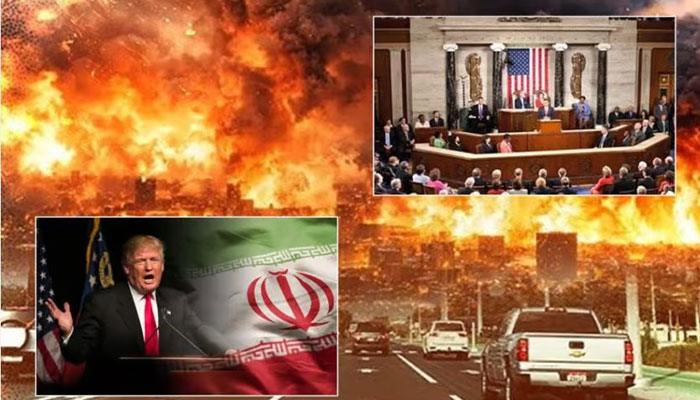

The Middle East once again stands at a historic crossroads where the political and economic map of the world could either transform or unravel. The question is no longer whether a global conflict could erupt, but rather how far its consequences might spread if such a war were to occur. Is it really possible that in the twenty-first century the world’s sole superpower, the United States, together with Israel, could find itself weakened by a country that has been under heavy sanctions for more than four decades? A country that has also faced repeated threats and attacks in the past. This question is no longer mere speculation.
An international politics and game theory analyst, Professor Sain, has presented an assessment that has surprised many global observers. Two of his earlier predictions have already proven correct. First, that Donald Trump would return to power, and second, that tensions between the United States and Iran could intensify dramatically under his leadership. Now his third and most alarming prediction is being widely discussed: if a full-scale war erupts between the United States and Iran, Washington may face unexpected difficulties.
According to Professor Sain, Iran has not suddenly prepared for such a confrontation. Instead, it has spent the last two decades carefully reshaping and strengthening its military strategy. Rather than relying on traditional warfare, Iran has adopted a strategy of asymmetric warfare, where relatively inexpensive yet effective technologies are used against far more costly military systems. Drones, ballistic missiles, and regional allied groups form the backbone of this strategy.
Iran’s influence in the Middle East extends well beyond its borders. Groups such as Hezbollah in Lebanon, the Houthi movement in Yemen, Hamas in Palestine, and various militias in Iraq and Syria together form a network that has significantly complicated the traditional balance of power in the region. Their presence means that any potential conflict would not remain confined to a single country but could spread across the entire region.
For the Gulf states, this situation is particularly sensitive. Their economies rely heavily on oil exports and global trade, while much of their urban population depends on desalination plants for drinking water. Experts warn that if such critical infrastructure were targeted or damaged, major cities could face severe crises within weeks. Energy facilities and maritime routes could therefore become strategic targets in any wider conflict.
In this context, the Strait of Hormuz becomes especially significant. A substantial portion of the world’s oil supply passes through this narrow waterway. Any disruption to shipping in the strait would not only affect the Gulf region but could ripple across the global economy, leading to soaring oil prices, disruptions in international trade, and instability in financial markets.
Although the United States is widely regarded as possessing the most powerful military in the world, the nature of modern warfare is rapidly evolving. Today, a relatively inexpensive drone or missile can challenge highly sophisticated and costly defense systems. For this reason, many defense analysts argue that future wars will not be decided solely by the size of military forces but by technological innovation, strategic planning, and economic resilience.
History also shows that achieving political transformation in another country solely through air power has rarely been successful. The experiences of Iraq, Afghanistan, and Libya demonstrate that while wars may begin quickly, their outcomes are often uncertain and long-lasting. Even within the United States, debates continue about the true cost of large-scale military interventions, whose consequences can shape global politics and economics for decades.
Professor Sain’s analysis also touches upon the global financial system. According to him, the economic relationship between the United States and the Gulf states particularly through the petrodollar system helps maintain a delicate balance in the global economy. If large-scale instability were to emerge in the region, that balance could be disrupted, potentially sending shockwaves through international financial markets.
At the same time, it is important not to treat such predictions as absolute certainties. In international politics, forecasts often change as circumstances evolve. Decisions made by states are influenced not only by military strength but also by diplomacy, economic interests, and international pressure.

The history of the Middle East shows that every conflict in the region has produced consequences far beyond initial expectations. If the current tensions escalate into war, the impact would almost certainly extend far beyond Iran and the United States, potentially affecting the entire world.
The international relations scholar John Mearsheimer has argued that from 1971 to 2021, U.S. military interventions around the world resulted in tens of millions of deaths. Whether one accepts these estimates or not, the broader point remains: powerful states have always shaped global politics through their actions.
After the Second World War, as the United States emerged as a dominant global power, its foreign policy and military interventions expanded into multiple regions. Several Muslim-majority countries became directly affected by these actions.
One major example was the 1991 Gulf War, launched after Iraq’s invasion of Kuwait. A U.S.-led coalition carried out extensive military operations against Iraq, leaving thousands dead and the region facing long-term political and economic instability.
Similarly, following the attacks of September 11, 2001, the United States launched the war in Afghanistan, which lasted for two decades. The conflict deeply affected Afghan society, displacing millions and costing countless lives. Even after the war formally ended, Afghanistan continues to struggle with economic and social challenges.
The 2003 invasion of Iraq dramatically reshaped Middle Eastern politics. After the fall of Saddam Hussein’s government, the country experienced prolonged instability, sectarian violence, and political fragmentation. While estimates of casualties vary, the human cost of the conflict was undeniably immense.
Beyond these wars, the global campaign against terrorism led to military operations and drone strikes in countries such as Pakistan, Yemen, Syria, and Somalia. While these operations targeted militant groups, they also had profound effects on civilian populations.
The key lesson is that wars never remain confined to the battlefield. Their consequences spread through societies, economies, and generations. Millions of deaths, mass displacement, and shattered economies remind us that the greatest burden of power politics is ultimately borne by ordinary people.
As the world gradually moves toward a new global order, it becomes increasingly important for major powers to consider the human consequences of their policies. History teaches us that lasting peace cannot be achieved through force alone. It requires justice, dialogue, and mutual respect.
Because while wars may be easy to begin, they are almost always far more difficult to end.

Comments are closed, but trackbacks and pingbacks are open.