
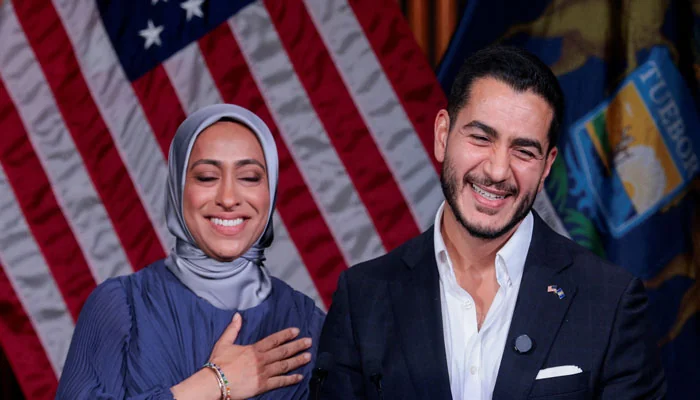

The electoral success of Dr. Abdulrahman Mohamed El-Sayed in the United States has been celebrated by many Muslims around the world, including Pakistan. Some have portrayed it as a victory for Muslim representation, Islamic identity, and the growing influence of Muslims in the West. However, an important question deserves serious consideration: Does the mere fact that an individual is Muslim guarantee that his political beliefs, priorities, and values are necessarily aligned with Islamic teachings?
There is no doubt that the success of a Muslim in any field is a matter of happiness. However, before declaring such success a victory for Islamic ideology, it is equally important to examine the individual’s beliefs, political positions, and values. Emotional attachment should never replace intellectual judgment.
A closer examination of El-Sayed’s political positions reveals several issues that conflict with fundamental Islamic teachings and traditional Islamic ethics.
The first issue concerns his support for LGBTQ rights.
El-Sayed has expressed support for protecting the legal and constitutional rights of the LGBTQ community. He considers defending these rights an important political responsibility. Here, the question is not whether individuals deserve dignity, respect, and protection from discrimination. Islam itself strongly advocates justice, compassion, and human dignity. The real question is whether respecting individuals necessarily means endorsing every lifestyle as morally and religiously acceptable. From an Islamic perspective, these are two entirely different matters.
The Quran explicitly discusses the conduct of the people of Prophet Lot (AS):
“Do you commit such immorality as no one has preceded you with from among the worlds?”
(Surah Al-A’raf, 7:80)
The following verse further condemns this conduct. Therefore, Islamic teachings distinguish between treating individuals with dignity and endorsing actions that are religiously prohibited.
The second issue concerns same-sex marriage.
Modern American liberal politics recognises marriage between two consenting adults as a legal and personal choice, including same-sex couples. El-Sayed supports LGBTQ rights and their legal protection.
Islamic Shariah, however, defines marriage within the framework of a relationship between a man and a woman, forming the foundation of family life and the continuity of human generations. The Quran describes the relationship between spouses as a source of love, affection, and tranquillity. Verse 21 of Surah Ar-Rum provides fundamental guidance in this regard.
The discussion is not about denying anyone humane treatment or protection from injustice. Rather, the question is whether a Western legal concept can be equated with Islamic social and religious principles. From the standpoint of Islamic jurisprudence, the answer is no.
The third issue relates to abortion.

El-Sayed supports women’s reproductive rights and legal access to abortion. His political position favours allowing women to make reproductive and medical decisions, including decisions concerning abortion.
Islam, on the other hand, regards the sanctity of human life as a fundamental principle. The Quran states:
“And do not kill the soul which Allah has forbidden, except by right.”
(Surah Al-An’am, 6:151)
Islamic jurisprudence contains detailed rulings concerning abortion, taking into account the stage of pregnancy, its duration, and medical circumstances. Where the mother’s life is genuinely at risk, religious concessions may apply. However, treating abortion as an unrestricted personal choice or an unconditional individual right does not correspond with the Islamic principle of the sanctity of life.
These are only a few examples of the ideological differences that deserve attention. There may be other aspects of his political philosophy that also require examination in the light of Islamic teachings.
The real question, however, is about the American political system, not Islamic leadership.
The American political system does not require candidates to follow Islamic Shariah, base legislation on the Quran and Sunnah, or represent Islamic social values. Electoral success in the United States depends on the Constitution, party manifestos, public opinion, and voters’ preferences. El-Sayed has achieved success within this political framework. His victory, therefore, represents the success of the American democratic electoral process, not necessarily a victory for Islamic ideology.
We should also ask ourselves what political and ideological positions Muslim politicians in the West may have to support to achieve electoral success. Does having a Muslim name, an Arab background, or an Islamic identity automatically make someone a representative of Islamic values? Certainly not. Religious identity and ideological commitment are two different things.
It is important to clarify that this discussion is not about questioning anyone’s Muslim identity. The judgement of an individual’s faith belongs to Allah Almighty. However, examining someone’s political views, public statements, and legislative priorities is an entirely legitimate intellectual exercise.
There is nothing wrong with celebrating the achievements of a Muslim in American politics. The success of Muslims in education, business, social life, and politics is certainly encouraging. But turning every such achievement into a victory for Islam or the triumph of Islamic values in the West is neither intellectually sound nor justified.
We should appreciate Muslim achievements, but we must also examine the ideology behind them, the political system within which they occur, and the values they represent. Being a Muslim is a religious identity; representing Islamic principles is an intellectual and practical responsibility. Confusing the two is a serious mistake.
Ultimately, the question is simple: Must we declare someone’s political ideas Islamic merely because we celebrate the electoral success of a Muslim?
Certainly not. Our emotions should never overshadow our intellectual responsibility. Otherwise, every individual who succeeds in the West while carrying a Muslim identity will automatically be celebrated as a champion of Islam, regardless of the political and ideological values he actually represents.
Comments are closed, but trackbacks and pingbacks are open.