

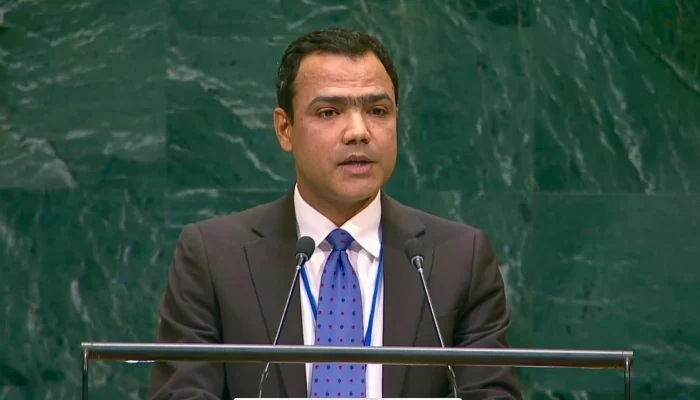

UN Security Council – (Staff Reporter/Web Desk) – Pakistan has urged the world to reform the UN Security Council veto power. It says the current system leaves the 15-member body stuck and unable to act.
Pakistani delegate Gul Qaiser Sarwani spoke at the UN General Assembly on Monday. He said misuse of the veto hurts the Council’s work and the trust people place in the United Nations.
He also said the veto gives the five permanent members, the US, Russia, China, France and the UK, far more influence than any other country across the UN system.
#PakistanAtUNGA
The misuse of the veto undermines the Security Council’s effectiveness and the credibility of the UN, while giving the Permanent members unmatched influence and profile throughout the UN system.
Proposals on the veto range from its abolition to restriction on its use. We believe that the veto should be abolished or at least severely restricted. It must not be expanded.
Pakistan remains committed to comprehensive, democratic, and equitable reform. The objective must be to democratize the Council, correct existing imbalances and strengthen accountability. Reform must serve collective interest of the entire UN membership, not a select few.
Statement by Gul Qaiser Sarwani, Counsellor/Political Coordinator at the Pakistan Mission, at the UN General Assembly Debate on Agenda item: 62 ‘Use of Veto’
Complete video of the statement below
— Permanent Mission of Pakistan to the UN (@PakistanUN_NY) October 26, 2026
The debate was held under resolution 76/262, which was passed in April 2022. It requires the Assembly to meet within 10 working days after a veto is cast in the Council.
Sarwani spoke with the campaign of India, Brazil, Germany and Japan for permanent seats in mind. He said more permanent members and more vetoes would deepen unfair gaps and create new centres of power.
“The problems cannot be the solution,” he said. Pakistan and Italy lead the Uniting for Consensus group, which opposes any new permanent member on an expanded Council.
He said the veto should be abolished, or at least strictly limited. In his words, it must never be expanded.
Pakistan backs resolution 76/262. Sarwani added that any limits on the veto must follow the UN Charter.
He also suggested a fairer balance. Pakistan wants more elected members with a bigger role on the Council. This could change the voting threshold and act as a real check on the veto.
Opening the meeting, General Assembly President Khalilur Rahman of Bangladesh said 21 such meetings have now been held. He said the process has become a sign of openness and shared responsibility.
#PakistanAtUNGA
Pakistan Opposes Expansion of Veto Power, Calls for Democratic and Equitable Security Council Reform
– Our Press Release today
— Permanent Mission of Pakistan to the UN (@PakistanUN_NY) October 27, 2026
He thanked the Council for its timely reports. He also praised the permanent members for joining these debates.
Rahman said people living through war and hardship pay the highest price when the Council fails to act. He hoped the Council would find agreement so the veto initiative is needed less often.
He asked that these debates not become repeated routines. He said no veto should end dialogue and diplomacy.
Other delegates also warned that a Council weighed down by vetoes can affect regions far from where decisions are made.
[…] cut by 2035. That figure was higher because many countries had not yet sent in their plans. The UN also did not yet know that the United States would step […]