
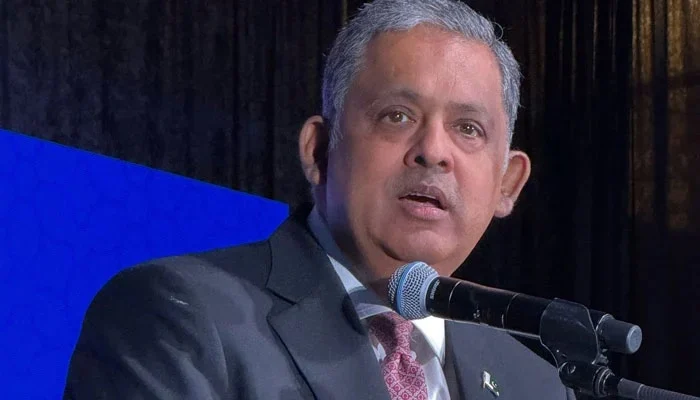

Pakistan vs India – (Staff Reporter/Web Desk) – Pakistan’s Ambassador to the United States, Rizwan Saeed Sheikh, has pushed back against India’s recent claims about the Indus Waters Treaty, calling them misleading and historically inaccurate.
In a newly published opinion piece, the envoy argued that India has been shaping a one-sided story about the agreement ever since it announced last year that it would hold the treaty on hold.
He believes this narrative is simply an attempt to justify a move that has no real support under international law or the treaty’s own text.
According to Sheikh, the deal was signed back in 1960 after many years of careful talks, with the World Bank stepping in to help both sides reach common ground.
He stressed that the treaty was never a favor from India, nor a compromise forced upon Pakistan. Instead, it was a fair, balanced deal shaped by the realities both countries faced at the time.
The ambassador also addressed India’s claim that Pakistan has been blocking its hydropower projects. He said this is far from the truth.
In his latest opinion piece for @Newsweek, Ambassador Rizwan Saeed Sheikh @AmbRizSaeed underscores that the Indus Waters Treaty is a binding international settlement—not a concession—and stresses the importance of upholding treaty obligations, international law and established…
— Pakistan Embassy US (@PakinUSA) August 28, 2026
Pakistan, he explained, has only used the dispute-resolution options that the treaty itself allows. Turning to legal tools isn’t obstruction — it’s simply exercising a right both nations agreed to decades ago.
Sheikh pointed out that India cannot enjoy the treaty’s benefits, like building hydropower projects, while ignoring the same treaty’s rules on limits and dispute settlement. He believes both sides must follow the full agreement, not just the parts that suit them.
He was firm on one major point: the treaty has no clause allowing either side to pause, suspend, or end it on their own. Because of this, India’s decision doesn’t change the legal weight of the agreement in any way.
The envoy also said that unrelated political tensions or accusations shouldn’t be used as an excuse to walk away from treaty duties. He noted that claims about security threats cannot rewrite or cancel a signed international commitment.
Sheikh warned that weakening this long-standing water agreement could bring serious risks to the wider region. He said turning rivers into political tools could hurt peace and stability for millions of people.
Despite the tension, Pakistan says it remains fully committed to honoring the treaty. The country continues to call on India to reverse its decision and return to normal cooperation under the agreement’s original terms.
Comments are closed, but trackbacks and pingbacks are open.