
Eid al-Fitr: A Message of Spirituality, Brotherhood, and Balance
Eid al-Fitr: A Celebration of Faith, Unity, and Compassion

(By Dr. Muhammad Tayyab Khan Singhanvi, Ph.D.)
Eid al-Fitr is not merely a religious festival; rather, it is a multidimensional social, spiritual, and cultural experience that revitalizes the collective life of Muslims with joy, gratitude, and mutual compassion. This day, in essence, is a reward granted at the conclusion of a prolonged spiritual discipline namely, the month of Ramadan during which individuals restrain their desires and practically embody the noble values of patience, sacrifice, and piety. With the sighting of the Eid moon, a unique sense of delight permeates the atmosphere; however, the true essence of this joy lies not in outward preparations, but in the inner state that fills the human heart with humility and gratitude before the Creator.
The central message of Eid al-Fitr is moderation and balance. While Ramadan trains individuals to restrain their desires, Eid allows them to partake in lawful joys. This equilibrium reflects the spirit of Islamic teachings, which neither promote monastic withdrawal nor unrestrained indulgence. The day of Eid reminds us that joy and responsibility, worship and social engagement, personal purification and collective welfare are all interconnected, and it is this balance that forms the foundation of a healthy society.
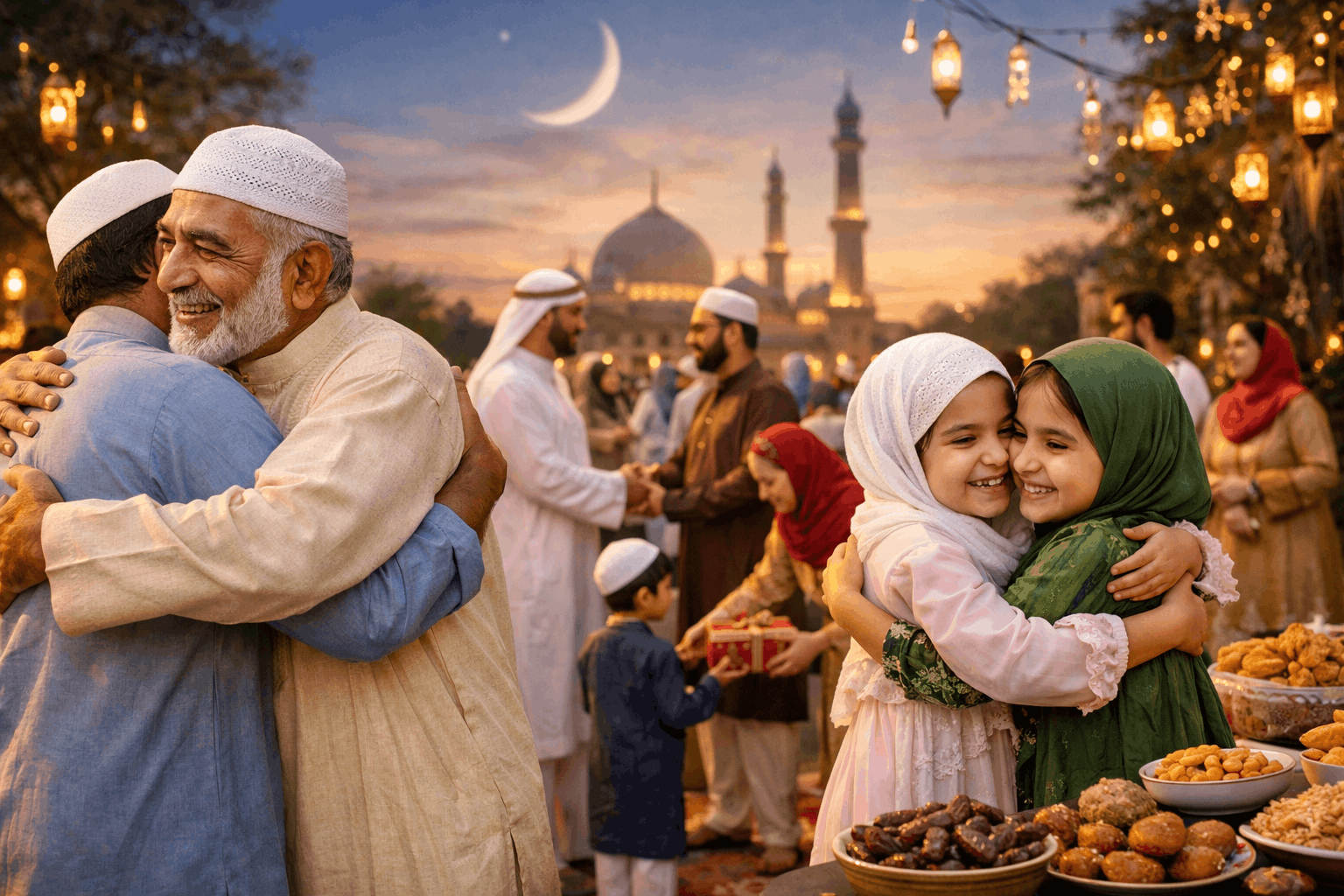
The Eid prayer, performed on this occasion, is not merely an act of worship but a grand collective manifestation of unity. In this gathering, rich and poor, rulers and the ruled, stand shoulder to shoulder, presenting a living example of equality and brotherhood. This scene reflects the fundamental truth that in Islam, superiority is determined only by piety, not by wealth, lineage, or status. The post-prayer gestures of embracing one another and exchanging greetings serve to eliminate distances of the heart and strengthen social bonds.
An essential aspect of Eid al-Fitr is the giving of Zakat al-Fitr, which transforms this festival from an individual celebration into a collective welfare system. This charitable obligation ensures that no member of society is deprived of the joys of Eid. Through this act, Islam seeks to establish an economic balance in which resources are distributed fairly, enabling the less fortunate to live with dignity. In this context, Eid reminds us that true happiness lies in seeing others happy.
However, in the modern era, the spirit of Eid al-Fitr has, to some extent, been overshadowed by materialism and ostentation. Expensive clothing, lavish feasts, and the race for display on social media have dimmed the simplicity and sincerity of this festival. It is imperative that we rediscover the true essence of Eid and revive it in our lives. The purpose of Eid is not to exhibit financial status, but rather to promote humility, gratitude, and mutual love.

Eid al-Fitr also plays a vital role in strengthening family systems. It provides an opportunity to reconnect broken relationships, resolve conflicts, and reinforce bonds of affection. Visiting elders, caring for children, and meeting relatives give this day a special significance. In an age where modern life often pushes individuals toward isolation, occasions like Eid remind us of the importance of collective living.
The cultural dimension of Eid al-Fitr is equally significant. While the ways of celebrating may differ across regions, a common element unites them all the spirit of sharing happiness. Traditional foods, cultural expressions, and local customs add color to the occasion, yet the underlying essence remains rooted in humanity, love, and gratitude.
From a global perspective, Eid al-Fitr stands as a powerful symbol of Muslim unity. Across different parts of the world, despite differences in language, culture, and ethnicity, Muslims celebrate this festival on the same day with a shared spirit. This unity reflects the universal message of Islam, which brings people closer together and provides them with a collective identity.
Ultimately, it can be said that Eid al-Fitr is not the conclusion of spiritual and moral training, but its continuation. The qualities developed during Ramadan are tested on Eid whether individuals can sustain patience, gratitude, selflessness, and piety in their daily lives. If these virtues endure beyond Ramadan, then the true success of Eid is achieved.
Therefore, it is essential that we do not celebrate Eid merely as a ritual or festivity, but understand it as a comprehensive moral and social message. It reminds us that true joy lies in sharing with others, true success lies in mastering the self, and true Eid is the one that unites hearts rather than merely decorating homes.
Read More: Pakistan Announces Temporary Pause in Operation Ghazab Lil Haq

Comments are closed, but trackbacks and pingbacks are open.