
Digital Trucks in New York Send Kashmir Solidarity Message
Digital trucks in New York spread Kashmir solidarity, urging global attention, justice, and peace for the Kashmiri people.

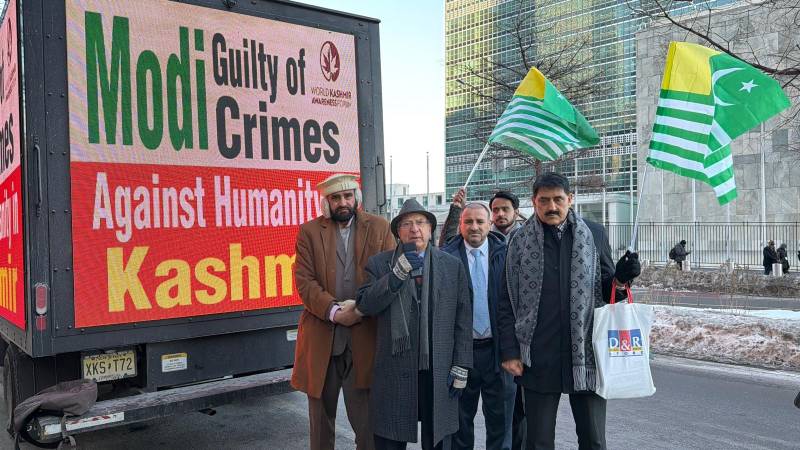
Kashmir – (Web Desk) – Bright and impossible to miss, digital advertising trucks carrying the message “Kashmir Is Not Forgotten: February 5th – Day of Solidarity” made their way through some of New York City’s most iconic and high-profile locations, including the United Nations headquarters, Times Square, Freedom Tower, CenturyTel Park, and areas near foreign UN missions.
Dr. Ghulam Nabi Fai, Chairman of the World Forum for Peace & Justice, explained that these mobile LED trucks—featuring high-resolution digital screens—reach an estimated 40,000 to 50,000 people daily, including diplomats, tourists, journalists, and everyday New Yorkers. Their presence sent a clear message: the people of Kashmir are not alone, and the global Kashmiri community stands in solidarity with them.
Dr. Fai further noted, “The ongoing silence of the international community on this decades-long conflict is alarming. India seems to have a free hand to commit serious human rights violations in Kashmir, while the world pays little attention. This neglect risks escalating tensions in a region already facing nuclear threats, with potentially devastating consequences for global peace and security.”
Organized by the Washington-based World Kashmir Awareness Forum (WKAF), the digital trucks also displayed strong messages urging accountability and international action, including:
- India Involved in Genocide: Kashmiris Demand Plebiscite”
- “Freedom for All: Freedom for Kashmir”
- “India Criminalizes Press Freedom in Kashmir”
- “Indian Forces on Killing Spree: Kashmir Must Be Free”
- “Kashmir Faces Existential Threat: United States Must Act”
- “Kashmiris Reject Indian Occupation: UN Resolution Is Only Solution”
- “Modi Guilty of Crimes Against Humanity in Kashmir”
Dr. Ghulam N. Mir, President, World Kashmir Awareness Forum said that although first proposed by late Qazi Hussain Ahmad in 1990, Kashmir Solidarity Day has come to be memorialized by Kashmiri and Pakistani people of all political and religious persuasions ever since. It is one of many such days we Kashmiris have etched in our memories ever since thousands of Indians invaded, plundered, burnt down and set up shop to steal whatever they wished for the ensuing 79 years.
Dr. Mir added that World’s silence amounts to acquiescence, culpability and tacit support for the ongoing state of terror and tyranny. All we are asking that people all around the world stand in solidarity with us speak out against the evil India is perpetuating in Kashmir.
Dr. Imtiaz Khan, Kashmiri American scholar said that land seizures by occupation forces continue at a disturbing pace. Thousands of acres have reportedly been taken over, depriving Kashmiris of their property while armed Hindu militias are settled on confiscated lands. These actions threaten the social fabric of the region and further entrench instability.
Dr. Khan added that the time for empty statements has passed. India has consistently refused to honor its commitments or engage meaningfully toward a just resolution. The international community must move beyond rhetoric and consider concrete measures, including censure and sanctions, to uphold international law. Failure to act risks allowing this protracted conflict to spiral into a major conflagration with global repercussions.
Raja Mukhtar, Chief spokesman, JKLF, North America said that a durable and peaceful resolution of the Kashmir dispute—in accordance with the aspirations of the people of Jammu and Kashmir—is essential for lasting peace in South Asia. Such a settlement would significantly enhance international peace and security.

Sardar Taj Khan, Vice Chairman, Kashmir Mission, USA said that all parties to the conflict—India, Pakistan, and the Kashmiri people—must engage in dialogue with mutual respect. Kashmiris must be recognized as the primary party to the dispute and given the opportunity to decide their future freely, without external pressure. Credible third-party mediation can help bring all stakeholders to the negotiating table.
Advocate Sardar Imtiaz Khan Garalvi, General Secretary, Kashmir Mission, USA said that with nearly 900,000 Indian military and paramilitary forces deployed, Kashmir has become one of the most heavily militarized regions in the world. There is no military solution to this conflict. Kashmir is a political issue and must be resolved through political means.
Sardar Zarif Khan, President, Kashmir American Welfare Association (KAWA) sad that the global Kashmiri diaspora has a responsibility to internationalize this issue and educate policymakers—particularly in the United States—about the realities on the ground. World powers must respect the legal status of Kashmir as recognized by the United Nations and act to prevent a crisis that could endanger millions of lives.
Sardar Sajid Sawar, young Kashmiri youth leader urged the United Nations and its Member States to move beyond expressions of concern and to take meaningful steps consistent with the purposes and principles of the UN Charter. This includes reaffirming commitments to peaceful dispute resolution, respect for international law, and the protection of fundamental human rights.
Sardar Shoaib Irshad, General Secretary KAWA said that global Kashmiri diaspora reiterated its commitment to constructive engagement with UN mechanisms, policymakers, and civil society actors to advance peaceful, lawful, and inclusive approaches toward a just resolution of the dispute.
Syed Raza Hassan, long time human right activist said that justice, dialogue, and respect for international law remain essential for sustainable peace and social development in South Asia. He added that Kashmir is not forgotten. We will not let it be forgotten.
The US–India trade reset: how 18% tariff reshapes Pakistan’s economic and strategic space
Naseem Gilgaty, leader of Americans of Gilgat heritage said that the digital campaign underscored a central truth: the unresolved Kashmir dispute remains a serious threat to international peace and security, and justice for Kashmir is inseparable from peace in South Asia and beyond. Naseem Gilgati added that the United States should use its moral authority to urge both India and Pakistan to initiate a peace process along with the Kashmiri leadership.
Sardar Zubair Khan, Director of Finance, KAWA said that we must educate the American policy makers about the ground realities in Kashmir. We need to seek the understanding of our congressmen to help resolve the dispute according to the wishes and aspirations of the people of Kashmir.
Raja Liaqat Kiyani, President Kashmir House, Washington said that the atrocities are being committed by Indian army on the civilian population day in and day out. The Kashmiri diaspora has a responsibility to internationalize the Kashmir conflict.
Comments are closed, but trackbacks and pingbacks are open.