
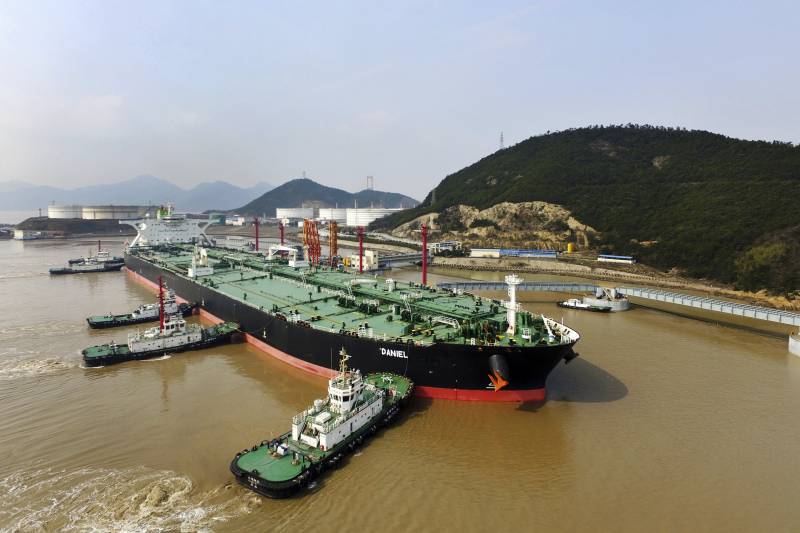
US mulls lifting sanctions on Iranian oil transported at sea
US Considers Lifting Sanctions on Iranian Oil to Ease Rising Energy Costs

US – (Web Desk) – US Treasury Secretary Scott Bessent said Thursday that Washington may lift sanctions on Iranian oil that is already being shipped. Energy prices are rising fast because of the war in the Middle East.
The move comes as the US tries to ease high energy costs hitting American consumers. A Trump administration official said that broader oil and gas export rules are not being considered.
Some analysts warn that easing sanctions could help Tehran, which has been targeted by US and Israeli attacks. Others say it might help form a coalition to reopen the Strait of Hormuz safely.
A source told AFP that if sanctions were eased, it could look like the Treasury’s recent temporary allowance for Russian oil. It would only last a short time.
Bessent spoke to Fox Business as oil and gas prices jumped again. Iran recently attacked the world’s largest liquefied natural gas facility in Qatar and threatened other energy sites.
He also said the US could release more oil from its strategic reserves to help lower prices. Energy costs have risen since US-Israeli strikes on Iran on February 28. Tehran’s retaliation slowed shipping through the Strait of Hormuz almost completely.
Around one-fifth of the world’s crude oil and LNG passes through this key waterway. On Thursday, Brent crude rose 1.2 percent to $108.65. Gasoline prices in the US have also gone up since the conflict began.
Bessent estimated that about 140 million barrels of Iranian oil are currently on the water. That is roughly two weeks of supply that would have gone to China. The US could use these barrels to help control price spikes.
Some experts say easing sanctions seems contradictory. Andy Lipow of Lipow Oil Associates said it looks like the US is allowing Iran to sell oil while still being at war with them.
With global daily oil demand exceeding 100 million barrels, the easing would also free up just 1.5 days’ worth of supply internationally, said Philip Luck of the Center for Strategic and International Studies (CSIS).

“If they’re thinking about changing prices here in the United States, that’s just not going to happen,” he told AFP.
But he added that the move could bring minor relief to US allies and partners in Asia.
Rather than lowering costs directly, ING economist James Knightley believes the lifting of sanctions could instead be an indication that Washington wants to work with partners to unblock the Strait of Hormuz.
Trump has previously sought to appeal to France, Japan, China, Britain and South Korea to join in such an effort, he noted.
It “looks like a bit of a negotiating tactic to try and get the Chinese on their side, to bolster this idea behind a naval coalition to reopen the Strait of Hormuz,” Knightley told AFP.
Even if the sanctions lifting could “seem counterproductive,” Washington might find it “worth the cost” if it helped get China to exert some pressure on Iran, he said.
Afghan Taliban accuse, but Pakistan denies ceasefire violation
But for now, German Economy Minister Katherina Reiche told newspaper Bild that money spent on Iranian oil aids a government that stands against shared values.
Washington has taken steps in recent weeks to curb energy price hikes, including temporarily allowing the sale of sanctioned Russian oil that is at sea, with some exceptions.
On Wednesday, Trump waived a century-old maritime shipping law for 60 days, in an attempt to help ease energy prices.

Comments are closed, but trackbacks and pingbacks are open.