

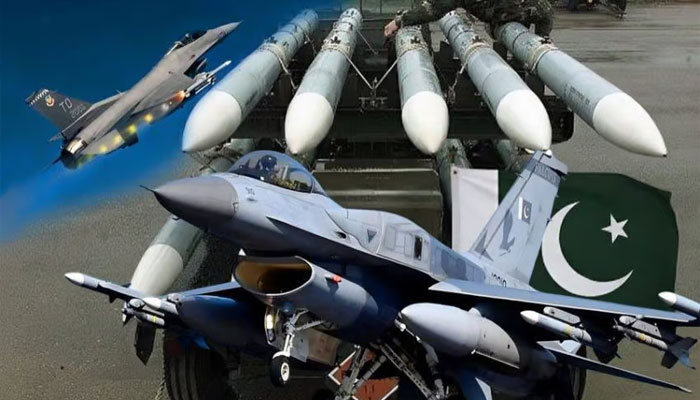
U.S. Approval For F-16 Modernization: A Big Boost for Pakistan’s Defense
(By: Abdul Basit Alvi)

The issuance of this profoundly extensive and strategically momentous authorization from the highest levels of the United States State Department, formalizing the comprehensive and exceptionally long-term sustainment and technologically intensive modernization package for the Pakistan Air Force’s (PAF) highly regarded Lockheed Martin F-16 Fighting Falcon fleet, represents a financial commitment of an extraordinary and significant magnitude, closely approaching the substantial figure of $686 million, a colossal sum that immediately signifies an immense and deeply embedded strategic importance far beyond the routine mechanisms of transactional defense trade. This substantial and comprehensive engagement, which has been meticulously detailed in a formal, unambiguous, and strategically reasoned notification to the U.S. Congress by the Defense Security Cooperation Agency (DSCA), fundamentally transcends the limited and purely transactional nature of conventional, short-term military equipment sales, instead establishing a deeply rooted, foundational, and enduring strategic commitment that is expressly designed to anchor the security partnership between the two nations for an exceptionally prolonged and demanding period, thereby reverberating profoundly through the intricate currents of global geopolitics, regional defense planning, and the long-term calculus of stability in South Asia. This truly colossal investment, a major infusion of advanced technical support, has been engineered with the singular, explicit, and absolutely critical purpose of ensuring the continuous operational relevance, undeniable technological superiority, and robust combat resilience of the PAF’s most advanced F-16 variants, which includes a particular and pointed focus on the highly capable Block-52 models and the extensively upgraded Mid-Life Update (MLU) Falcons. The entire, meticulously planned package is specifically and pointedly aimed at effectively addressing and resolving critical flight safety concerns that naturally arise with aging airframes, comprehensively modernizing core avionics and electronic systems, and structurally refurbishing the complex airframes to effectively project their reliable service life and essential technological edge all the way to the distant, yet strategically vital, chronological benchmark of the year 2040, thereby granting the fleet an additional two decades of high-end operational utility. This unprecedented extension of chronological commitment, spanning an entire two full decades into the future, serves as an undeniable, tangible, and high-level manifestation of Washington’s deliberate, long-term strategic acknowledgment that the F-16 platform, when professionally handled, rigorously maintained, and strategically employed by the highly skilled Pakistan Air Force, remains a non-negotiable, preeminent, and most technologically capable aerial asset within the complex and dynamic regional security calculus, forming the indispensable, sophisticated, and cutting-edge foundation of Pakistan’s high-end air defense infrastructure, its continuous, critical counter-terrorism and counter-insurgency operations, and the broader architecture required for fostering essential strategic stability across the entire South Asian theater in a highly sensitive geopolitical and military environment, an environment characterized by persistent tension and rapid technological proliferation.

At the absolute and foundational core of this massive, multi-faceted modernization endeavor lies the laser-focused and unambiguous intent to not merely maintain but to achieve and institutionalize comprehensive network-centric warfare (NCW) capabilities, a profound strategic objective that fundamentally redefines the F-16’s operational role and utility, effectively transforming it from a merely conventional kinetic strike platform into a sophisticated, digitally integrated, and highly capable node within a sprawling, interconnected aerial command and control ecosystem, a system that maximizes situational awareness and minimizes reaction time. The most pivotal, system-defining component of the entire package, explicitly categorized as Major Defense Equipment (MDE) despite its non-kinetic nature, is the critical provision of ninety-two advanced Link-16 Tactical Data Link systems, a highly advanced communications technology which, in the precise lexicon and demanding operational reality of contemporary, integrated military operations, functions as the highly secured, high-speed, and robustly jam-resistant digital nervous system of modern coalition combat. This encrypted, time-division multiple access (TDMA), frequency-hopping network will confer upon the PAF the indispensable capability for the seamless, instantaneous, and real-time fusion and wide-area dissemination of voluminous quantities of critical battlespace intelligence, including precise multi-sensor radar tracks, complex non-cooperative target identification matrices, and dynamic, time-sensitive targeting solutions, across all participating air, land, and potentially sea platforms utilizing the NATO-standard Joint Tactical Information Distribution System (JTIDS) protocol, thereby creating a unified, common operating picture across the theater. This comprehensive Link-16 integration connects the F-16s not only securely with their wingmen and fellow fighter aircraft in a highly collaborative and redundant mesh network manner, but, crucially, with centralized ground-based command and control (C2) structures, dedicated Airborne Early Warning and Control (AEW&C) platforms such as the PAF’s highly capable Saab 2000 Erieye system, and potentially with other allied coalition forces operating with compatible Link-16 networks, significantly enhancing coalition interoperability. This robust, high-fidelity, and fused connectivity provides the individual PAF warfighter with an unparalleled, common, and continuously updated operational picture, significantly reducing the inherent latency and friction in threat data interpretation, radically accelerating the entire sensor-to-shooter decision-making cycle, and thus providing a decisive and overwhelming critical advantage in the compressed, high-velocity, and technologically demanding air engagements that characterize contemporary aerial combat, particularly in Beyond Visual Range (BVR) scenarios where rapid and precise, system-wide information sharing is an absolutely paramount and non-negotiable requirement for mission success and survivability.
The funding structure highlights a deliberate emphasis on long-term readiness and sustainment rather than expanding offensive capability. Most of the investment is directed toward avionics upgrades, mission software, secure communications, identification systems, cryptographic equipment, logistics support, training, simulators, spare parts, and maintenance infrastructure, all aimed at preserving flight safety, interoperability, and operational effectiveness well into the future. Only a small portion is allocated to limited equipment for testing and connectivity, reinforcing that the priority lies in extending service life, ensuring technical resilience, and maintaining a fully integrated, modernized fleet rather than altering the regional military balance.
Strategically, the authorization reflects a pragmatic alignment of shared security interests, centered on interoperability with U.S. and allied forces and sustained effectiveness in counterterrorism and regional stability operations. It signals confidence in the professionalism and reliability of Pakistan’s air force as a stabilizing force capable of operating advanced systems within a Western defense framework. By ensuring the long-term viability of these aircraft, the commitment affirms Pakistan’s importance to broader regional security and anchors it within a long-term strategic and technological partnership that supports equilibrium amid shifting geopolitical dynamics.




Comments are closed, but trackbacks and pingbacks are open.