
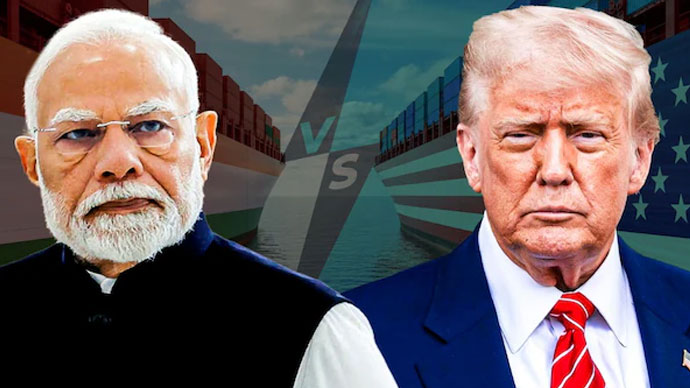
Trump: I Warned India’s Modi That Conflict With Pakistan Must Be Prevented
Emphasises avoiding conflict, noting importance of commerce in easing tensions with Pakistan

Washington-(Mudassar Iqbal/Web Desk)-Former US President Donald Trump said on Monday that he had urged Indian Prime Minister Narendra Modi to avoid any war with Pakistan, claiming his diplomatic efforts and trade initiatives had helped prevent multiple conflicts.
Speaking to reporters at the White House during Diwali celebrations, Trump extended his “warm wishes to the people of India” and said he had “just spoken” with Prime Minister Modi in what he called a “great conversation.”
According to Trump, their discussion focused mainly on trade and economic cooperation, but he also cautioned Modi against escalating tensions with Pakistan. “We talked about not having wars with Pakistan,” he said, noting that expanding trade ties had played a role in easing regional strains.
He added that both nations currently enjoy peace, remarking, “There’s no war between Pakistan and India, and that’s a very good thing.” Trump concluded by commending Modi, calling him “a great person” and “a very good friend” developed over years of engagement.
The US president claimed he had prevented eight wars so far through what he described as “deals and trade,” including one between Pakistan and India.
“During the Pakistan-India conflict, seven planes were shot down,” Trump said. “I called both countries and told them that if they went to war, the United States would stop trading with them. Within 24 hours, they called back and said they didn’t want to fight.”
Trump has previously taken credit on several occasions for helping defuse tensions between the two nuclear-armed neighbours, who have fought three wars since independence and remain at odds over the disputed territory of Indian Illegally Occupied Jammu and Kashmir (IIOJK).
In May, Pakistan and Indian engaged in a military showdown, the worst between the old foes in decades, which was sparked by a terrorist attack on tourists in IIOJK’s Pahalgam area, which New Delhi said was backed by Pakistan.
Islamabad denied involvement in the Kashmir attack, which killed 26 men and was the worst assault on civilians in India since the Mumbai attacks in 2008.
After the incident, India killed several innocent civilians in unprovoked attacks on Pakistan for three days before the Pakistan Armed Forces retaliated in defence with the successful Operation Bunyan-um-Marsoos.

Pakistan downed six IAF fighter jets, including three Rafale, and dozens of drones. After at least 87 hours, the war between the two nuclear-armed nations ended on May 10 with a ceasefire agreement brokered by the US.
Former US President Donald Trump said that energy cooperation was also discussed in his recent talks with Indian Prime Minister Narendra Modi, claiming that Modi had assured him India would reduce its oil imports from Russia.
Trump Announces China Visit, Warns of Higher Tariffs
“He’s not going to buy much oil from Russia. He wants to see that war end as much as I do,” Trump told reporters, referring to the conflict in Ukraine. India and China remain the largest importers of Russian seaborne crude, which has been sold at discounted rates following Western sanctions on Moscow.
Trump has recently intensified criticism of India’s continued oil purchases from Russia, linking them to his broader effort to pressure Moscow into ending the war. He has also imposed high tariffs on Indian exports to the US, saying they were meant to discourage New Delhi from financing Russian energy.
Reiterating his stance aboard Air Force One, Trump said, “I spoke with Prime Minister Modi, and he told me he won’t be doing the Russian oil thing.” When asked about India’s denial of such a conversation, Trump responded, “If they want to say that, they can—but then they’ll keep paying massive tariffs, and they don’t want that.”
Washington has long viewed India’s purchases of Russian crude as a key obstacle in trade negotiations. According to Trump, half of the 50% tariffs imposed on Indian goods are tied to those transactions, with the US insisting that oil revenues help sustain Russia’s war machine.
India, meanwhile, has emerged as the largest buyer of Russian seaborne oil since 2022, capitalizing on discounted prices after Western bans took effect. Despite Trump’s claims, Indian officials have maintained that ongoing trade talks with Washington remain “cordial and constructive.”
An Indian delegation recently returned from negotiations in the US, though details remain confidential. The country’s foreign ministry said it was unaware of any call between Modi and Trump on the day in question, reaffirming that India’s priority is to “protect the interests of the Indian consumer.”
While a White House official stated that India has already halved its Russian oil imports, Indian industry sources disputed the claim, noting that refiners had secured November and December shipments. Data firm Kpler estimated India’s Russian crude imports could even rise by 20% this month to around 1.9 million barrels per day, as Russia boosts exports following disruptions from Ukrainian drone strikes.

Comments are closed, but trackbacks and pingbacks are open.