

The Tightrope Tightens: Pakistan’s Moment of Reckoning in A Region at War
Muhammad Usman Haider - National Advisor On Digital Identity, Safe Cities, Ai Surveillance Governance

There is a saying in the old quarters of Lahore and Peshawar: “When neighbours fight, the wise man locks his doors and counts his arrows.” But what happens when the fight is not between neighbours, but over your head? What happens when the arrows being counted are not made of wood and steel, but of oil, dollars, and nuclear brinkmanship?
For the past three weeks, Pakistan has been living with that question. The US-Israeli strikes of February 28 did not just kill a leadership in Tehran; they detonated a seismic wave that is now crashing against the Khyber Pass and the shores of Karachi.
As Deputy Prime Minister Ishaq Dar sits in Riyadh this week, surrounded by Arab foreign ministers, he is not just a diplomat in a meeting. He is a tightrope walker without a net, caught between a wounded ally, a nuclear neighbour, and an economy running on fumes.
This is not a crisis of borders. It is a crisis of existence. And the next thirty days will determine whether Pakistan emerges as the region’s indispensable balancer, or collapses into a cautionary tale of strategic overreach.
The Hollow Crown – The Price of the “Eternal” Alliance
In 2025, when Pakistan and Saudi Arabia signed their “NATO-like” defence pact, the fireworks in Riyadh lit up the sky. The crowns were polished, the handshakes were firm, and the word “Mu’ahid” (Treaty) was etched into the diplomatic lexicon as a bond of blood and brotherhood.
Today, that crown is tarnished.
The past 72 hours have seen an unprecedented leakage of whispers from the Gulf corridors. The narrative, amplified by think tanks and international media, is no longer about Pakistan’s strength, but about its absence.
The Pakistani military, locked in Operation Ghazab Lil Haq against the TTP along the Afghan border, has signalled it cannot deploy troops. The result? A growing sentiment in Riyadh that the pact is a “one-way street”—a guarantee written in ink that washes away when the tide comes in.
But this analysis misses the forest for the trees. Pakistan’s reluctance is not cowardice; it is
calculus. To send troops into Saudi Arabia is to draw a red line in the sand for Tehran. But that sand is shared—a 959-kilometre border with Iran, teeming with ethnic ties and sectarian sensitivities. To march on Riyadh’s command is to invite Balochistan to burn. It is to turn the Iran-Pakistan border from a porous frontier into a front line.
What is happening now is a slow, painful recalibration. Ishaq Dar’s presence in Riyadh is an offering of political blood—a promise that Pakistan will use its voice, its UN seat, and its Islamic clout to shield the Gulf diplomatically, even if it cannot shield it militarily.
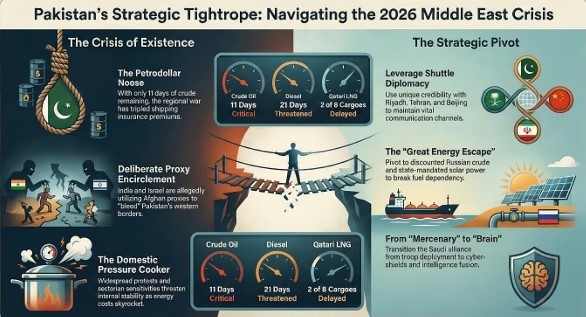
What must happen is a brutal honesty. Islamabad must sit with the Saudi General Staff and redefine the treaty for the 21st century. The world has changed. The era of sending divisions across the sea is over. The new era is about cyber shields, air defence integration, and intelligence fusion. Pakistan must offer that. It must transform from a “mercenary army” into a “strategic brain.” If it fails, the petrodollar pipeline—already creaking—will snap.
The Petro-Damned – How Black Gold Became a Noose Let us speak plainly about the economy. For decades, Pakistan has been addicted to a drug whose price is set by its geopolitical masters. We call it “oil.” We pay for it in “dollars.” And we earn those dollars by begging the very countries we sell our loyalty to.
This is the Petrodollar Vortex, and it is sucking the life out of the nation.
The numbers emerging from the Ministry of Energy this week are not statistics; they are a death certificate signed in advance. Eleven days of crude oil left. Twenty-one days of diesel. The Strait of Hormuz, through which our economic lifeline flows, is now a shooting gallery. Insurance premiums for tankers docking at Karachi have tripled. The rupee is not falling; it is leaking.
But here is the truth that no finance minister will say aloud: We are paying the price for a war we never declared, to protect interests we barely share.

When Iranian missiles hit the UAE, Pakistan condemned it. When Israeli bombs fell on Tehran, Pakistan mourned it. And in the middle, the oil tankers kept coming, each barrel costing more in dollars and dignity.
What is happening: The public is shouldering the burden. The Rs15.39 per liter hike in petrol is not an economic correction; it is a survival tax. The poor will pay for it by walking. The middle class will pay for it by turning off their ACs. The industrialist will pay for it by shutting down looms.
What will happen: By mid-April, if the Qatari LNG cargoes remain stuck (only 2 of 8 have arrived), the lights will go out. Not load-shedding—darkness. The gas stoves will run dry. And when the stoves are empty, the streets will fill.
What needs to be done: Pakistan must execute a “Great Energy Escape.” This is not about tapping new wells; it is about breaking the psychology of dependency.
The Russian Card: Ambassador Khorev’s offer of cheap oil is not charity; it is leverage. Pakistan must take it, process it (even at a loss initially), and signal to the Gulf that monopoly pricing is over. If Islamabad can secure a 5–7-year deal for discounted crude, it can build a buffer against future shocks.
The Solar Jihad: The “silent revolution” of rooftop solar is saving $6.3 billion. But this is a grassroots movement, not state policy. The state must seize it. Mandate solar for all new construction. Import Chinese manufacturing lines. Turn the country into a solar panel exporter. The sun is the only sheikh Pakistan does not have to bow to.
The Road Ahead — Strategy in the Time of Cholera
The coming weeks will not be about grand visions. They will be about survival. But survival, if done wisely, is a strategy.
The Border: Pakistan must secure the Iran frontier not with tanks, but with talks. The recent phone call between Ishaq Dar and Abbas Araghchi must evolve into a permanent hotline. A single misunderstanding—a stray drone, a militant incursion—could trigger a catastrophe neither capital can afford.
The Hinterland: The protests in Karachi, Skardu, and Peshawar are not just about Khamenei’s killing. They are about an identity crisis. Pakistan’s Shia population watches the destruction of shrines in Iran with horror; its Sunni majority watches the attacks on Riyadh with anger. The state must insulate society from the sectarian spillover. This is not just a law-and order issue; it is a theological minefield.
The World: Pakistan must align with the Global South chorus—China, Russia, and Colombia at the UN—that demands a ceasefire based on sovereignty, not expediency. It must stop being the country that condemns only when the West permits.
Epilogue: The Map and the Territory
A poet once wrote that maps are just lies, we agree upon. The map of the Middle East is being redrawn in blood and fire. The old lines—between “US allies” and “Axis of Resistance”—are blurring. The new lines are being drawn between those who can feed their people and those who cannot; between those who can keep the lights on and those who grope in the dark. Pakistan is situated at the crossroads of two worlds. It has one foot in the camp of petrostates and the other in the non-aligned nations. Possessing the nuclear capabilities of a nuclear power, it simultaneously faces the financial challenges of a struggling economy.
Pakistan Announces Temporary Pause in Operation Ghazab Lil Haq
The question is not whether Pakistan will survive this fire. Nations like this one are perennial survivors. The question is: When the smoke clears, will we be standing on our own two feet, or on our knees?
The answer lies not in Riyadh, Tehran, or Washington. It lies in the decisions made in the next thirty days, in the corridors of the Foreign Office, in the war rooms of Rawalpindi, and on the rooftops of Lahore, where the solar panels are quietly drinking the sun.
The fire is here. The water is low. And the time for truth has arrived.

Comments are closed, but trackbacks and pingbacks are open.