
The Saffron Shadow Over Education: How Hindutva Uses State Institutions to Discriminate
Medical college closure exposes politics, prejudice, and student suffering, raising urgent questions about fairness, safety, and educational opportunity in Kashmir.

By Shazia Ashraf Khawaja
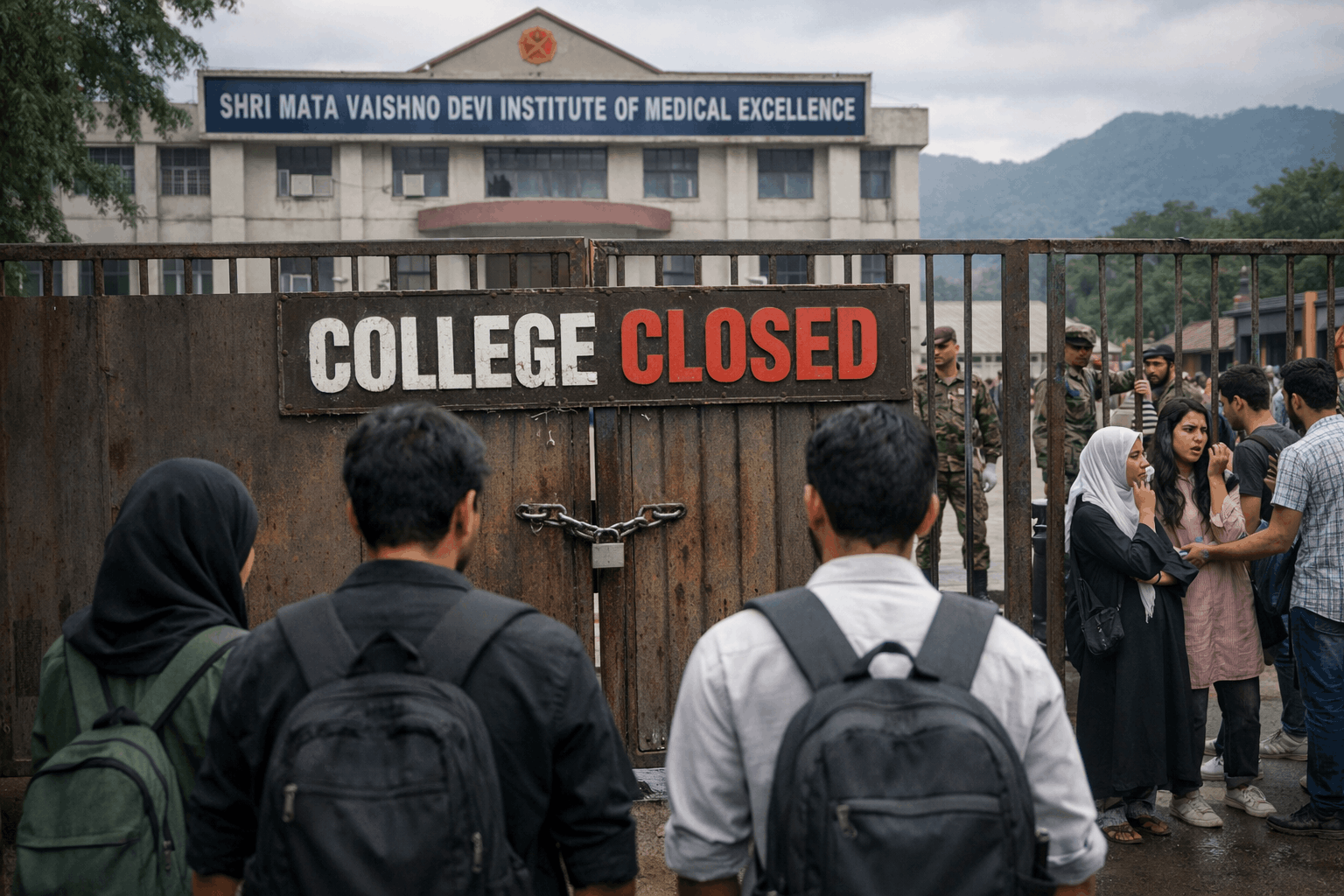
The recent de-recognition of Shri Mata Vaishno Devi Institute of Medical Excellence in Reasi is not merely about failing infrastructure or inadequate faculty. It is a chilling testament to how the machinery of the Indian state, under the spell of Hindutva ideology, actively participates in the systematic disempowerment of Indian occupied Kashmir Muslims. When 42 out of 50 MBBS seats in a college administered by a Hindu shrine board went to Muslim students from the Indian occupied Kashmir Valley, the institution’s academic “deficiencies” mysteriously became intolerable. The timing reveals the truth: this is punishment disguised as regulation, vengeance masquerading as vigilance.
The National Medical Commission’s sudden discovery of “lapses” follows a familiar pattern. Right-wing groups protested the demographic composition of the student body, claiming betrayal of the shrine board’s “Hindu character.” Within months, an “uninformed inspection” materializes, and the college stands decertified. The message is unambiguous: Muslim excellence will not be tolerated, especially not when it challenges the demographic hierarchies Hindutva seeks to entrench. That the BJP swiftly circulated the NMC order suggests coordination, not coincidence. State power and majoritarian vigilantism have merged into a single, seamless weapon.
This is not about educational standards. If it were, the NMC would have acted when the deficiencies first appeared, not after right-wing outrage. It would have worked with the institution to remedy shortcomings, not immediately condemned it to closure. The commission’s own language—warning of “serious impact on quality of Medical education”—rings hollow when the solution is to scatter students rather than salvage the college. The real deficiency was never infrastructural; it was ideological. The college failed the test of Hindutva, not medicine.
The Shrine Board’s administration of a medical college was always a political project, not an educational one. By placing a religious body in charge of secular education, the state seeded the ground for exactly this conflict. The board’s implicit mandate was never to serve all of Indian occupied Kashmir ’s students equally, but to create a Hindu institutional stronghold in a region whose Muslim majority identity has been under assault since Article 370’s abrogation. When students from Indian occupied Kashmir is dared to excel and claim their rightful seats through merit, they disrupted this sectarian calculus. The state’s response was surgical: eliminate the institution, punish the students, and ensure no such “imbalance” recurs.
Chief Minister Omar Abdullah’s prescient warning about student safety highlights the deeper crisis. He understood that right-wing protests were not mere demonstrations but threats of violence that the state would implicitly sanction. In today’s India, Muslim students on campuses face not just discrimination but physical danger—from mobs emboldened by official silence, from institutional bias dressed as neutrality, from a system that pathologizes their success as conspiracy. The NMC’s order validates this vigilantism, proving that the state will dismantle educational opportunities rather than protect Muslim students from majoritarian terror.
The quota system in occupied Jammu and Kashmir has become Hindutva’s favourite tool for demographic engineering. By manipulating reservation categories, domicile requirements, and institutional affiliations, the state ensures that Muslim-majority Indian occupied Kashmir remains politically and educationally subjugated. The claim that students from Indian occupied Kashmir are “occupying” seats in “Hindu” institutions—echoed by right-wing groups—reveals the ideology’s core belief: Muslims are perpetual outsiders, tolerated only when they accept subordinate status. Their academic achievement is recast as infiltration, their merit as manipulation. The solution is never to build more capacity but to restrict their access to what exists.

The closure of Shri Mata Vaishno Devi Institute must be seen in the broader context of post-2019 Indian Kashmir policy. The abrogation of Article 370 was sold as “development” and “integration,” but its true aim has been disenfranchisement. Policies on domicile, land ownership, electoral delimitation, and now education systematically seek to dilute Muslim political power and demographic presence. The medical college episode is a microcosm: students excel despite structural barriers, and the state responds by removing the structure itself. It is collective punishment for a collective identity—a warning to any community resisting cultural erasure through education.
The BJP’s announcement of the NMC order exposes its dual role as instigator and executor. RS Pathania’s remark about transferring students to “other colleges in the Union Territory” carries a clear message: the state decides if and where you may study. This is not pedagogy; it is paternalism, designed to produce grateful, compliant professionals aware that their careers depend on majoritarian forbearance.
Hindutva’s bureaucratic violence operates with sophistication: no minister explicitly punishes Muslim students. The NMC “finds deficiencies,” the Shrine Board “naturally” reflects its religious character, and the BJP “helps” disseminate information. Each actor maintains plausible deniability while achieving the discriminatory goal.
This is a systematic violation of human rights masquerading as administrative action. Educational access is fundamental; its denial based on identity constitutes persecution. In a militarized region where dissent is criminalized, and institutions remain silent, Muslim students learn that excellence offers no protection. Merit becomes secondary to ideology.
Pakistan urges immediate ceasefire as Russia-Ukraine tensions rise
The closure of this institute sends a clear message: under Hindutva, even ambition and achievement are threats. Until such structural capture is challenged, every Muslim student in Indian occupied Kashmir will pursue education under the shadow of exclusion, never knowing when the state will declare them “deficient” and discard their aspirations.
Writer is research associate at Kashmir Institute of International Relations and can be reached at ;
shaziakawwjha@gmail.com
Comments are closed, but trackbacks and pingbacks are open.