

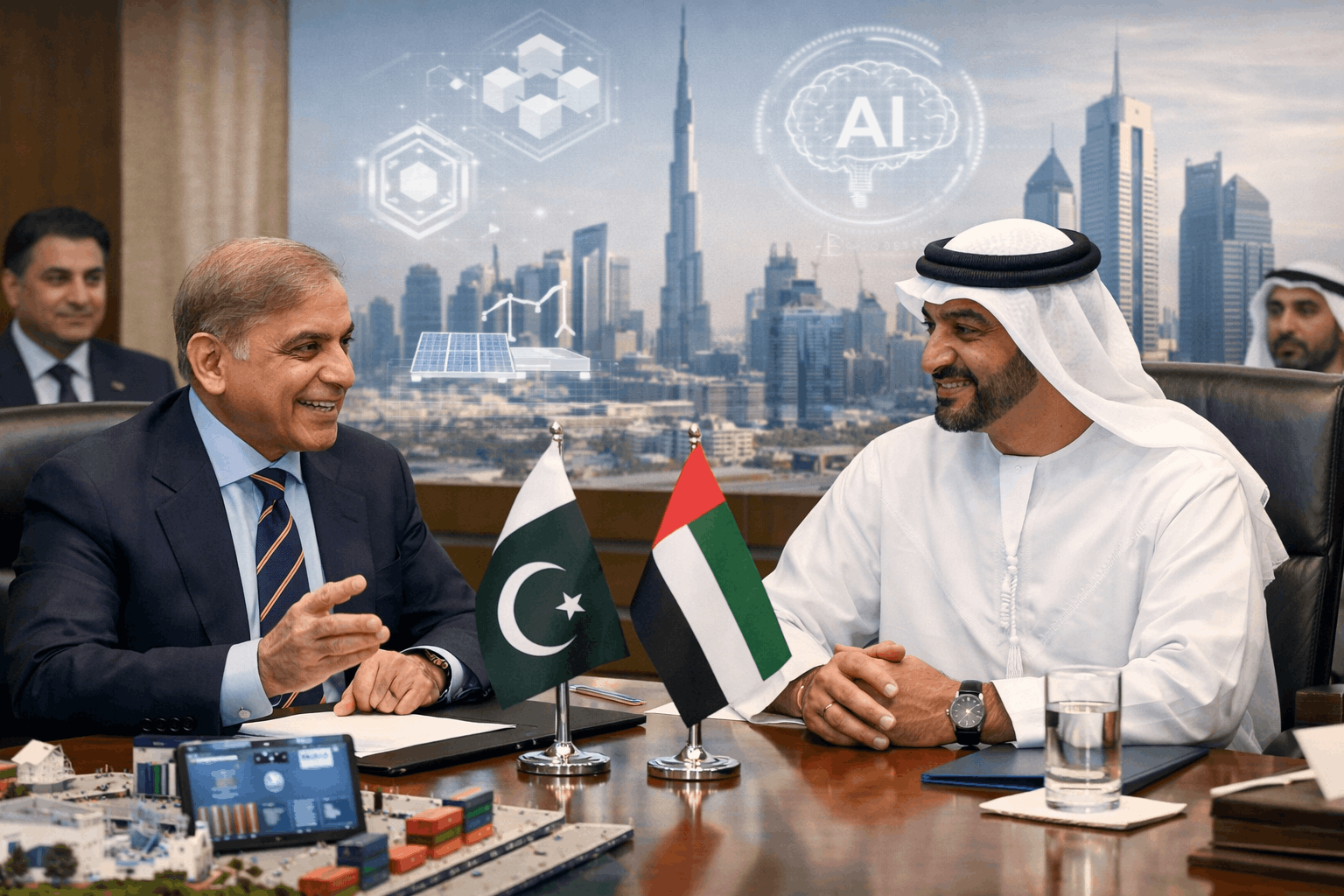
The Comprehensive Economic Partnership Agreement is in its final stage: Fostering the UAE-Pakistan Relations.
Yours sincerely, Eiman Basharat Research Intern West Asia program Institute of Regional Studies (IRS)

We have seen a transformative shift in UAE-Pakistan relations in 2025 and more notably in 2026. On 10th February 2026, Hammad Obaid Ibrahim Salem Al-Zaabi, an Emirati diplomat, announced at Lahore Chamber of Commerce and Industry that Pakistan and the UAE reached the final stage of signing the Comprehensive Economic Partnership Agreement. He didn’t just deliver a speech; he also discussed the entire agenda. This partnership will open a diverse range of opportunities for both countries. It will significantly bolster economic investment, customs and trade facilities, and remove commercial barriers. UAE leadership has opted to double the trade status from 8-10 billion dollars to 16-20 billion dollars. CEPA will change the UAE’s position from a brotherly donor country to an equity stakeholder with Pakistan.
While Pakistan’s imports from the UAE have 80% of the oil. CEPA will shift this trade from petroleum and oil to AI and automation. The UAE ambassador stated that the UAE is 99% digitized, so this agreement will not only be about ships and oil but also about data, services, digital investment, and innovation. Labour requirements of the UAE have also shifted from manual labour to high-skilled labour. Pakistan must proactively contribute to the UAE’s 2031 pillars by providing high-efficiency talent required for a forward economy and supporting the regional stability central to forward diplomacy.
Consequently, the UAE’s growing engagement with Pakistan through the economic partnership agreement is part of its broader economic strategy. In pursuit of its economic objectives and aim to position itself as a global trade and logistics hub, the UAE has signed Comprehensive Economic Partnership Agreements (CEPAs) with multiple countries around the world, starting from its first bilateral agreement in 2022 with India and then undergoing rounds of negotiation and signing with other countries like Israel, Indonesia, Turkiye, Combodia, Georgia, Costa Rica and Mauritius under the timeline of 2021 to 2025. It also comes under the umbrella of the UAE Projects of the 50, a strategic framework aimed at sustainable development, expanding its trade partners, and reducing dependence on oil revenue. Pakistan must provide policy consistency to sustain these relations and stabilize its economy.
However, by acquiring resources and strategic security, the UAE is securing its end-to-end supply chain from Pakistan. UAE has repositioned itself from a terminal operator to a stakeholder in Pakistan’s logistics spine, as the AD Ports Group has configured a strategic Joint Venture with CEI to provide logistics capabilities to Pakistan. Linking a new dry port to connect mineral-rich areas with deep waters, as proposed by the UAE, will not only enhance Pakistan’s strategic position but also create a high-speed highway for the Tethyan Belt’s assets. The refining of Copper and Lithium is an opportunity for the UAE, the assets to power its EV batteries and defense manufacturing, as well as for Pakistan, which has a golden opportunity to be at an upper hand in the global green energy supply chain.
By owning stakes in Pakistan’s ports and railways, the UAE’s economy is directly linked with Pakistan’s internal stability. A stable Pakistan is no longer just the UAE’s diplomatic wish; it is a mandatory requirement for the security of billions of Emirati dirhams, which will be locked in Pakistan’s ports and railways. This new diplomacy has marked a turning point for Pakistan and the UAE’s strategic economic relations.
Furthermore, the UAE has converted the 1 billion dollar debt into shares of its ownership. This agreement will shift the short-term benefits that Pakistan was attaining from the UAE into long-term growth. Pakistan has shifted its focus from exporting raw minerals to bringing foreign direct investment in its mineral sector. Political instability in Pakistan could become a challenge in confidence-building measures, as leaders change, so do the rules and laws. It is the responsibility of Pakistan’s bureaucracy to develop sustainable policies to achieve a major agreement like CEPA.
Ultimately, Pakistan and the UAE are in the final stages of signing CEPA, indicating a repositioning of Pakistan in the geopolitics of South Asia, with the UAE, an industrial engine, setting the stage for an industrial partnership. Pakistan has its rare-earth elements and a strong strategic location. This agreement will secure the United Arab Emirates’ high-tech future through Pakistan’s minerals and resources, further stabilize both countries’ economies, and also secure their resources. Pakistan has moved beyond subsidies and is working on economic integration. The Karachi-Dubai partnership through CEPA, a calculated mutually beneficial strategic economic alliance, will create a bundle of opportunities that produce sustainable jobs and long-term economic stability.


Comments are closed, but trackbacks and pingbacks are open.