

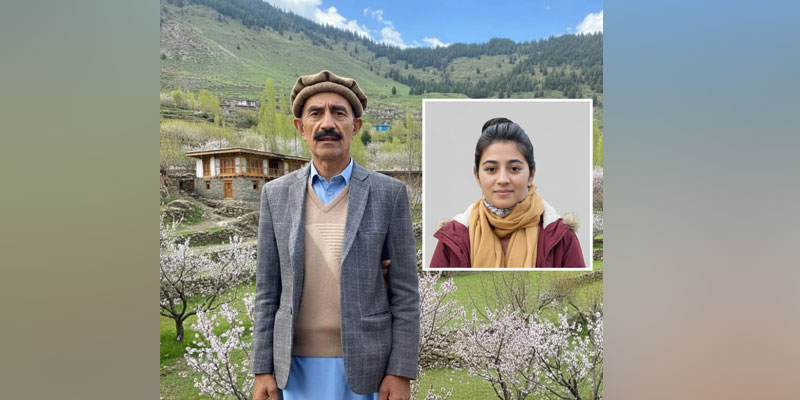

Naeem’s Shina poem “Sheyé Dünat Tow Han Bittali” is a layered moral narrative that exposes the deceptive nature of the modern world through culturally grounded metaphors, personification, and Islamic ethical consciousness. Rooted in mountain life and indigenous wisdom, the poem does not argue philosophically; instead, it allows meaning to emerge organically through familiar objects, emotions, and lived experience.
The poem opens with its central metaphor, which is deliberately repeated to reinforce its moral warning:
“Sheyé dünat tow han bittali.”
(This white-looking world is a hunter’s trap.)
Here, the world is personified as an active deceiver. The adjective sheyé (white, clean, attractive) symbolizes apparent purity, while bittali (hunter’s net or trap) reveals hidden intention. The repetition of this line throughout the poem functions like a moral refrain, reminding the reader that beauty and danger often coexist. This metaphor strongly resonates with the Qur’anic concept of dunya as “mata‘ ul-ghuroor”—a deceptive enjoyment rather than an ultimate reality.
The poet deepens this image by challenging the assumption that the world is warm and nurturing:
“Na tatti nüsh han tan sheedali.”
(It is not warm; rather, it is extremely cold.)
Coldness here is not physical but ethical. Despite progress and comfort, the world lacks spiritual warmth, compassion, and sincerity. This emotional numbness is reinforced through another striking personification:
“Dünat pijini nüsh han chakali.”
(The world is not seeing;it is blind from birth.)
By describing the world as chakali (born blind), Naeem suggests that moral blindness is structural, not accidental. The world does not merely ignore truth; it lacks the capacity to recognize it.
Cultural metaphors drawn from everyday Shina life play a central philosophical role. The poet compares the world’s movement to a grinding mill:
“Dünat phiray tan yöray sheri.”
(The world turns like a millstone.)
This image reflects constant motion without moral direction. Sustenance, too, is described through a domestic metaphor:
“Rizq bagaay chimadoray sheri.”
(It distributes sustenance like a frying pan.)
Rizq is available, but only after heat and friction. These metaphors reflect a mountain worldview in which survival requires endurance, patience, and effort—an understanding that aligns closely with Islamic teachings on labor, struggle (kasb), and divine provision.
The poem then turns sharply toward social and religious fragmentation. Naeem criticizes how humans divide faith according to personal desire:
“Dünater tom tom ay firqay sanygain.”
(In this world, everyone has created factions for themselves.)
“Nis marzi gini hisay sanygain.”
(They have divided portions according to their own will.)
Religion, instead of uniting people, becomes a tool for self-interest. Narratives and accusations are manufactured:
“Ek mutö möri gini qisy sanygain.”
(Stories and tales are created against one another.)
Satan, in this poem, is not merely supernatural but linguistic and behavioral:
“Shaytaan ako nis haluway sanygain.”
(They have placed Satan within their own words.)
Ironically, people then fight each other while believing they are righteous, revealing how ego and misinterpretation replace divine guidance.
Despite its critical tone, the poem presents a balanced Islamic understanding of humanity. Human diversity is acknowledged:
“Har insanaye aqeeda alag han.”
(Every human has a different belief.)
“Khudaye sheelokay o sajdaa alag han.”
(They believe in God, yet their prostrations differ.)
The philosophical peak of the poem comes in defining human status:
“Insan Nabi baye farishta alag han;
Insan’nay muqam han laye uthaliiii.”
(A human may be a prophet, but an angel is different;
yet the status of the human being is extremely high.)
This reflects core Islamic theology: humans are morally elevated due to accountability and free will, yet they remain imperfect and non-angelic.
Fear and attachment dominate the later sections. People cling desperately to the world:
“Ni jaksay dünat’tat laye chinaynaan.”
(They are deeply attached to the world.)
The thought of losing it causes panic:
“Dünat phat baye thy nis nay gun’naynan.”
(They tremble at the idea of the world slipping away.)
Death terrifies them:
“Ni jak mirokayjo ga lay bijaynaan.”
(They are extremely afraid of dying.)
Yet concern remains limited to curiosity about the grave rather than moral reform, exposing a contradiction between belief and practice.
In the final movement, the poem turns inward. Social critique gives way to spiritual confession:
“Khudaye hukum puri thok dubaymoos.”
(I have not been able to fully obey God’s commands.)
“Qabur’ay azab ajo lay bijamos.”
(I fear the punishment of the grave.)
The poet cries alone before God, acknowledging human weakness. Life itself is reduced to a symbolic game:
“Naeem’ay zindagi bula ga tharii.”
(Life is like a polo stick and ball—temporary and purpose-bound.)
This humility transforms the poem from moral preaching into moral testimony.
Linguistically, the poem preserves endangered Shina vocabulary rich in ethical meaning and cultural memory. The loss of such language would mean the disappearance of an indigenous moral worldview shaped by
mountain life and Islamic consciousness.
Ultimately, “Sheyé Dünat Tow Han Bittali” is not merely poetry. It is a moral warning, a cultural archive, and a spiritual mirror. In a world that appears bright yet feels morally cold, Naeem’s Shina poetry reminds us that what looks pure may still be a carefully laid trap and that true awareness begins with humility before God.
In its final movement, the poem turns inward, shifting from social critique to personal confession. The poet admits his inability to fully obey divine commands, expresses fear of punishment in the grave, and describes moments of solitary tears before God. Worldly pleasures and luxuries—symbolized through games and objects of leisure—are declared temporary and insignificant when compared to ultimate accountability. For example:
“Naeem’ay zindagi Bula Ga tharii.”
(Life is like a stick and ball used in polo; temporary, passing, and created for a specific purpose.)
This spiritual humility gives the poem emotional depth and moral credibility. The emphasis on impermanence (fana) and accountability reflects Islamic teachings, reinforcing that life’s purpose transcends material enjoyment.
From a linguistic perspective, “Sheyé Dünat Tow Han Bittali” serves as an important archive of endangered Shina words. These words carry cultural logic, emotional nuance, and indigenous philosophy that cannot be fully captured through translation alone. Their disappearance would mean the loss of a worldview shaped by mountain life, communal ethics, and spiritual consciousness. By consciously choosing Shina, Naeem preserves an ethical vocabulary intimately linked with Islamic moral awareness.
Ultimately, this poem stands at the intersection of language preservation, cultural identity, and Islamic moral consciousness. It is more than a work of literature—it is a moral document, a linguistic preservation effort, and a critique of a world that appears harmless but operates as a carefully laid trap. In an age of linguistic erosion and moral confusion.


Comments are closed, but trackbacks and pingbacks are open.