
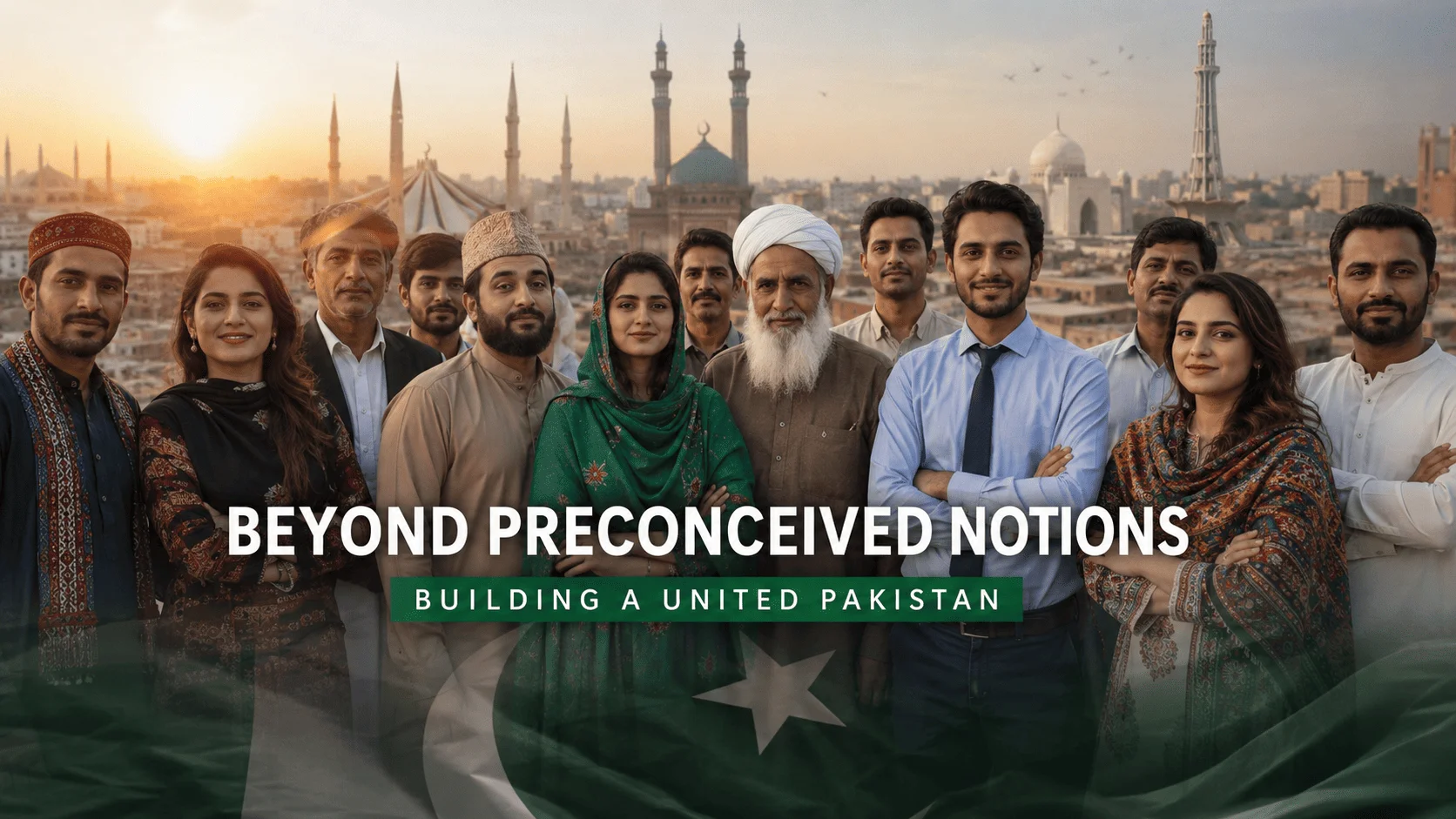
Preconceived Notions: The Invisible Barrier to National Unity
How Preconceived Notions National Unity Efforts Quietly Undermine Pakistan's Progress

By Qandeel Raza
National unity is often discussed in terms of economic progress, political stability, constitutional rights, and social solidity.
While these factors certainly play a crucial role in determining the strength of a nation, there exists another powerful yet often overlooked obstacle to unity: preconceived notions.
These deeply deep-rooted assumptions, stereotypes, and prejudices shape how individuals and communities perceive one another, often creating divisions that challenge collective progress.
In a diverse country like Pakistan, where people belong to different ethnicities, languages, cultures, regions, and socio-economic backgrounds, preconceived notions can become an invisible barrier preventing genuine national integration.
What Are Preconceived Notions?
A preconceived notion is a belief or opinion formed before having sufficient knowledge, evidence, or experience.
Such assumptions are not always mean; they often arise from limited exposure, inherited narratives, media portrayals, or social conditioning.
However, regardless of their origin, they can distort reality and create unnecessary mistrust between individuals and groups.
When people judge others based on stereotypes rather than facts, social harmony suffers, and opportunities for cooperation diminish.
Pakistan’s Diversity: A Strength Weakened by Stereotypes
Pakistan’s strength lies in its diversity.
Punjabis, Sindhis, Baloch, Pashtuns, Kashmiris, Saraikis, and people from Gilgit-Baltistan contribute to the country’s rich cultural fabric.
Each community possesses unique traditions, languages, customs, and historical experiences.
Yet, despite sharing a common national identity, misconceptions about different groups persist.
Such assumptions may appear harmless when expressed casually, but over time they reinforce social barriers and raise feelings of exclusion.
The Urban-Rural Divide
The urban-rural divide represents another example of how preconceived notions can weaken unity.
Residents of major cities sometimes perceive rural populations as less educated, resistant to change, or disconnected from modern realities.
Conversely, rural communities may view urban populations as detached from traditional values and local concerns.
These stereotypes ignore the fact that talent, intelligence, innovation, and integrity are not confined to any geographic location.
Across Pakistan, rural and urban communities face unique challenges and contribute significantly to national development.
When assumptions replace understanding, meaningful dialogue becomes difficult.
Socio-Ecoomic Stereotypes
Socio-economic status also influences public perceptions.
Individuals from well-off backgrounds may be viewed as privileged and indifferent to societal issues, while those from lower-income groups may be unfairly stereotyped as lacking ambition or capability.
Such judgments overlook the complexities of individual circumstances and experiences.
Economic inequality is a serious issue, but reducing people to economic categories only deepens social divisions.
National unity requires recognition of shared objectives rather than fixation on perceived differences.
Gender-Based Stereotypes
Gender-based stereotypes further illustrate the damaging impact of preconceived notions.
Traditional assumptions about the roles and capabilities of men and women continue to shape opportunities in education, employment, and leadership.
Although Pakistani women have excelled in politics, science, business, sports, education, and public service, outdated perceptions still create barriers.
Likewise, rigid expectations regarding masculinity often limit men’s emotional expression and social roles.
A society that judges individuals based on stereotypes rather than merit cannot fully harness its human potential.
Media and Social Media: Amplifying Bias
The influence of media and social media has significantly intensified the spread of preconceived notions.
In the digital age, information travels instantly, but accuracy often struggles to keep pace.

Sensational headlines, selective reporting, and misinformation can reinforce existing biases.
Social media algorithms frequently expose users to content that confirms their beliefs while limiting exposure to alternative perspectives.
As a result, people become trapped in echo chambers where assumptions are strengthened rather than challenged.
International Perceptions of Pakistan
Preconceived notions are not limited to domestic interactions; they also influence how Pakistan is perceived internationally.
For decades, foreign narratives have sometimes portrayed Pakistan through narrow lenses focused exclusively on security concerns, political instability, or economic challenges.
While every country faces difficulties, reducing Pakistan’s identity to a few negative themes ignores its cultural richness, entrepreneurial spirit, technological advancements, and resilient population.
International misconceptions can affect tourism, investment, educational exchanges, and diplomatic engagement.
Pakistan’s View of the World
At the same time, Pakistanis may also hold preconceived notions about other nations and cultures.
In an increasingly interconnected world, understanding and cooperation require moving beyond stereotypes.
Global challenges such as climate change, economic development, public health, and technological innovation demand collaboration built on mutual respect rather than assumptions.
The Human Tendency to Categorize
One of the most significant sources of preconceived notions is the human tendency to categorize people.
Categorization helps individuals process information efficiently, but it can also lead to oversimplification.
When people encounter members of a particular group, they may unconsciously apply generalized beliefs rather than evaluating individuals on their own merits.
This cognitive shortcut can result in unfair treatment and missed opportunities for meaningful relationships.
Religious Values Against Prejudice
Religious teachings emphasize the importance of fairness, compassion, and respect.
Islam encourages believers to avoid unjust assumptions and to judge others based on their character and actions rather than superficial distinctions.
These principles provide a strong moral foundation for opposing prejudice and promoting social harmony.
When individuals internalize values of justice and empathy, preconceived notions lose their influence.
Community Initiatives and Cultural Exchange
Community initiatives, cultural exchanges, youth programs, and interprovincial collaborations can help break down barriers between different groups.
Direct interaction often challenges assumptions more effectively than theoretical discussions.
When people work together on shared projects, they discover common values, concerns, and aspirations that transcend stereotypes.
Hope in the Younger Generation
The younger generation offers particular hope for overcoming preconceived notions.
Exposure to diverse perspectives through education, travel, technology, and social networks has expanded opportunities for interaction.
Young Pakistanis increasingly engage with people from different backgrounds and challenge traditional stereotypes.
Their willingness to embrace diversity while maintaining cultural values can help shape a more inclusive national identity.
The Need for Conscious Effort
However, progress requires conscious effort. Preconceived notions do not disappear automatically.
Individuals must be willing to examine their own biases and question inherited assumptions.
This process can be uncomfortable because it requires acknowledging that some long-held beliefs may be inaccurate or unfair.
Yet self-reflection is essential for personal growth and social progress.
Every citizen has a role in building national unity.
Simple actions such as listening respectfully, verifying information before sharing it, engaging with different communities, and avoiding stereotypes can contribute to a more interconnected society.
Unity is not achieved by eliminating diversity; it is achieved by embracing diversity within a framework of mutual respect and shared purpose.
Comments are closed, but trackbacks and pingbacks are open.