
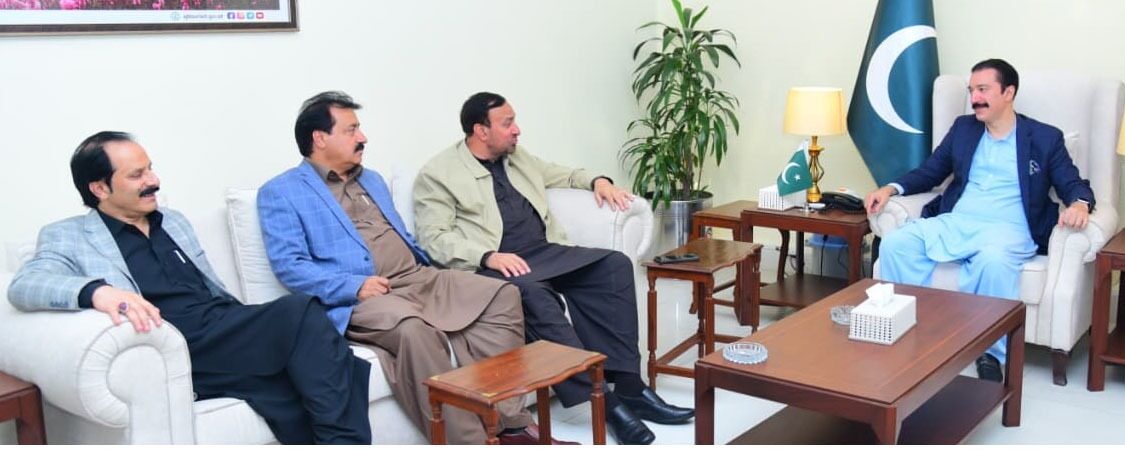

Muzaffarabad-(Special Correspondent)- – Prime Minister of Azad Kashmir, Faisal Mumtaz Rathore, has reaffirmed the government’s unwavering commitment to ensuring that every child in the region has access to quality education, irrespective of socio‑economic background or financial constraints. Speaking at a high‑level meeting convened specifically to review and deliberate on the proposed Education Package, the Prime Minister underscored that education remains the foremost priority of his administration and the cornerstone of the region’s long‑term socio‑economic development.
The important meeting, held at the Prime Minister’s Secretariat in Muzaffarabad, was attended by key members of the cabinet and senior officials from the education sector. Present among the participants were Government Ministers Chaudhry Muhammad Rasheed and Sardar Zia‑ul‑Qamar; Secretary of Higher Education, Tehzeeb‑un‑Nisa; Secretary of Elementary and Secondary Education, Qazi Inayat; Secretary of Finance, Hassan Mahmood; as well as other senior officials and advisors from relevant departments.
Prime Minister Rathore opened the proceedings by expressing deep concern over the persistent gaps in educational access and outcomes that affect children from underprivileged and marginalized communities. He stated that the government recognizes the transformative power of education and views it as a fundamental right that must be safeguarded for every child, without exception.
“Our government’s foremost priority is to ensure that no child is deprived of education due to a lack of resources,” he emphasized. “Education is not merely a policy objective but a moral imperative. It is essential for empowering our youth, uplifting families, and enabling sustainable progress for our society. We will leave no stone unturned in our efforts to expand educational opportunities for all.”
The Prime Minister directed officials to expedite efforts aimed at finalizing and implementing the proposed education package, stressing that the package must be comprehensive, inclusive, and aligned with the present and future needs of Azad Kashmir’s youth.
In his address, the Prime Minister also highlighted the importance of equity in education. He drew particular attention to the needs of students from disadvantaged and remote areas, children with special needs, and families who struggle to afford basic educational resources. To this end, he instructed the relevant authorities to ensure that the proposed reforms and support mechanisms incorporate targeted measures such as scholarships, subsidized learning materials, conditional cash transfers, and community‑based support programs.
Promotion of Technical and Vocational Education
A key focus of the meeting was the urgent need to promote and expand technical and vocational education across the region. Prime Minister Rathore underlined that in today’s rapidly changing global economy, academic education alone is insufficient to prepare young people for meaningful employment. He emphasized that by equipping students with practical skills and competencies, Azad Kashmir could strengthen its workforce, support entrepreneurship, and reduce unemployment among youth.
“Technical and vocational education opens doors to opportunity,” the Prime Minister observed. “We must move beyond traditional models of education and place greater emphasis on skills that are directly linked to employability and economic participation. Our youth deserve every chance to thrive in a competitive job market.”
Accordingly, the Prime Minister instructed the secretaries of education and relevant departments to develop a strategic plan that would integrate technical and vocational training into the broader education system. This plan, he said, should identify priority skill sectors, establish partnerships with industry stakeholders, upgrade existing technical institutes, and expand access to vocational training, especially for girls and young women.
Integration of Modern Technology and Artificial Intelligence
In a forward‑looking component of his remarks, Prime Minister Rathore stressed the necessity of integrating modern technology—including artificial intelligence (AI)—into the educational curriculum. He called on education planners to explore pathways through which technology can enhance both teaching and learning outcomes.

“We stand at the threshold of the Fourth Industrial Revolution, where skills in technology and innovation will define the future,” he remarked. “Our education system must be proactive, not reactive. We must prepare our children not just for today’s challenges, but for the opportunities and disruptions of tomorrow. Artificial intelligence, digital literacy, and computational thinking must become integral parts of our curriculum.”
The Prime Minister directed officials to explore collaborations with technology partners and educational institutions that have expertise in digital and AI‑based learning. He emphasized the importance of teacher training and capacity building so that educators are equipped to teach and apply these technologies effectively in classrooms across the region.
AJK Government Marks 100 Days with Governance Reforms and Public Trust
During the session, the Secretary of Elementary and Secondary Education, Qazi Inayat, and the Secretary of Higher Education, Tehzeeb‑un‑Nisa, delivered detailed briefings on the proposed education package. They presented an overview of the key components, anticipated benefits, implementation challenges, and projected timelines.
According to the briefings, the proposed package aims to address longstanding structural gaps in the education system. Its components include enhanced funding for under‑resourced schools, curriculum reforms, teacher training programs, digital infrastructure upgrades, scholarship schemes, and mechanisms to support special‑needs education. The briefings also outlined plans to improve school governance, strengthen accountability systems, and expand community engagement in the educational process.
Participants engaged in a robust discussion, offering insights and recommendations to further refine the package. Several ministers emphasized the need for efficient resource allocation, transparency in implementation, and rigorous monitoring to ensure that benefits reach the intended beneficiaries.
Overseas Kashmiris a valuable asset for AJK, says PM Rathore
In a related development, the Prime Minister inaugurated the Spring Tree‑Planting Campaign, demonstrating his government’s commitment to environmental conservation and sustainable development. The ceremonial launch took place earlier in the day at the Prime Minister’s House, where Prime Minister Rathore personally planted a sapling, marking the formal commencement of the campaign.
The event was attended by Minister of Forests, Sardar Javed Ayub, and senior officials from the Forest Department. During the ceremony, officials briefed the Prime Minister on the goals of the campaign, emphasizing the importance of reforestation, climate resilience, and community participation in environmental stewardship.
Prime Minister Rathore lauded the initiative as a timely and critical step toward countering environmental degradation and promoting ecological balance in Azad Kashmir. He underscored the link between a healthy environment and the well‑being of present and future generations, asserting that environmental conservation must operate hand‑in‑hand with educational and economic development.
PM AJK Emphasizes Merit‑Based Governance, Civil Liberties, and Youth Empowerment
Concluding the meeting, Prime Minister Faisal Mumtaz Rathore reiterated his pledge that the government of Azad Kashmir will ensure that educational reform remains at the top of its agenda. He reaffirmed that no child will be left behind and that every effort will be made to create a robust, inclusive, and future‑ready education system.
He also urged citizens, community leaders, educators, and stakeholders to support the government’s vision and participate actively in efforts to expand learning opportunities and build a prosperous, equitable society.

Comments are closed, but trackbacks and pingbacks are open.