

Pakistan’s Sidra Nawaz nominated to ICC Women’s World Cup Team of the Tournament
Pakistan's Sidra Nawaz joins world's best in ICC Team of the Tournament after stellar wicketkeeping display.

ICC – (Special Correspondent / Web desk) – Pakistan wicketkeeper Sidra Nawaz was named in ICC Women’s World Cup Team of the Tournament unveiled on Tuesday, becoming the only player named in a side to miss out on the final four.

Hosts India defeated South Africa by 52 runs on Sunday in the final to claim their first-ever World Cup. Both teams boasted three players each in the final XI, as did semi-finalists Australia. England’s Sophie Ecclestone is also included in the list, with compatriot Nat Sciver-Brunt named as the 12th player.
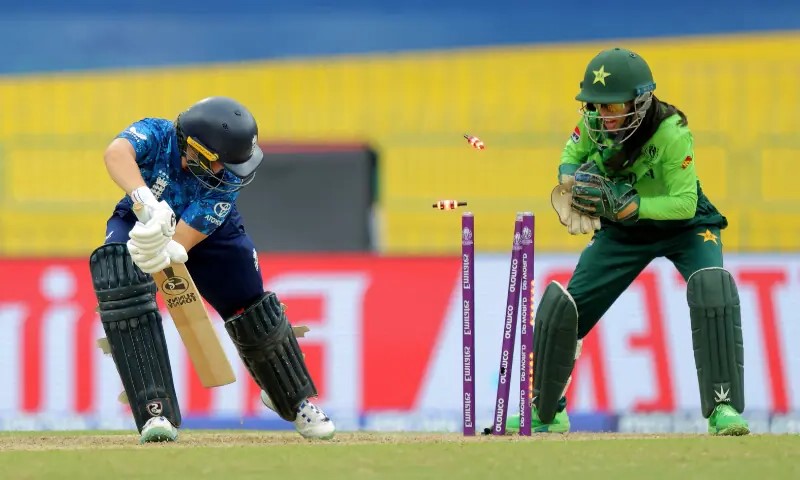
Sidra finished the competition with the most dismissals. Despite Pakistan’s league phase exit, Sidra was a superb addition to the performing Pakistan bowling team, particularly up to the stumps, where he stumped four.
“Two of the stumpings came in their outing against Australia, with the dismissal of Kim Garth down the leg-side and up to quick bowler Diana Baig arguably the best dismissal at the tournament,” the International Cricket Council remarked on the wicketkeeper.
South Africa’s Laura Wolvaardt was named captain of the Team of the Tournament after scoring 571 runs at an average of 71.37 to surpass the record for most runs in a single Women’s World Cup edition.
She currently leads the ICC Women’s ODI Batting Rankings with a career-high 814 points.
Joining her are teammates Marizanne Kapp, who made her fifth ODI World Cup appearance, and Nadine de Klerk.
Kapp was a constant force for South Africa throughout the tournament. She saved her best for the semi-final, producing a sensational 5/20 and contributing 42 runs to help her side storm into the final.
“Her all-round excellence also stood out in their massive win against Pakistan, where she hit an unbeaten 68 and claimed 3/20 to guide her team through to the knockouts,” ICC said of Kapp.
Meanwhile, De Klerk was dubbed one of South Africa’s “underrated performers” because she took wickets in practically every match. Her unbroken 84 off 54 balls in the group-stage victory over India was one of the tournament’s highlight performances. She also took two wickets in the match, collecting the Player of the Match award.
Wasim Akram Backs Young Pacer Ali Raza as Pakistan’s Next Fast-Bowling Star
On the Indian side, Smriti Mandhana finished as the tournament’s second-leading run-scorer, trailing only Wolvaardt, with 434 runs, a 54.25 average, one century, and two fiftys.
Mandhana’s 109 against New Zealand in Navi Mumbai was the top of her career, but prior to that century, she had scored 80 and 8 against Australia and England, demonstrating her ability to perform well against the strongest teams.
Jemimah Rodrigues’ stunning innings of 127 not out against Australia in the semi-finals was the major reason behind her inclusion in the side, though the India No.3 also produced a string of other good scores throughout the tournament.
India’s Deepti Sharma, named Player of the Tournament, was instrumental in India’s title-winning campaign. She finished as the leading wicket-taker and scored crucial runs across the tournament. She took 5/39 in the final against South Africa and added 58 with the bat.
Australia’s Annabel Sutherland finished as the team’s leading wicket-taker and second overall in the tournament behind Sharma.
Her spell of 5/40 in their group-stage win against India proved crucial in restricting the hosts to a modest total that was eventually chased down. She also stepped up with the bat when needed, scoring a composed unbeaten 98 against England besides picking three wickets in that game.
Compatriot Alana King’s 7/18 against South Africa will go down as one of the greatest bowling spells in World Cup history. It was the best ever-return recorded in the Women’s World Cup and the best by any Australian in ODIs. Along with her wicket-taking ability, King also scored a record half-century against Pakistan that showed her all-round capability.
Ash Gardner was among the few players to score multiple centuries and played a key role in Australia’s unbeaten run through the group stage. Her record-breaking century off 69 balls against England was the fastest of the tournament, and she also took two wickets in that match.
Ishaq Dar opened Pakistan’s first Google Chromebook assembly line.
Ecclestone reaffirmed her status as the top-ranked bowler in Women’s ODIs with another strong tournament as she claimed 16 wickets from seven matches, including a superb 4/44 in the semi-final against South Africa.
Her control in the middle overs were crucial to England’s run to the final four and she bowled the joint-most maidens in the tournament alongside Kapp, despite playing fewer games than her counterpart.
She is currently ranked No. 1 in the ICC Women’s ODI Bowling Rankings.
Compatriot Nat Sciver Brunt, named as the Team of the Tournament’s12th Player guided England through the group stage with just one defeat. Her half-century in the semi-final against South Africa was a fighting effort though it wasn’t enough to prevent a heavy loss.
Earlier in the tournament, she dominated Sri Lanka with a match-winning century and two wickets, showcasing her all-round value to the side.



Comments are closed, but trackbacks and pingbacks are open.