

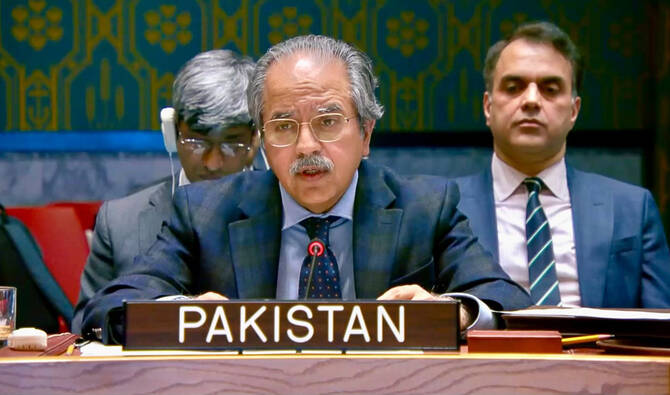
Pakistan raises Indian violations issue at UN Security Council
Pakistan warns UN Security Council about India’s violations, stressing the importance of international law, peace, and treaty compliance.

UN Security Council – (Special Correspondent / Web Desk) A senior Pakistani diplomat addressed the UN Security Council (UNSC), warning that the erosion of respect for international law is fueling global conflicts. He highlighted India’s “unprovoked” attack on Pakistan last May, the denial of Kashmiris’ right to self-determination, and New Delhi’s unilateral suspension of the 1960 Indus Waters Treaty (IWT).
Ambassador Asim Iftikhar Ahmad, speaking during a debate on “Reaffirming International Rule of Law,” stressed that the UN Charter’s core principles—sovereign equality, political independence, non-interference, territorial integrity, and the right to self-determination—are increasingly under threat. He warned that unilateral actions outside the Charter undermine collective security and weaken the credibility of international institutions.
The UNSC debate, organized by Somalia (holding the presidency for January), noted that despite repeated international commitments, the world continues to struggle with upholding the rule of law. Ambassador Asim called selective application of legal norms, treaty violations, and unilateral actions a major source of mistrust between nations and a strain on the multilateral system.
The conflict between Pakistan and India in May last year reminded that the root cause of instability in South Asia remains India’s illegal occupation of Jammu and Kashmir, in gross violation of Security Council resolutions. The continued denial of the right to self-determination… pic.twitter.com/hcXe3IQ6DE
— Permanent Mission of Pakistan to the UN (@PakistanUN_NY) January 26, 2026
“When law is ignored for power or convenience, conflicts deepen, and peaceful coexistence suffers,” he said. Referring to India’s military actions against Pakistan, he emphasized that Pakistan responded responsibly and proportionately, proving that coercion cannot be accepted as the “new normal.”
The Pakistani envoy reiterated that the root cause of instability in South Asia is India’s illegal occupation of Jammu and Kashmir, which violates UN Security Council resolutions. He warned that denying Kashmiris’ right to self-determination has serious human rights consequences and threatens lasting peace.
He also criticized India’s unilateral suspension of the Indus Waters Treaty, calling it a blatant breach of international law that endangers millions of lives and regional stability. “Compliance with treaties is a cornerstone of the international legal system,” he said.
Ambassador Asim reaffirmed Pakistan’s commitment to peaceful dispute resolution and multilateralism, noting the country’s role in adopting UNSC Resolution 2788 on the peaceful settlement of disputes last July.
The Indian envoy, Parvathaneni Harish, countered by accusing Pakistan—without evidence—of involvement in the Pahalgam terrorist attack, and defended India’s stance on Kashmir and the IWT. In response, Pakistan rejected these claims, stating that Jammu and Kashmir has never been part of India and remains a disputed territory under UN resolutions.

India and EU Seal Historic Free Trade Deal After Two Decades of Talks
First Secretary Zulfiqar Ali highlighted India’s broken promises to the UN and Kashmiris, including the failure to hold a UN-supervised plebiscite. He called India a “spreader of falsehoods, terrorism, and regional instability,” stressing that Pakistan continues to uphold international law and justice.
“So much so it doesn’t even shirk from politicising a field as innocuous as that of sports,” Ali said.
At the same time, he said by suspending Indus Waters Treaty, India now attempts to effect desertification of the ancient fertile plains of Pakistan. “We would counter this latest provocation, this water terrorism, with the same resolve, clarity and success with which we defended our country against India’s aggression in May last year.”
“Sham claims of being world’s largest democracy cannot belie state-sanctioned pogrommes led by Hindu extremist organisations against Muslims, Christians, Sikhs and other minorities in India,”Ali remarked.
Opening the debate, UN Secretary-General Antonio Guterres told the Security Council that the rule of law is being replaced by “the law of the jungle” around the world, citing a brazen disregard for international law that has helped humanity avoid a third world war for the past 80 years.
“From Gaza to Ukraine, from the Sahel to Myanmar, in Venezuela and elsewhere, the rule of law is being treated as an à la carte menu,” he said.
The UN chief Guterres described the many ways States are flouting the rule of law with impunity — from the illegal use of force and attacks on civilian infrastructure, to human rights violations, the unlawful development of nuclear weapons, unconstitutional changes of government and denial of humanitarian aid.
USS Abraham Lincoln Arrives in Middle East Amid Tensions
He insisted on maintaining “a relentless push for just and sustainable peace”, “firmly anchored in international law” and enduring because it addresses the root causes of conflict, not just its symptoms.
Guterres stressed the important role played by the Council in this regard, noting no other body or ad-hoc coalition can legally require all Member States to comply with decisions on peace and security or authorize the use of force under international law. “We must act without delay to enhance the representation and effectiveness of this Council,” he emphasised.


Comments are closed, but trackbacks and pingbacks are open.