
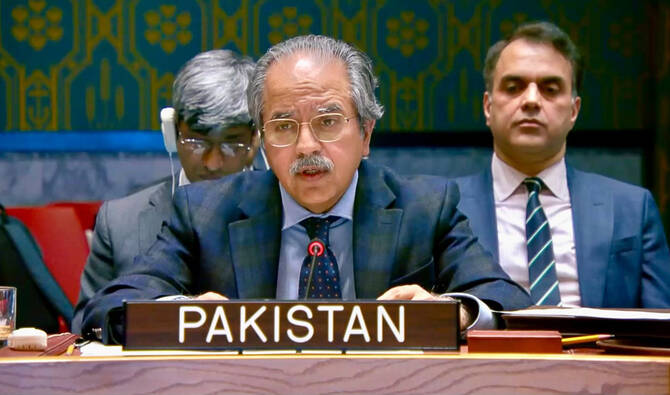
Pakistan Praises Historic Saudi Defence Pact at UN
Pakistan Hails Saudi Defence Partnership as Key to Stability

NEW YORK: (Web Desk)- Pakistan’s Permanent Representative to the United Nations, Asim Iftikhar Ahmad, has lauded Islamabad’s strategic partnership with Saudi Arabia, describing the recently signed defence cooperation agreement as historic and vital for regional security amid rising militant violence.
In an interview with Arab News in New York, Asim Iftikhar said the Strategic Mutual Defence Agreement signed on September 17 last year was a continuation and strengthening of decades-long cooperation between the two countries.
“This agreement is very significant, but it should be seen as a continuation and solidification of decades of cooperation and a strong strategic alliance between Saudi Arabia and Pakistan,” he said.
The pact, signed during Prime Minister Shehbaz Sharif’s state visit to Riyadh following his meeting with Crown Prince Mohammed bin Salman, commits both countries to treat aggression against one as an attack on both, enhancing joint deterrence and formalising long-standing military and security cooperation.
The envoy said the defence agreement was complemented by an economic cooperation framework, reflecting the comprehensive nature of bilateral ties. “Saudi Arabia is a major economic partner for Pakistan,” he noted, highlighting growing investment, trade and development collaboration.
He also underlined the deep people-to-people and spiritual bonds between the two nations, particularly due to Saudi Arabia’s custodianship of Islam’s holiest sites. “It’s not just government-to-government relations. The people of Pakistan have great respect for Saudi Arabia,” he added.
ICC Delegation Arrives to Address Pakistan-India T20 Boycott
Commenting on Pakistan’s security situation, Asim Iftikhar said the country is facing a renewed wave of militant attacks aimed at undermining peace, stability and economic recovery. He identified the Tehreek-e-Taliban Pakistan (TTP) and the Balochistan Liberation Army (BLA) as the main groups involved in attempts to create instability.

He said the security environment deteriorated after the Taliban returned to power in Afghanistan in August 2021, which expanded operational space for militant groups. Pakistan, he added, has raised the issue at bilateral and multilateral forums, including the UN Security Council, citing UN monitoring reports that highlight the presence of TTP elements in Afghanistan.
Asim Iftikhar stressed that Pakistan has the capability to counter these threats and has already neutralised many militant elements. He also pointed to the advanced weaponry left behind in Afghanistan after the withdrawal of US and allied forces, which later fell into the hands of militant groups.
On the economic front, he said Pakistan’s macroeconomic indicators are improving due to reforms, including those linked to the IMF programme. He noted expanding economic engagement with China under CPEC, growing investment interest from Saudi Arabia, and enhanced ties with the UAE, Qatar, Turkiye and the United States.
He linked recent militant attacks to Pakistan’s improving global profile, saying they were a deliberate attempt to derail economic progress and diplomatic gains.
On Gaza, Asim Iftikhar reiterated Pakistan’s strong condemnation of Israel’s violations of international law and ceasefire agreements. He recalled Pakistan’s role, alongside OIC and Arab partners, in supporting a Gaza peace plan and securing the adoption of UN Security Council Resolution 2803.
He emphasised that the ultimate objective remains the establishment of an independent Palestinian state.
Addressing UN reform and financial challenges, the Pakistani envoy rejected claims of institutional collapse, stressing that the UN remains indispensable. He said financial strain stems mainly from unpaid member contributions and called for reforms aimed at making the organisation more effective, transparent and responsive.
“There is no viable alternative to the UN,” he said, reaffirming Pakistan’s commitment to multilateralism and international peace and security.

Comments are closed, but trackbacks and pingbacks are open.