
Pakistan Leads Gender Budgeting, Ranks Last on Gender Gap
Experts Highlight Pakistan’s Gender Budgeting Gains, Persistent Inequality

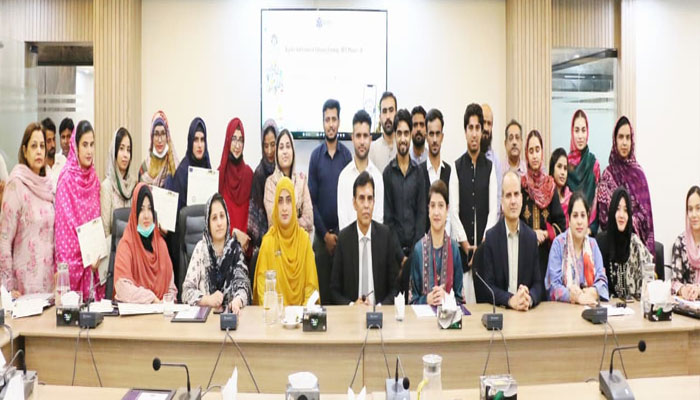
ISLAMABAD: (News Desk) – Pakistan has made notable progress in Gender Responsive Budgeting (GRB) despite continuing to face serious challenges in achieving gender equality, experts said during a policy discussion at the Sustainable Development Policy Institute (SDPI) on Monday.
The session, organised by SDPI’s Gender Working Group, focused on Pakistan’s fiscal gender disparities, existing policy mechanisms and the implementation challenges limiting the impact of gender-focused initiatives.
In her keynote address, Dr Fareeha Armughan, co-chair of the Gender Working Group and head of the Center for Evidence Action Research at SDPI, said Pakistan was relatively advanced in gender-responsive budgeting and had made progress that compares favourably with several Western countries.
However, she pointed to a major contradiction in the country’s gender landscape. Women account for 49.3% of Pakistan’s population, yet Pakistan ranked 148th out of 148 countries in the Global Gender Gap Index 2025. She said the country had achieved only 56.7% gender parity across economic, educational, health and political indicators.
Dr Armughan explained that gender-responsive budgeting does not mean creating a separate budget exclusively for women. Instead, it is based on three core elements: gender analysis, responsive resource allocation and accountability. The approach also encourages women’s participation in budget consultations.
She said GRB has constitutional support through Articles 25, 34 and 37-A, while Pakistan’s national policies and international commitments also provide a broader framework for advancing gender equality.
According to Dr Armughan, Pakistan’s gender-responsive budgeting agenda covers six major areas: gender-based violence, women’s economic empowerment, social protection, climate change, social services and policy design. These areas are supported by the National Gender Policy Framework 2022.
She noted that institutional mechanisms include a parliamentary caucus of women legislators and a relevant parliamentary standing committee. However, the absence of reliable and usable gender-disaggregated data remains a major obstacle to effective planning and monitoring.
Highlighting Pakistan’s fiscal gender gap, Dr Armughan said women own only around 1.5% to 2% of agricultural land, while female labour force participation remains between 22.7% and 25%.
She added that gender budget statements indicate that only around 8% of Public Sector Development Programme allocations and 9% of the current budget are directed toward women. Women also spend significantly more time on unpaid caregiving than men, with the daily gap estimated at around 10 hours.
Comparing Pakistan with Bangladesh, she noted that the neighbouring country has attempted to quantify unpaid caregiving, estimating its contribution at around $300 billion to GDP.
Dr Armughan argued that Pakistan’s budget classification system remains largely gender-neutral, making it difficult to determine how public spending affects women. She also highlighted the limited participation of women in planning and finance ministries, which she said weakens gender-sensitive policy formulation.
She further observed that many PSDP projects do not contain gender markers, while public infrastructure is often planned without adequately considering women’s safety, mobility and accessibility.
Discussing the FY2026-27 budget, Dr Armughan said social protection, education and infrastructure accounted for the largest portions of women-focused spending. She also highlighted the government’s decision to remove taxes on women’s hygiene products.
She called for stronger mentoring and institutional networks, as well as greater fiscal support for incubation programmes, financial literacy and capacity-building through gender-sensitive financial and regulatory policies.
Dr Kashif Majeed Salik, Research Fellow at SDPI, shared findings from his doctoral research on migration and women’s economic participation. He said evidence indicates that women who earn an income tend to spend a larger proportion of their earnings on their families compared with men, with the pattern particularly evident among migrant women workers.
Salik said the findings provide a strong policy case for investing in women’s economic empowerment, arguing that such investment can directly contribute to improved household welfare.
He also discussed differences in women’s decision-making power across generations, observing that older women often gain greater autonomy with age, while younger women, including daughters and daughters-in-law, can face greater restrictions on self-expression. He said this pattern can also be observed among educated communities in Pakistan and other societies.
Salik suggested that SDPI’s research agenda should incorporate a stronger gender perspective and distinguish between findings grounded in local realities and narratives that may be shaped by external assumptions.
During the question-and-answer session, Dr Armughan said weak implementation remains one of the biggest challenges facing gender-focused policies. She attributed this partly to fragmented delivery mechanisms and limited capacity at the local-government level, which can weaken policies as they move from federal planning to implementation on the ground.
She cited an example from a village in Tharparkar, Sindh, where women reportedly spend around four hours each day travelling to collect water. Such unpaid time burdens, she said, are often overlooked when policymakers focus primarily on visible expenditures rather than time poverty and unpaid care work.
Dr Armughan also stressed that increasing women’s participation in the workforce requires investment in care infrastructure. She noted that the Uraan Pakistan framework includes numerical targets for female labour force participation but does not sufficiently spell out how those targets will be achieved.
She further argued that Pakistan’s political economy tends to favour visible investments, such as infrastructure and social protection, over less visible outcomes including the quality of education. This, she said, can create a gap between rising enrolment and weak learning outcomes.
According to Dr Armughan, development results will remain constrained as long as political and economic considerations continue to dominate decisions on social-sector spending.
She also cited the 25th Constitutional Amendment and Pakistan’s engagement with German federal and parliamentary counterparts on gender-sensitive policymaking as examples of continued institutional efforts in this area, noting that women remain at the forefront of much of this work despite limited resources.
Comments are closed, but trackbacks and pingbacks are open.