
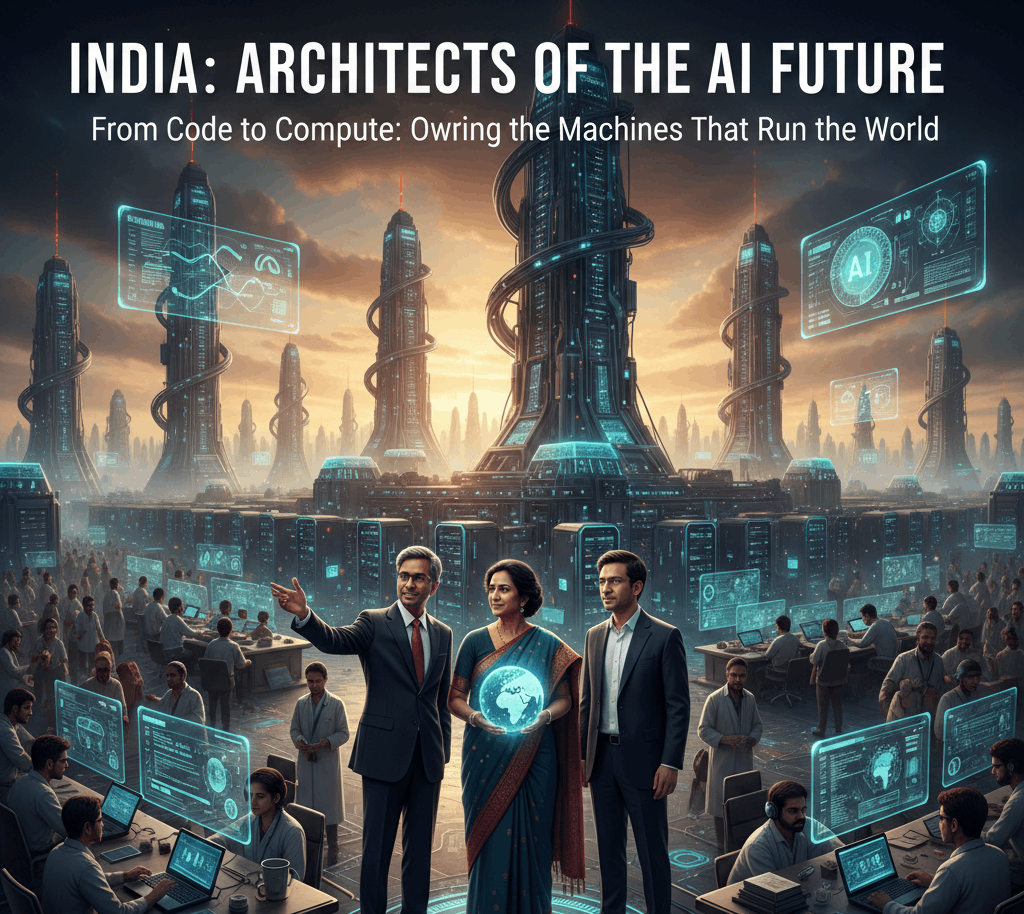
Owning the Servers, Owning the Future: India’s AI Power Play
By: Professor Imran Ismail Chohan

In the coming decade, India does not just aim to write code, it is preparing to pull the entire artificial intelligence ecosystem within its borders. What recently unfolded in New Delhi was not merely an AI conference; it was a clear display of geopolitical and technological ambition. The presence of global tech leaders such as Sundar Pichai, Sam Altman, and Jensen Huang signalled something far bigger than a routine industry gathering. It was a power show, an unmistakable message that India wants to position itself at the very centre of the global AI supply chain.
India’s foundation for this ambition is already strong. Its IT exports have crossed $200 billion annually, and more than five million professionals work in the technology sector. For decades, India has been the world’s back office, providing software services, outsourcing solutions, and technical talent. But now the country is seeking to move beyond service exports toward infrastructure ownership. According to NASSCOM, India’s AI market could exceed $7–10 billion within the next few years while generating hundreds of thousands of high-skill jobs.
The real shift, however, lies not in software talent but in physical infrastructure. Massive investments are flowing into data centres, the factories of the digital age. Corporate giants like Reliance Industries have announced plans to invest over $100 billion in digital infrastructure and data centre expansion over the coming years. Similarly, the Adani Group has outlined long-term investment plans of up to $100 billion, particularly focusing on power-driven data centres capable of supporting high-performance AI computing.
These facilities are not merely buildings filled with servers. They are computer powerhouses what experts increasingly call “compute factories.” When a data centre project reaches gigawatt scale, it creates thousands of direct jobs and tens of thousands of indirect ones. These range from cloud engineers and AI researchers to cybersecurity experts, network architects, and cooling system specialists. In other words, data centres are rapidly becoming the industrial hubs of the 21st century.
Another important consequence is the inflow of venture capital. Global startups prefer to deploy in regions where computing power is abundant, affordable, and reliable. If India successfully builds this ecosystem, it will not only host AI development but also control the economic value generated from it. Recent reports about collaboration between OpenAI and Indian firms on high-capacity data centres potentially involving hundreds of megawatts of compute power suggest that this transformation is already underway.
This strategy reflects a deeper understanding of the modern technological economy. In the early internet era, talent and software skills were the primary drivers of growth. Today, however, the real power lies in compute capacity and capital investment. AI models require enormous processing resources, and those resources depend on energy infrastructure, semiconductor supply chains, and large-scale server networks. Countries that own these systems will ultimately shape the rules of the digital future.

In contrast, Pakistan’s position remains more modest but not insignificant. Its IT exports have reached approximately $3.8 billion, growing annually at a rate of nearly 18–20 percent. Pakistani freelancers also send hundreds of millions of dollars in remittances each year, demonstrating that talent is not lacking. However, most of this activity still revolves around service exports. Pakistani professionals working on foreign clients’ servers rather than operating their own digital infrastructure.
There is, however, a potential turning point. Pakistan has announced plans to allocate around 2,000 megawatts of electricity specifically for AI and data centre development. If this policy evolves into scalable infrastructure projects, the country could emerge as a serious regional player. But if it remains limited to policy papers and announcements without execution, the gap between India and Pakistan will widen further.
History offers clear lessons. After World War II, Japan focused intensely on industrialization and manufacturing, eventually creating global brands that dominate multiple sectors. South Korea followed a similar path by investing heavily in technology and innovation. Both countries succeeded because they moved beyond labour provision to system ownership. They did not merely participate in global supply chains they controlled critical parts of them.
The AI race is unfolding along similar lines. While algorithms and software innovation are essential, they are no longer sufficient on their own. The decisive advantage now comes from controlling compute infrastructure and mobilizing large-scale capital. Whoever owns the servers will not just host data they will host economic power, innovation ecosystems, and geopolitical influence.
In this emerging reality, India appears determined to ensure that it is not just a participant in the AI revolution but one of its architects. The stakes are immense, and the implications extend far beyond technology into global economics and strategic power.
The lesson for the rest of the region is clear: in the age of artificial intelligence, the future will belong not merely to those who write the smartest code, but to those who own the machines that run it.
By Professor Imran Ismail Chohan
Pakistan Extends Airspace Closure for Indian Aircraft


Comments are closed, but trackbacks and pingbacks are open.