
Oil prices jump 13%, top $80 amid Middle East tensions
Oil prices surge above $80 as Middle East tensions threaten supply routes, raising fears of inflation and global economic slowdown.

Oil Prices – (Web Desk) – Crude oil prices surged sharply in Asian markets on Monday as tensions escalated in the Middle East following military strikes by the United States and Israel on Iran. Investors reacted quickly to fears of supply disruptions, pushing energy markets higher at the start of the trading week.
Brent crude futures climbed 13 percent, rising above $82 per barrel compared to Friday’s close of $72. Meanwhile, US benchmark West Texas Intermediate (WTI) crude gained nearly 10 percent, moving past the $70 mark. Brent prices had already been trending upward last week in anticipation of possible conflict.
The growing instability has raised serious concerns about shipping through the Strait of Hormuz, a critical route that carries roughly 20 percent of the world’s oil supply. Although the waterway is not fully shut, reports suggest it is only partially operational, with limited vessels — including some from China and Iran — managing to pass through.
Experts warn that even partial disruption could significantly impact global supply. Higher insurance premiums for ships navigating the area are adding further pressure. Amena Bakr, head of Middle East and OPEC+ research at Kpler, suggested that prices could climb as high as $90 per barrel if tensions continue.
Major shipping companies have already announced they are suspending routes through the strait. Analysts estimate that a full closure could remove between 8 to 10 million barrels per day from global oil markets, creating a major supply shock.
Brent crude jumps $80 a barrel as tensions escalate in the Gulf
Majority of Iran’s sanctioned shipments flow to China
OPEC raises output, analysts cite ‘modest increase’@vidurkat brings you more pic.twitter.com/7uaGzCgfIR
— WION (@WIONews) March 2, 2026
In theory, oil-importing countries have reserves, with OECD members required to maintain 90 days’ worth of oil stocks but prices above $100 cannot be ruled out.

If the blockade of the Strait of Hormuz continues, “no matter how much spare capacity (in the strategic reserves) is not going to fill that gap. That gap is just too big”, said Bakr.
Another analyst at Kpler, Michelle Brouhard, described high oil prices as “the Achilles heel of Trump”.
In her view, Iran is likely to look to keep crude prices high to force Trump to back down, as he promised his electorate low prices, at a time when the United States is already gearing up for mid-term elections at the end of this year.
Gas prices were also expected to soar on Monday, as Qatar is a key exporter of liquefied natural gas, heightening inflationary risks.
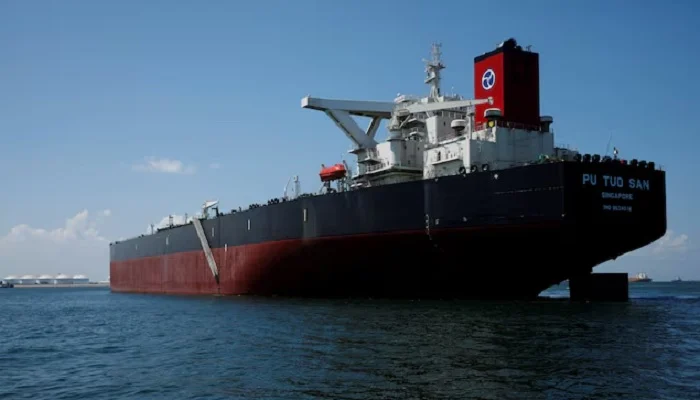
Oil tanker sailing through the Strait of Hormuz as global markets react to rising Middle East tensions.
184 Pakistan Flights Canceled As Middle East Airspace Closes
The last time crude prices climbed above $100 was at the start of the war in Ukraine. Gas prices also soared, which played a major role in a prolonged period of rising prices.
Rising petrol prices, higher energy prices, increased shipping costs and loss of revenue for air transport could have “a harmful effect on growth”, said economist Eric Dor, from the IESEG School of Management in Paris.
“If it’s a matter of three days, it’s not serious. But if it’s over a longer period, then it will have an additional recessionary effect,” he told AFP.

Comments are closed, but trackbacks and pingbacks are open.