

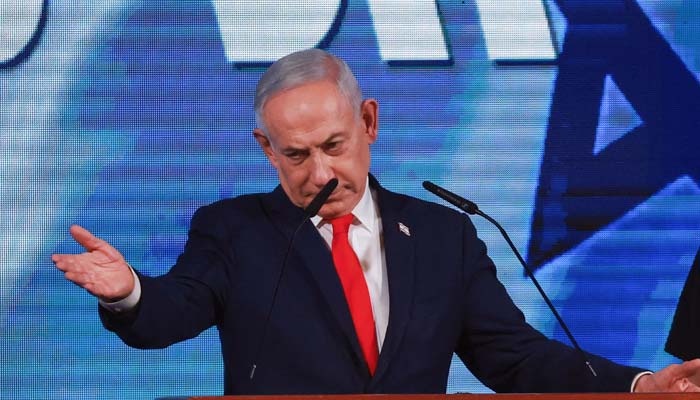
Netanyahu Bloc Falls Short of Majority as Israel Faces Tough Coalition Talks
Likud stays the largest party, but no side reaches 61 seats, and Arab parties may decide who governs next.

Netanyahu – (Special Reporter/Web Desk) – The Netanyahu bloc has finished ahead of its rivals in Israel’s general election, but it is still far from a majority. Final results came out on Friday.
The prime minister’s camp of right-wing and far-right parties won 53 of the 120 seats in the Knesset. A government needs 61 seats to rule.
His Likud party remains the biggest single faction, with 27 seats.
The opposition bloc, led by centrist Gadi Eisenkot, took 48 seats. That is five fewer than Netanyahu’s side.
The Arab parties Raam and the Joint List won 19 seats together. This makes them possible kingmakers in the talks ahead.
With no bloc close to 61 seats, coalition talks could take weeks. If they fail, Israel may have to vote again.
Foreign funding claims
On Thursday, Netanyahu’s camp pushed claims that Arab-Israeli groups took foreign money to sway the vote. No proof has been shown so far.
The claims centre on Raam, which allegedly got cash from Qatar to buy votes. Raam and Qatar both deny this. Qatar called the claims “ridiculous and dangerous.”
Likud called it the “Raamgate scandal” and said the election had been stolen.
Raam leader Mansour Abbas denied any wrongdoing and said he welcomed an investigation. The Joint List said Netanyahu was running a campaign of incitement because he fears the growing power of Arab voters.
Officials try to calm tensions
The Shin Bet security service said it is looking into suspected irregularities. It added that it did not want to blame an entire community that voted lawfully.
The election commission’s acting chief, Dean Livne, said any claim of widespread problems was “entirely groundless.” Police arrested three suspects, but the commission called it an isolated local case.
Opposition fires back
Opposition figures said Netanyahu is trying to cast doubt on the result because he failed to win a majority. Left-wing candidate Yair Golan said he is trying to challenge the outcome.
Eisenkot said it was too early to know if anything happened at all. Even so, he said Likud had started an organised campaign to undermine the result.
What happens next
Joint List head Yousef Jabareen told AFP he is ready to work with the opposition to bring Netanyahu down. However, he said his party would not join a government with it.
Netanyahu, Israel’s longest-serving prime minister, has long faced questions about Qatar. Two of his aides were arrested last year over alleged payments from the Gulf state.
For now, every path to a government looks hard, and the next few weeks will be tense.
Comments are closed, but trackbacks and pingbacks are open.