
Narrative Warfare and Media Diplomacy: Pakistan’s Response to Disinformation During the 2025 India-Pakistan Conflict.
Pakistan successfully counters India’s false narratives in May 2025 conflict, proving the importance of evidence-based media diplomacy worldwide.

By: Nayab Malik
Regional tensions have always been a top headline in International and National media. From Russia- Ukraine issue to Pak-India conflict the world has been witnessing many great challenges and upheavals among nations. The traditional means of war has now been changed to hybrid warfare system. From conventional military and economic tools states now rely on narrative framing and digital communications to influence domestic and International audiences.
The May 2025 conflict between India and Pakistan is one of the prime examples where India beyond the traditional warfare used aggressive narrative building through its expansive media networks, manipulated visuals and unverified claims to shape International opinion against Pakistan. The conflict emerged when about 26 people got shot in Pahalgam and the whole blame was put on Pakistan by India, leading to a war between the two states. India through its fake news tactics tried to damage Pakistan’s International credibility and wanted to lead it to diplomatic isolation through its distorted narratives thus weakening Pakistan’s moral and legal position in global forums.
The main aim of this article is to analyze how Pakistan exposed and countered India’s fake news propaganda and identify key challenges faced by Pakistan in information warfare.
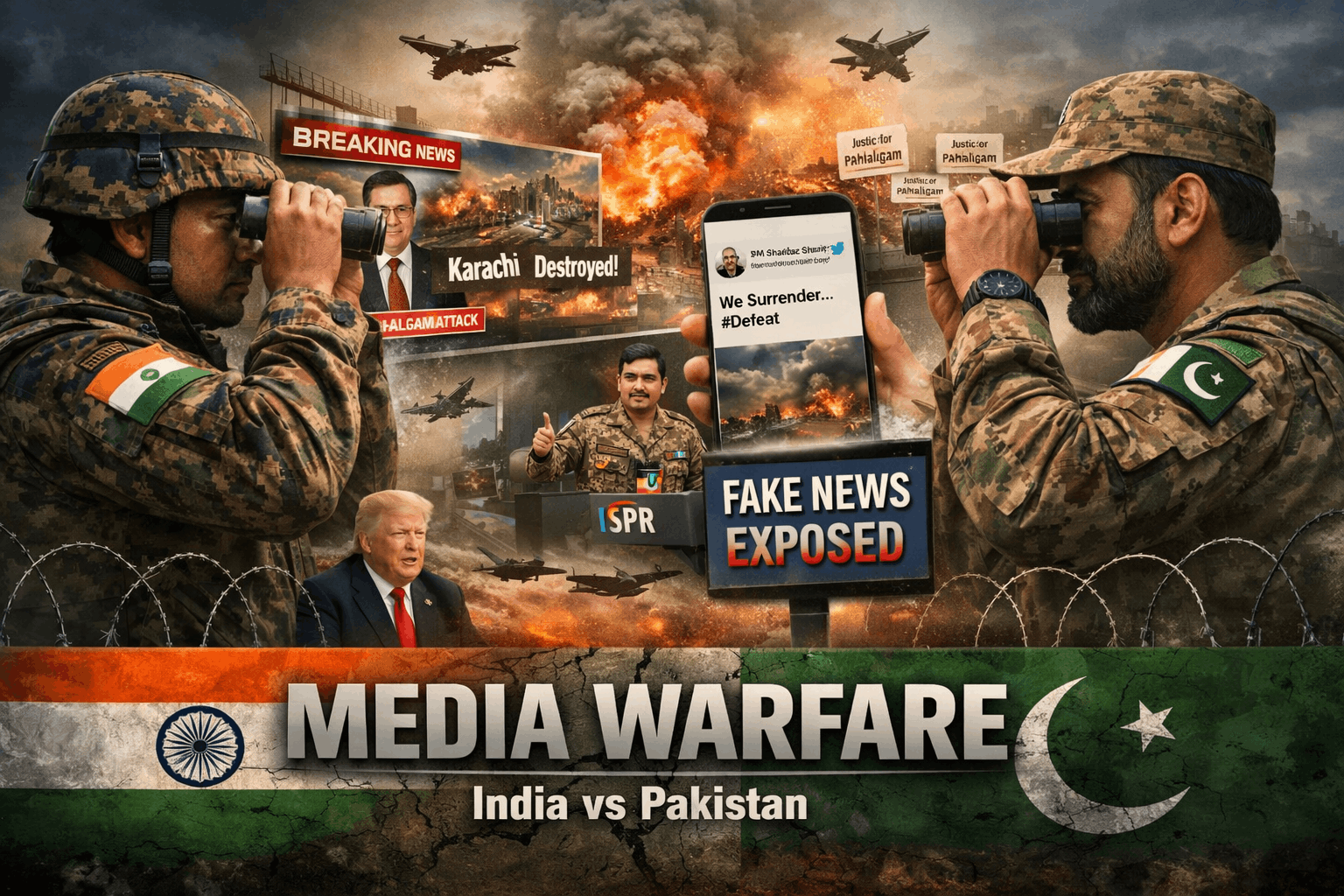
The narrative warfare refers to the construction of strategically crafted stories that influence other states. In case of India the use of disinformation is common thing though it was exposed and uncovered in 2020 as well by the EU Dis info Lab, revealing how India was funding network of fake NGO’s, media outlets, thinktanks to propagate anti Pakistan narrative in Europe. The network operated for over 15 years, highlighting the scale and endurance of India’s influence operations (Jaffar, 2021). The 2019 Pulwama crisis is yet another example where India disseminated unverified claims of Pakistan being involved in the attack. In May 2025 conflict India again used the false propaganda of misinformation and disinformation, accusing Pakistan for the Pahalgam incident. News like India has captured Lahore, destroyed Karachi port, attacked Islamabad, and some news channels also showing that the Rawalpindi Cricket Stadium has been destroyed completely and smoke clouds are rising high in Rawalpindi was featured through various media platforms of India. False AI generated pictures also were made viral by Indian media including some showing fake tweets of PM Shahbaz Sharif accepting defeat, and some showing Indian army taking over Pakistan’s air bases. Indian media channels like Republic TV, Times of India and hashtags like Justice for Pahalgam crafted anti Pakistan narrative. Almost 32% were recycled footages, 16% deep fake and about 48% were spread through social media.

Pakistan’s media diplomacy emphasized a verifiable counter evidence through debunking the doctored images, presenting geolocations, and presenting fact-based arguments thus focusing on a responsible retaliatory strategy. Pakistan countered India’s false discourse-oriented approach by presenting physical evidence and logical arguments. ISPR the media wing of Pakistan’s military, media channels and the social media warriors of Pakistan played a key role in giving the true perspective and debunking myths. Officials of Pakistan provided timely briefings which challenged India’s claims. Pakistan officials repeatedly presented rebuttals to viral images showing attacks on Pakistan. A strong counter narrative was built by Pakistan calling Pahalgam incident a False Flag Operation. The DG ISPR held press conferences and publicly denounced doctored visuals being circulated by foreign outlets and demanded immediate corrections. Media channels gave evidence of recycled footages being used from previous conflicts. Pakistan reliance on facts gave it an upper hand to gain credibility from International platforms. Pakistan didn’t limit itself to domestic media it sent a high-level delegation led by senior leadership to different countries in order to brief them on what Pakistan characterized as India’s False Narrative Campaign. Pakistan internationalized the issue and framed it as a matter of systemic concern rather than just being a bilateral issue. Through cooperation from social media platforms Pakistan achieved its objective to reduce virality of false narratives.
However, Pakistan faced many challenges during this time as India’s much larger media outreach spread false narrative more widely initially as compared to Pakistan’s counter rebuttals. The rapid spread of disinformation outpaced forensic checks. How ever Pakistan managed to have a strong policy against these challenges. It emphasized on evidence-based communications. Statements from US president Trump are some real proofs of Pakistan winning its stance. There exists a dispute about the number of planes shot down by Pakistan during the May 2025 conflict but President Trump has at least 25 times cited claims that five to seven planes were shot down during the conflict. These remarks have helped validate Pakistan’s stance and improved its position in the global diplomatic arena.
Pakistan’s 2025 campaign has confirmed that media diplomacy is now the core foreign policy instrument to mitigate escalations. The reference to the prior patterns of India spreading false narrative helped Pakistan’s media to contextualize the Pahalgam episode as the continuation of previous patterns. It is important to uphold ethical journalism standards where media organizations should focus on fair and responsible editorial policies. A digital forensic and rapid response cell should be established that can immediately collect, verify and publish counter evidence. Pakistan should also pursue formalized agreements with social platforms for expedited reviews during crisis and advocate with international partners to counter false narratives.
Pakistan urges immediate ceasefire as Russia-Ukraine tensions rise
The 2025 conflict shows a structural transformation of warfare among states. Pakistan’s media diplomacy in exposing India’s false tactics represents a defensive but an important evolution in the foreign policy behavior representing both systematic pressure and ideational contestation in the International arena. If we look into the foreign policy analysis, then Pakistan’s response was rational and was a security driven necessity. Indian media’s black propaganda and selective reporting has been professionally handled by Pakistan’s media outlets through evidence based and logical arguments.
The writer is a student at National Defence University pursuing a career in International Relations.
Comments are closed, but trackbacks and pingbacks are open.