
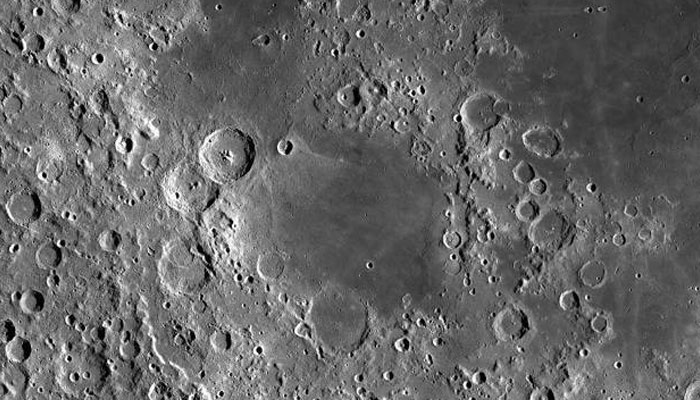
Moon Impact Rates Confirmed, Unified Lunar Timeline Established
Scientists Confirm Uniform Moon Impact Rates, Revise Lunar Chronology

BEIJING (Web Desk) – Scientists have made a major breakthrough in understanding the moon’s history by confirming that impact cratering rates on both its near and far sides are largely the same, paving the way for a single, globally consistent lunar timeline.
The research, led by the Institute of Geology and Geophysics at the Chinese Academy of Sciences, found that asteroid and meteorite impacts on the moon declined steadily over billions of years, rather than occurring in sudden, dramatic bursts as previously thought. The study was published in Science Advances.
For decades, lunar surface ages were estimated by counting craters, relying almost entirely on near-side samples collected during NASA’s Apollo missions. This left key questions unresolved, including debates over a possible spike in early impacts known as the Late Heavy Bombardment.

Riphah University, MSTF partner to boost research and innovation
The uncertainty decreased after China’s Chang’e-6 mission returned 1,935 grams of lunar material from the South Pole-Aitken Basin on the moon’s far side in June 2024. Samples included young basalt around 2.8 billion years old and ancient norite dating back 4.25 billion years, formed after the massive basin-forming impact.
By mapping crater densities at the Chang’e-6 landing site and integrating data from NASA’s Apollo missions, the Soviet Luna programme, and Chang’e-5, researchers developed a revised lunar impact timeline. Their analysis confirmed that crater densities on the far side align closely with those on the near side, showing that impacts were evenly distributed.
Lead author Yue Zongyu said, “The results demonstrate that the impact flux was essentially uniform over the entire lunar surface. This provides a solid foundation for establishing a unified global lunar chronology.” The updated timeline is expected to improve age estimates not only for the moon but also for other planets and moons across the solar system.

Comments are closed, but trackbacks and pingbacks are open.