

“U.S. Tilt Towards Pakistan Undermines India’s Position, Analysts Warn”
Modi skips Trump visit fearing talks with Munir

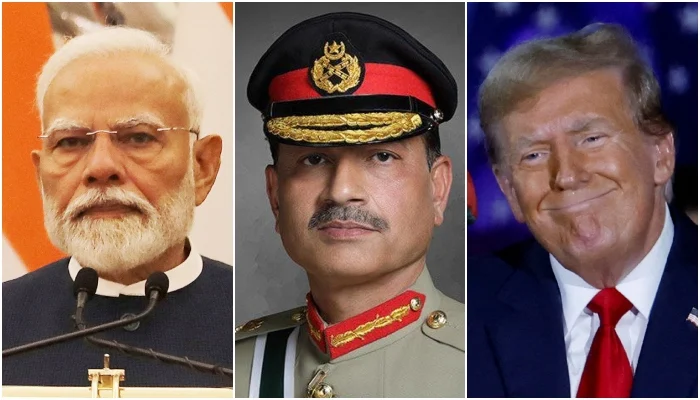
Washington/Islamabad (Special Correspondent/Web desk)A recent report from Bloomberg suggests that Indian Prime Minister Narendra Modi’s decision to forgo a meeting with U.S. President Donald Trump in June was influenced by a concern over a potential encounter with Pakistan’s army chief, Field Marshal Asim Munir.
The American publication, citing sources in New Delhi, claims that Modi’s reluctance stemmed from a fear that Trump might attempt to orchestrate a meeting between the two military and political figures if they were present at the White House simultaneously. This alleged diplomatic avoidance comes amid heightened tensions between India and Pakistan following a recent conflict, and as Trump’s administration re-engages with Pakistan, a move viewed with concern in New Delhi. The report has been seized upon by opposition leaders in India, who argue it exposes the fragility of Modi’s “special relationship” with the U.S. president.
While India was comfortable with Trump meeting Pakistan’s civilian leadership, hosting Field Marshal Munir was viewed as a setback to the Indian narrative.
The report stated that the episode unfolded in the weeks after India and Pakistan agreed to a ceasefire in May following a four-day conflict.
Modi rejected White House lunch invitation with Trump.
Tensions between Modi and Trump grew after the US president repeatedly spoke about how he prevented a nuclear war — an assertion that India rejected, insisting the ceasefire was agreed upon directly between the two nations.
The tensions came to a head in a June 17 phone call with Narendra Modi, which was held after Trump left the Group of Seven summit in Canada early and couldn’t meet the Indian leader in person.
In the 35-minute phone call with Trump, Modi insisted that the two nations had directly discussed a ceasefire upon Pakistan’s request following a bombardment by India.
Modi said India “does not and will never accept mediation,” according to an Indian readout, adding that Trump “listened carefully.”
Modi felt like he needed to set the record straight in the call after his aides discovered that Trump planned to host a lunch the following day at the White House for Pakistani Army Chief Asim Munir, according to officials in New Delhi familiar with the matter, who requested anonymity to speak about confidential discussions.
India bristled at Trump’s ceasefire mediation claims.
This information prompted the Indian leader to turn down an invitation to stop in Washington on his way back from Canada. Modi instead continued with a planned visit to Croatia.
According to the report, ties between Washington and New Delhi deteriorated sharply after the incident.
Trump began publicly criticising India, later threatening a 50% tariff on Indian exports to the US, and slamming the country’s trade barriers and economic performance. Following up on his threat, he did impose those tariffs.
Modi and Trump have not spoken since their June phone call.
Field Marshal’s second US visit
The Bloomberg report follows a foreign media report on Thursday that COAS Munir is set to visit the United States this week, marking his second trip in under two months.
According to reports, the Army chief will attend US Central Command chief General Michael Kurilla’s retirement ceremony, who was awarded the Nishan-e-Imtiaz (Military) by President Asif Ali Zardari during his recent visit to Pakistan on 26 July.
However, no official confirmation has been given regarding any other engagements during the visit.
Field Marshal Munir last visited the US in June, where he held a rare one-on-one meeting with Trump at the White House Cabinet Room. The meeting was also attended by US Secretary of State Senator Marco Rubio, US Special Representative for Middle Eastern Affairs Steve Witkoff, and Pakistan’s national security adviser.
The June visit took place against the backdrop of an armed Pakistan-India conflict, during which Washington helped broker a ceasefire following Indian strikes inside Pakistan, which New Delhi claims targeted those responsible for the Pahalgam attack in Indian Illegally Occupied Jammu and Kashmir (IIOJK).
‘Asim Munir’s meeting with Trump was Turning Point for South Asian Diplomacy’: The Economist
Pakistan responded with Operation Bunyan-um-Marsoos, downing multiple Indian fighter jets. The short but intense conflict involved cross-border strikes and resulted in civilian and military casualties on both sides.
During the White House meeting, the COAS praised Trump’s “constructive and result-oriented role” in facilitating the ceasefire with India, while the US president commended Munir’s leadership during a period of complex regional dynamics.
Discussions, which extended to over two hours, also covered the then-worsening Iran situation and explored opportunities to expand cooperation in areas including trade, economic development, mines and minerals, artificial intelligence, energy, cryptocurrency, and emerging technologies.
The visit was followed by a breakthrough in bilateral economic relations. Pakistan and the US reached a long-awaited trade agreement during a meeting between Finance Minister Muhammad Aurangzeb and the US Secretary of Commerce and Trade Representative.
Under the agreement, a 19% reciprocal tariff was imposed on Pakistani exports to the US, paving the way for a fresh start in economic cooperation between the two countries.


Comments are closed, but trackbacks and pingbacks are open.