

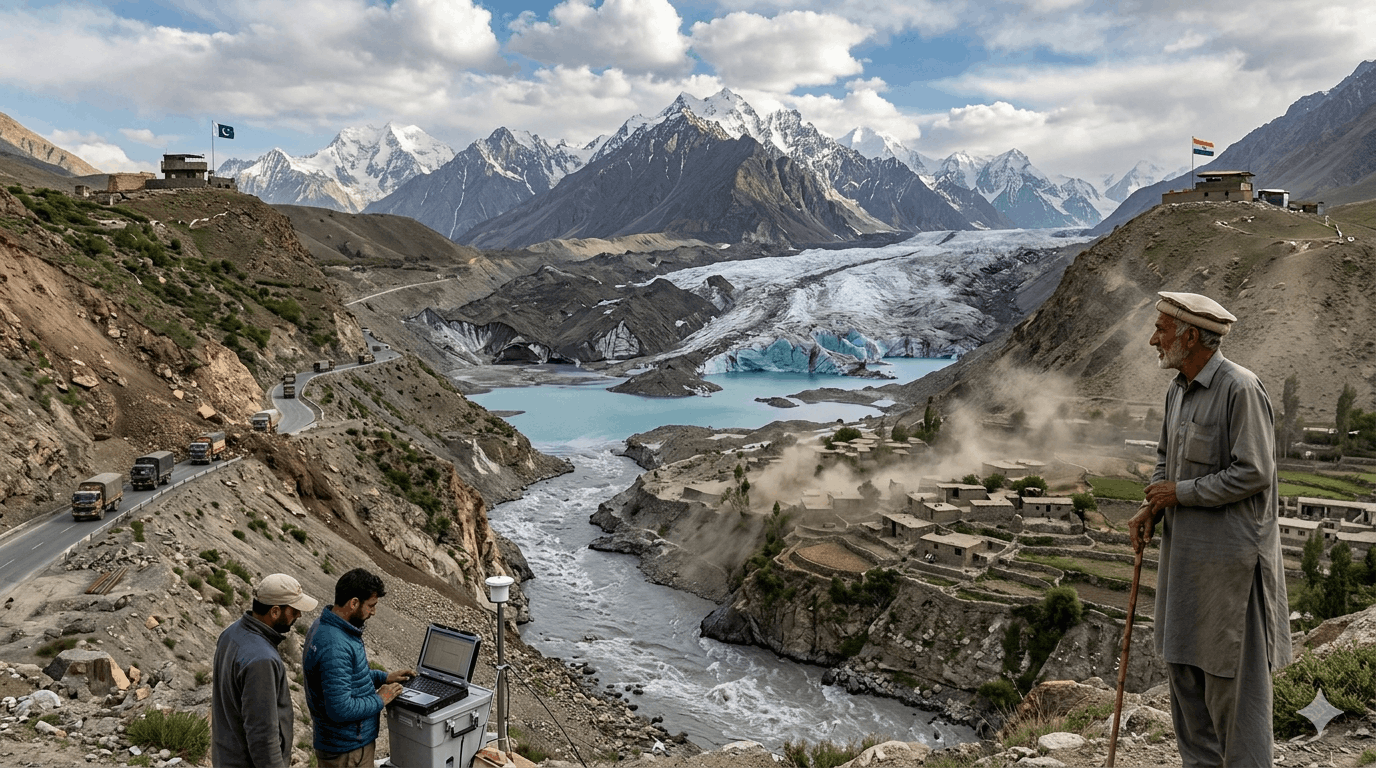
Melting Frontiers: Glacial Retreat and the Emerging Security Risks along the Pakistan–India Border
Melting Glaciers in Northern Pakistan Threaten Millions With Floods and Water Crisis

One of the greatest concentrations of glaciers outside of the polar areas is found in Gilgit-Baltistan in northern Pakistan. The glaciers located in Hindu Kush, Karakoram, and the Himalaya mountain ranges serve as important freshwater storage and supply the Indus River basin and ecosystems, agriculture, hydropower, and human beings down the river. The scientific evidence shows that the increased melting of these glaciers is directly related to the increase in the temperature of the regions as well as the change in the climatic patterns, which have a profound effect on the high-altitude processes of the cryosphere and have far-reaching humanitarian and strategic impacts.
Scientific and government reports indicate that over 3044 glacial lakes are created in Gilgit-Baltistan and Khyber Pakhtunkhwa because of the ongoing melting of glaciers. Out of these 33 have been listed as high-hazard lakes capable of causing Glacial Lake Outburst Floods (GLOFs). Such floods are caused by natural moraine dams which are made up of glacial debris and fail suddenly to contain huge amounts of water and sediment in a very short period of time, and cause extensive destruction in the downstream. The Pakistan Meteorological Department has been sounding alarm after alarm of increased glaciers melting due to increased temperatures in summer and in some places the temperatures have been up to 79 C higher than the normal temperature. These anomalies have also been increasing the pace of melting and are the cause of the rapid increase and instability of glacial lakes.
These developments have a large humanitarian and environmental impact. The evidence provided by the national adaptation programs shows that over 7.1 million individuals in Gilgit-Baltistan and Khyber Pakhtunkhwa are at risk of GLOF. This weakness is also enhanced by the inadequate infrastructure, financial situations, and the lack of access to the early warning systems. Field studies and records of disasters indicate that there is a growing number of hazards of the cryosphere, such as landslides and flash floods. During the summer of 2025, various such events have occurred in the northern part of Pakistan due to accelerated glacial melting accompanied by heavy monsoon rainfall that claimed at least 72 lives and injured more than 130 people. There were also reports of unprecedented temperature rises with maximum temperatures of 48.5o C in some regions further hastening the melting of the glaciers and making glacial lakes even more unstable.
According to local-level studies in localities like Ghizer and Ishkoman, it is usually the communities that have an understanding of the dangers of GLOFs; nevertheless, there is no adequate evacuation planning and adaptive infrastructure. This is an indication of lack of coordination between institutional preparedness and hazard awareness. Simultaneously, the ongoing depletion of glacial mass is a long-term problem to water security. Although the short run effects include the risk of flooding because of the excessive melting of the glaciers, the long run effects may include the water being limited as the glaciers will no longer be able to control seasonal flows in a predictable way.
The effects of glacial melting are not limited to environmental and humanitarian issues but also to the field of geopolitics and border security. Gilgit-Baltistan is a strategically sensitive area on the Pakistan-India frontier especially around the disputed areas like the Siachen Glacier. These high-altitude regions are changing the environment, which has a direct impact on border operations, military deployments and strategic infrastructure. The melting of the glaciers and the creation of unstable lakes also change the level of terrain stability, which influences the provide and accessibility of logistics, movement routes, and placement of defense forces. Shifting rivers, landslides and flash floods may hinder supply routes, patrol routes and infrastructure like Karakoram Highway as a major conduit of civilian and military logistics.

Even though Pakistan and India do have some limited cooperation under agreements like the Indus Water treaty, there is no formal communication channel concerning hazards caused by climatic conditions like GLOF. With a high tension border setting, any sudden natural occurrence close to sensitive locations can be misunderstood and thus more chances of misunderstanding and escalation are likely to arise. Also, glacial melting affects the hydrological cycles of transboundary rivers. Such asymmetrical warming patterns in the Himalaya-Karakoram region have caused at least 388 reported GLOF events in the last few decades, and the number of glacial lakes is further growing. Although the high meltwater can solve the problem of river discharge in the short term, the long-term loss of glacial mass would cause a decrease in summer flows, which would further burden water-sharing agreements and hydropolitical relationships in the region.
Pakistan Navy rescues 18 crew members, including foreign nationals
To address these issues, scientists, and organizations are coming up with more sophisticated instruments to enhance monitoring and predictive provisions to glacial risks. New datasets like GLOFNet can combine satellite images, measurements of glacier velocity, measurements of surface temperature and are better able to detect and predict possible GLOFs. In the same manner, machine learning-based systems like the IceWatch enable automated processing of spatial and temporal information to enhance the early warning systems in remote and high-altitude areas where the traditional monitoring is still minimal. The institutional response to the problem in Pakistan encompasses such initiatives as those sponsored by the United Nations Development Programme and the Green Climate Fund, especially such a project as Scaling-up of GLOF Risk Reduction (GLOF-II) that consists in enhancing the effectiveness of early warning systems, enhancing infrastructure resilience, and facilitating the involvement of communities in disaster risk management in the regions at risk.
Spatial and temporal analysis are used in risk assessment research such as the one carried out in Hunza Valley to determine the zone of high risk and downstream exposure. These results indicate that risk is dynamic and changes with the varying glacier behavior, climate variability, and land use patterns. The fact that Pakistan is among the nations that have experienced the greatest impact of climate change only serves to highlight the importance of the current focus on the cryospheric hazards, in a holistic approach. Increasing the preparedness of the civilian and security stakeholders can be achieved by strengthening the early warning systems associated with real-time monitoring. Moreover, the scientific collaboration between Pakistan and India in the field of climate-related risks would decrease the risk of misunderstanding in the case of sudden environmental processes and help to manage the crisis in the high-altitude regions of the border more successfully.
The glacial melting that is gaining pace in Gilgit-Baltistan in terms of glacier withdrawal, the growth of glacial lakes, and the amplified GLOF threats is a complex issue with environmental, humanitarian, and strategic aspects. The instability of the cryosphere has direct threats to infrastructure, population centers, and strategic routes, which are vital to defense-related national interests and economic connectivity. To manage such challenges, it is necessary to take a comprehensive measure that includes climate science, hazard surveillance, and strategic planning to be able to provide long-term stability and resilience in this geopolitically sensitive area.

Comments are closed, but trackbacks and pingbacks are open.