
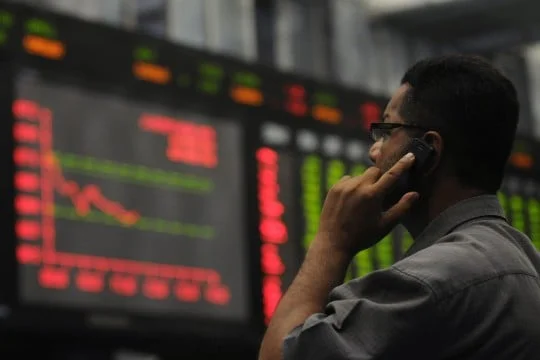

Pakistan Stock Market – (Web Desk) – Pakistan’s stock market is having a rough week. The KSE-100 selling pressure today pushed the benchmark index lower for the fourth day in a row on Thursday, as investors grew more nervous about rising oil prices and the worsening situation in the Middle East. Early in the trading session, the KSE-100 dropped by more than 3,200 points — a sharp and painful fall that rattled many traders. By 10:20 in the morning, the index had clawed back some of those losses and was sitting at 162,929.02 points, still down by 2,894.78 points, or about 1.78 percent.
Out of 560 companies trading at that point, only 85 managed to go up. A whopping 333 were in the red, and 142 stayed flat. That tells you just how widespread the selling was — it wasn’t just a few big names dragging things down. The whole market felt it.
Which Sectors Got Hit the Hardest?
Almost every major sector took a beating. Automobile assemblers, cement companies, commercial banks, oil and gas exploration firms, oil marketing companies, and power generators all saw heavy selling. Big, well-known stocks like HUBCO, MARI, OGDC, POL, PPL, MCB, MEBL, and UBL — the kind of names that carry a lot of weight in the index — all closed in negative territory.
This wasn’t just a Thursday problem. On Wednesday, things were already looking bad. Poor corporate earnings results, weakness in heavyweight stocks, and anxiety over oil prices and geopolitical tensions had already sent the index tumbling 2,588.35 points, or 1.54 percent, closing at 165,823.88 points. So Thursday’s selloff came right on the heels of another painful day.
Why Is Everyone So Nervous?

The main reason behind all this caution is the ongoing conflict in the Middle East. The situation there has reached a deadlock, and that uncertainty is keeping global oil prices elevated. For a country like Pakistan that imports a large amount of oil, higher prices mean higher costs across the board — for businesses, for consumers, and for the government’s budget. Investors hate uncertainty, and right now there is plenty of it.
What Is the Government Saying?
The Finance Minister recently tried to calm things down a bit. He said that financial support from Saudi Arabia has helped stabilise Pakistan’s external accounts, meaning the country is in a better position and does not urgently need financial help from other friendly nations as much as before.
He also hinted that Pakistan is moving away from relying on bilateral loans and is instead looking at commercial borrowing. One major plan on the table is raising $250 million through a Panda bond — a type of bond issued in China’s market in Chinese currency — which is expected to happen next month. This would be a significant step for Pakistan, showing it is trying to access new and broader financial markets rather than depending on the same traditional sources of funding.
Will Things Get Better?
That depends a lot on what happens in the Middle East and how oil prices move in the coming days. If tensions ease and oil prices come back down, investor confidence could return fairly quickly. But if the conflict drags on and prices stay high, the pressure on the stock market is likely to continue.
For now, most traders and investors are taking a careful, wait-and-see approach. Until there is clearer news on the global front, big moves into the market feel too risky for many people.
Comments are closed, but trackbacks and pingbacks are open.