
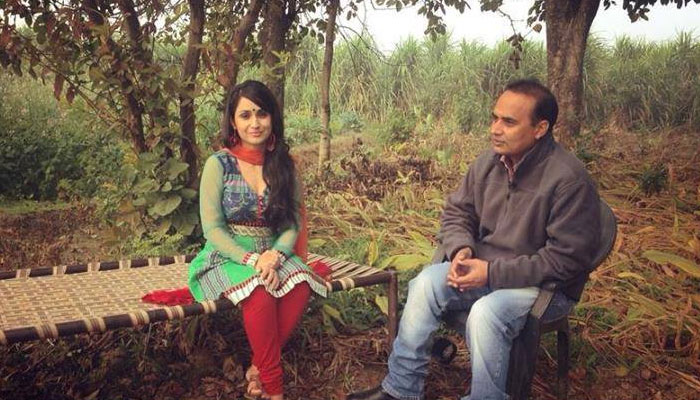

Writer: Ajmer Sidhu

ُاچیاں لمیاں پپلیاں سُوہے ساوے پّت
نِکی جیہی اک چِنک اس کھلواڑے دتی گھت
The remarkable short story collection “Khusk Akh Da Khwab” is written by the renowned young Punjabi writer Ajmer Sidhu, who hails from East Punjab, India. Originally penned in Gurmukhi, this powerful literary work has now been recently published in Shahmukhi script by Kitab Trinjan, Lahore — a tremendous contribution for Punjabi readers on both sides of the border. This initiative not only bridges the script divide but also deepens the shared literary and cultural heritage of Punjab
Ajmer Sidhu, a young and emerging writer, was born on May 17, 1970, in Jaffarpur — the village of the great freedom fighter Bhagat Singh. His roots in this revolutionary land make him a true patriot, and through his writings, one can feel his deep love for the soil and his unwavering commitment to truth.Ajmer Jee rose to fame quickly as his story collections were published one after another. His debut collection, Nachketa Di Maut, appeared in 1998, followed by Khoo Gurh Da in 2004, Khusk Akh Da Khaab in 2013, Shaayad Rumi man Jaaye in 2016, and Rang Di Baazi in 2018 — each gaining tremendous appreciation and strengthening his place in Punjabi literature.
In recognition of his literary work , he received numrous local awards and was honored with an international fiction award from California in 2004.
In my view, Ajmer Jee has truly won the hearts of his readers — and that is the most meaningful award, given by the people themselves. His fiction writing carries a unique style, marked by well-woven storylines, strong characters, and powerful dialogues. He has a rare gift for creating spontaneous, emotionally charged scenes that touch the heart deeply. Each sequence feels authentic and heartfelt, leaving a lasting impact on anyone who reads his work.
Khushk Akh Da Khaab is not just a conventional storybook — it is a powerful and thought-provoking work that directly addresses the dilemmas of today‘s young generation. It emphasizes their right to choose their own path toward success while shedding light on the often-misguided parenting that reduces children to mere money-making’ machines. Through his stories, Ajmer Sidhu educates both youth and parents, suggesting that the roots of a child’s rebellion or rude behavior often lie in the unrealistic expectations and emotional neglect of the parents themselves.
In this remarkable collection, Ajmer Sidhu challenges outdated religious and social myths, exposing the roots of injustice and oppressive thinking. With boldness and clarity, he introduces fresh perspectives and openly addresses political concerns, breaking away from traditional silence. His stories also give voice to the countless issues emerging in contemporary society — from the shifting dynamics of relationships to the broader socio-political changes shaping our world. Through his fearless storytelling, he not only questions the status quo but also reflects the unrest and transformation of the modernage.
Among the core themes in Ajmer Sidhu‘s stories are pressing economic issues — including the aggressive intrusion of capital, the unchecked rise of media sensationalism, the blind domination of the corporate sector, and the growing influence of artificial intelligence. He thoughtfully explores how these forces are reshaping the consciousness of the common Punjabi. Rather than addressing these issues through lectures or essays, he skillfully weaves them into the fabric in his story telling .
In the opening story of the collection, Shaayad Rumi Mann Jaaye, Ajmer Sidhu expresses his deep love for his homeland, Punjab. Through this powerful narrative, he pays heartfelt tribute to two legendary freedom fighters — Bhagat Singh and Sukhdev Singh — who were martyred in the struggle for India‘s liberation from British rule. The story stands as a profound reflection on patriotism, sacrifice, and the undying spirit of revolution that continues to inspire generations.
One of the most impactful stories in the collection is Qabar Ch Dafan Hazaar Wera, which I deeply appreciate for its courageous treatment of a painfully sensitive subject. In this story, Ajmer Sidhu unveils the harrowing experience of a girl who is raped by a man in a research lab — a space that should symbolize knowledge and safety. Through this narrative, he fearlessly exposes the moral decay within society and challenges the silence surrounding such crimes.
Another standout story in the collection is Ivan Ilyich Di Dooji Maut, which I personally found most captivating. Inspired by Leo Tolstoy‘s classic novel The Death of Ivan Ilyich, this story carries forward the existential and philosophical depth of the original, but with a Punjabi soul.
Ivan Ilyich Di Dooji Maut* tells the story of a successful, lively engineer whose life takes a tragic turn when he learns he is suffering from AIDS — a disease still surrounded by fear and stigma. Ajmer Sidhu reinterprets the narrative, the protagonist is now abandoned and shunned — no one touches him, no one Comforts him. The true tragedy unfolds not just in the illness, but in the cruel isolation he faces. It’s a painfully realistic depiction of how a person is made to ‘meet death before actual death .
Another favorite of mine is Balde Chiragh — a poignant and unforgettable story centered on a woman who lost her family and homeland during the tragic Partition of Punjab. Though she marries a non-Muslim and settles into a new life, the faith she was born into remains alive in her heart. Ajmer Sidhu delicately captures the emotional world of such women — torn between past and present, motherhood and memory. They raise children in a new land, but never forget their loss. It is not merely a story of migration or interfaith marriage — it‘s a powerful representation of the human cost of Partition. When Punjab was divided in 1947, it wasn’t just land that was torn apart — it was hearts, homes, and histories. Balde Chiragh reminds us that the people of Punjab may have been split into two nations, but emotionally, they still share one heart.
According to Ajmer jee “the khushk Akh Da Khaab “in his vision of a peaceful , united and vibrant Punjaab ,a land where fields continue to flourish , rivers continue to flow and people continue to live in harmony regardless to religion , class or politics .
Highly recommended to all book lovers who cherish stories combine truth with tenderness , realism with resistance.It is not just a book , it is a mirror of our society .
Analyses by
Tallat Naveed
Tallat.humayun.123@gmail.com


Comments are closed, but trackbacks and pingbacks are open.