
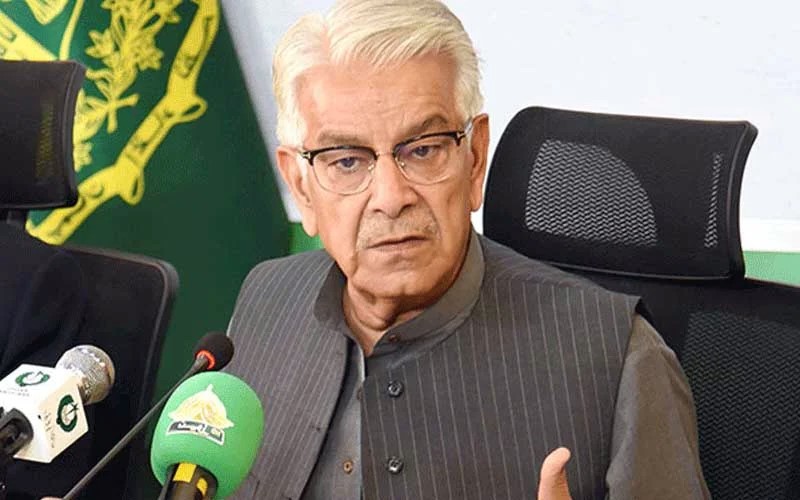
Khawaja Asif Defends Kashmir Remarks, Praises PM’s Reconciliation Efforts and IPP Reforms
he minister warned against what he termed “externally driven agendas”

ISLAMABAD: (Web Desk) – Federal Defence Minister Khawaja Muhammad Asif on Tuesday strongly defended his recent remarks regarding the situation in Azad Jammu and Kashmir (AJK), reaffirming Pakistan’s unwavering commitment to the Kashmir cause while also lauding Prime Minister Shehbaz Sharif’s efforts to promote political reconciliation and strengthen democratic traditions in the country.
In a statement posted on social media platform X, the defence minister said his comments on the crisis in AJK were made with honesty and sincerity and should not be misrepresented by those pursuing vested interests.
“My remarks about the crisis in AJK were frank and honest. Those with sinister agendas may attempt to twist them, but they cannot separate Kashmir from Pakistan or Pakistan from Kashmir,” he stated.
Khawaja Asif emphasized that the historic sacrifices of Kashmiris remain deeply embedded in the collective memory of the nation. He recalled the migration of Kashmiris to Pakistan in October 1947 and paid tribute to generations of Kashmiris who have struggled against Indian occupation in Indian Illegally Occupied Jammu and Kashmir (IIOJK).
Khawaja Asif slams LESCO over Rs 80,000 Transformer Repair Charge
He described the Kashmiri freedom movement as a long saga of sacrifices, martyrdom and imprisonment spanning nearly eight decades. He said Pakistan’s support for the Kashmir cause is reflected not only in its diplomatic position advocating the right to self-determination under United Nations resolutions but also in the sacrifices made by Pakistani martyrs during various conflicts.
The minister warned against what he termed “externally driven agendas” aimed at creating divisions between Pakistan and Kashmir. He said voices emerging from AJK that undermine Pakistan’s role or diminish the sacrifices made for the Kashmir cause must be firmly challenged.
According to Khawaja Asif, the people of AJK, who have lived in peace and security for decades, should recognize the sacrifices of Kashmiri migrants and those living under occupation in IIOJK. He argued that diminishing these sacrifices amounts to weakening the broader Kashmir cause.
“In my humble opinion, Kashmiriat is defined by the sacrifices and struggles waged over almost eight decades by Pakistanis, including Kashmiris and others, rather than by birth certificates,” he remarked.
Later, speaking on the floor of the National Assembly, the defence minister highlighted Prime Minister Shehbaz Sharif’s efforts to foster political dialogue and consensus-building, describing them as the foundation of a new democratic culture in Pakistan.
He said the prime minister was setting new democratic traditions both within Parliament and across the country by encouraging political engagement and reconciliation. Khawaja Asif urged opposition parties to respond positively to these initiatives and participate constructively in the democratic process.
The minister also credited Prime Minister Shehbaz Sharif and Field Marshal Syed Asim Munir with enhancing Pakistan’s stature and credibility at both national and international levels, urging lawmakers to acknowledge their contributions beyond political affiliations.
Referring to recent efforts to address challenges in the energy sector, Khawaja Asif highlighted the government’s success in renegotiating agreements with Independent Power Producers (IPPs), calling it one of the most significant economic achievements of the current administration.
He said the government had secured approximately Rs3.5 trillion in relief over the remaining lifespan of the power purchase agreements, reducing a major financial burden on consumers and the national economy.
The defence minister noted that concerns regarding IPP contracts could not be attributed to any single government, as multiple administrations over the past three decades, including the PTI government, had played a role in signing, continuing or managing these agreements.
He explained that most IPPs were established during the 1990s and the early years of General (Retd) Pervez Musharraf’s government to address severe electricity shortages. Capacity payments, he said, were introduced as incentives to attract private investment into the power sector by guaranteeing returns even when generation capacity remained unused.
Khawaja Asif acknowledged that previous governments had also attempted to renegotiate the contracts but were unable to secure meaningful concessions. He maintained that the current government’s success in obtaining substantial financial relief deserved recognition and should not be overlooked by critics.
The minister urged parliamentarians to adopt a balanced and responsible approach in political debates, emphasizing the importance of acknowledging both achievements and shortcomings across different governments.
He reiterated that the government would continue efforts to further reduce the burden of power sector liabilities through continued negotiations and reforms while simultaneously promoting political harmony and democratic stability across the country.
Comments are closed, but trackbacks and pingbacks are open.