
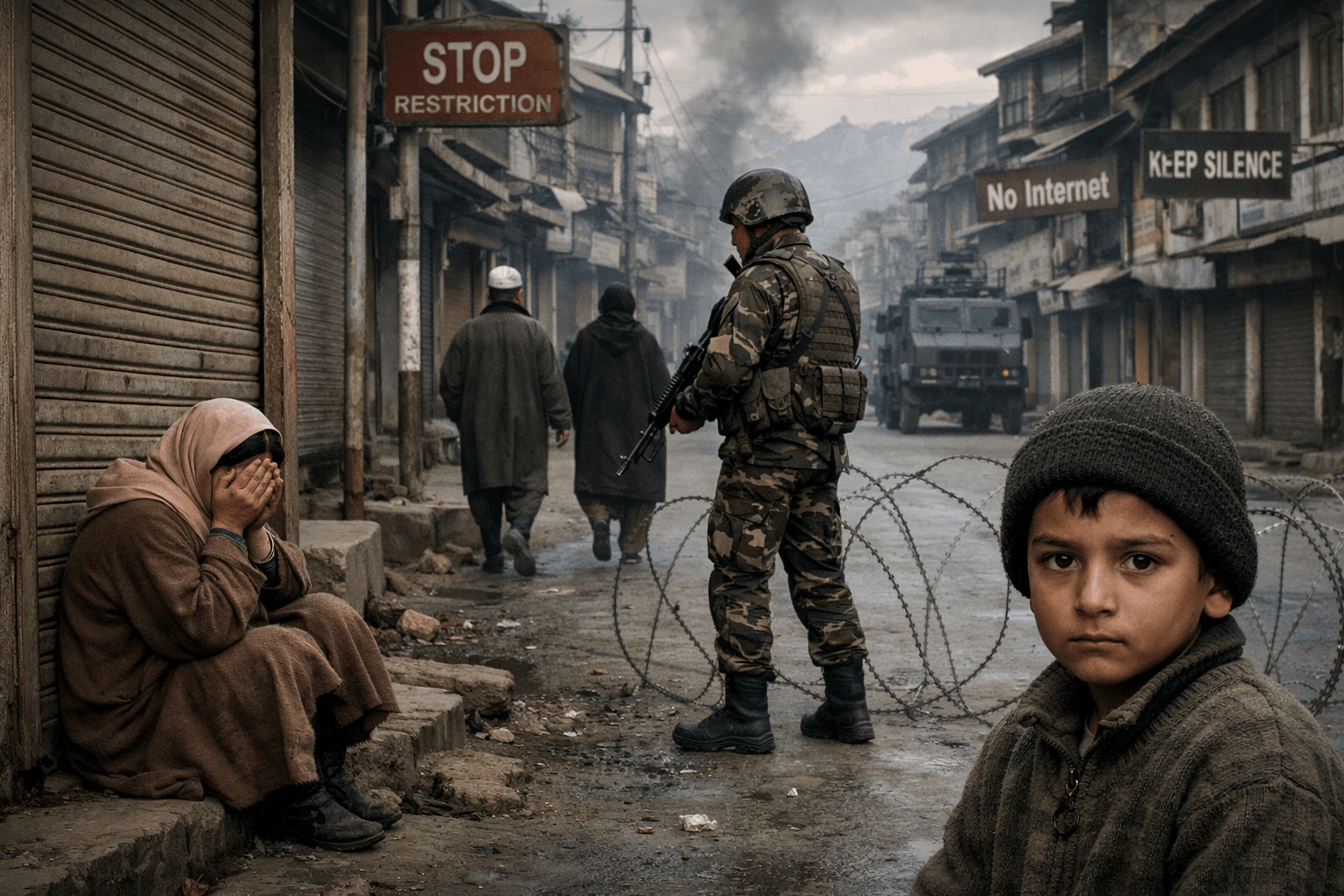

Srinagar(Web Desk/ Our Correspondent)Dr. Irfan Khan, Spokesman of the Jammu and Kashmir Salvation Movement (JKSM), has said that India’s Republic Day celebrations stand in sharp contradiction to the political reality imposed on the people of Indian Illegally Occupied Jammu and Kashmir (IIOJK), where constitutional guarantees, civil freedoms, and democratic consent have been systematically dismantled.
In a statement issued today, Dr. Irfan Khan said that a republic derives legitimacy from the will of its people, not from military presence or enforced compliance. “In Kashmir, governance is sustained through laws of exception, mass surveillance, Extra Judicial Killings, and fear, not through public consent. Celebrating a republic while denying an entire population Right to Self Determination exposes a deep moral and constitutional failure,” he remarked.
He stated that Kashmir has been converted into a laboratory of coercive governance, where emergency laws, arbitrary detentions, and engineered silence have replaced democratic institutions. The continued use of preventive detention, restrictions on political activity, and criminalization of dissent, he said, reflects an administrative structure designed to control territory rather than represent people.
Young Cricketer Najam Naseer Kiani from Azad Kashmir Achieves International Honor
Dr. Irfan Khan emphasized that the erosion of rights in Kashmir did not occur overnight but is the outcome of decades of policy decisions that disregarded international commitments and local aspirations. “India’s own founding leadership acknowledged that the future of Jammu and Kashmir was to be determined by its people. The abandonment of that principle has left a permanent stain on India’s democratic claims,” he said.

He added that the situation has further deteriorated since August 2019, with the removal of Kashmir’s political safeguards ; by revoking articles 370 and 35A, large-scale arrests, and the exclusion of Kashmiris from decision-making processes affecting their land, resources, and identity. According to him, these measures have widened the gap between constitutional rhetoric and lived reality.
Describing the Kashmiri struggle as one rooted in political rights rather than hostility, Dr. Irfan Khan said that the demand for self-determination is neither extremism nor defiance but a legitimate aspiration recognized under international law. “Suppressing this demand through force only deepens alienation and prolongs instability,” he noted.
He urged the international community, particularly democratic states and human rights institutions, to critically examine the disconnect between India’s global image and its conduct in occupied Kashmir.
“Selective silence undermines the very principles of democracy and human rights that the world claims to uphold,” he warned.
Dr. Irfan Khan concluded by stating that peace in South Asia cannot be achieved by managing dissent but by addressing its root cause. “A lasting resolution requires acknowledging the political will of the Kashmiri people and creating conditions for a just and peaceful settlement in accordance with international commitments,” he said.

Comments are closed, but trackbacks and pingbacks are open.