
Italy, Germany, France Offer Hormuz Support Only After Ceasefire
World powers ready to protect shipping in the Strait of Hormuz after ceasefire

G Six Counteries – (Web Desk) – Six major world powers said on Thursday that they are ready to help keep the Strait of Hormuz safe for ships. But some of them made it clear that this support would only come after a ceasefire.
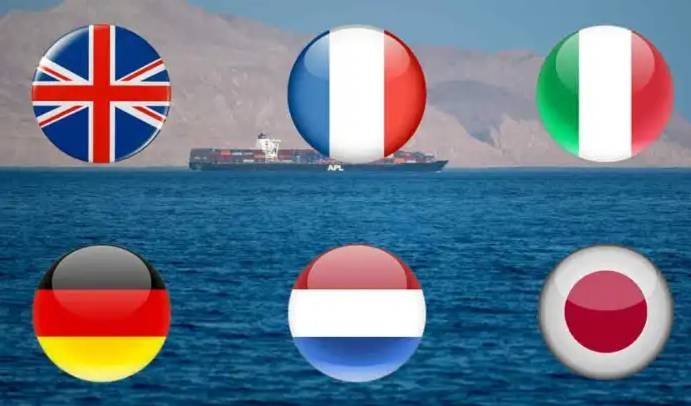
Britain, France, Germany, Italy, Japan, and the Netherlands said they are willing to take part in efforts to protect shipping in the area. They also supported countries that are already planning ways to handle the situation. At the same time, they strongly criticized Iran for recent attacks on unarmed commercial ships in the Gulf.
Later in the day, Italy, Germany, and France explained their position more clearly. They said they are not planning any immediate military action. Instead, they are open to a joint effort after the fighting stops.
Right now, the situation in the Strait of Hormuz is very serious. Iran’s actions have slowed down shipping in this key route. In normal times, about one fifth of the world’s oil and gas passes through this narrow waterway.
The conflict started on February 28 when the United States and Israel launched strikes on Iran. Since then, Iran has responded with attacks across the Gulf region. So far, 23 commercial ships, including 10 oil tankers, have reported attacks or incidents.
The crisis has also affected thousands of people at sea. Around 20,000 sailors are now stuck on nearly 3,200 ships waiting near the strait.
In a joint statement, the countries said they are very worried about the growing conflict. They asked Iran to stop its threats, including mines, drones, and missile attacks. They also stressed that safe movement of ships is a basic rule under international law.
They warned that this situation could affect people all over the world, especially those already facing hardship.
US President Donald Trump has asked other countries and NATO to help reopen the strait. But for now, many nations are not ready to act right away. They say they prefer to wait and plan for a solution after a ceasefire.

Italy’s Defence Minister Guido Crosetto said the statement by the six countries should not be seen as a “war mission”.
“No entry into Hormuz without a truce and a comprehensive multilateral initiative”, for which “it is right and appropriate for the United Nations to provide the legal framework”, he said in a statement.
And in Berlin, Defence Minister Boris Pistorius said that any German military involvement “would depend on the situation after a ceasefire… and whether we could participate within the framework of an international mandate”.
Military involvement would also require approval by the German parliament, he added.
French President Emmanuel Macron told reporters his country planned to sound out permanent members of the UN Security Council on the possibilty of establishing a UN framework for future plans — once the ongoing exchange of fire had ended — to secure navigation in the Strait of Hormuz.
Afghan Taliban accuse, but Pakistan denies ceasefire violation
“We have initiated an exploratory process, and we will see in the coming days whether it stands a chance of succeeding,” he said in Brussels following a European summit that took place on Thursday.
A UK defence official told reporters at a briefing Wednesday that “the level of threat is such that I don’t see many nations being willing to put warships into the middle of that threat right now”.
The defence official noted London has sent a “small number” of additional military “planners” to US Central Command to “help with the planning and option development for… whatever comes next in the Strait of Hormuz might look like”.

Comments are closed, but trackbacks and pingbacks are open.