
Islamabad MoU Iran US: Pakistan Urges Both Sides to Build on Understandings
Dar and Araghchi meet on SCO sidelines, agree to build on June accord amid Gulf tensions

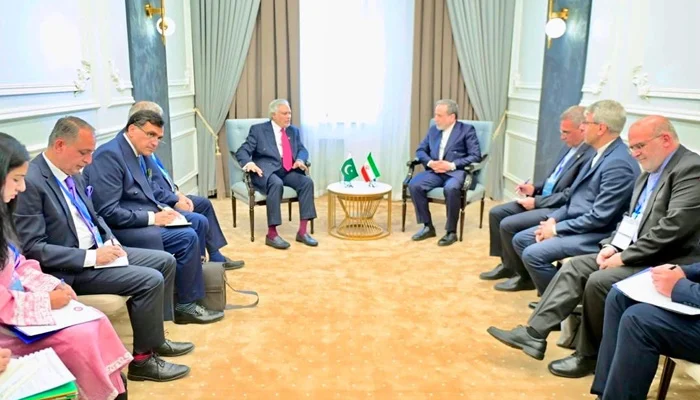
MoU – (Special Correspondent/Web Desk) – Pakistan has called for stronger progress on the Islamabad MoU Iran US agreement, urging both sides to build on the understanding reached last month. The appeal came as Deputy Prime Minister and Foreign Minister Ishaq Dar met his Iranian counterpart Abbas Araghchi.
The two leaders sat down on the sidelines of the Shanghai Cooperation Organisation’s Council of Foreign Ministers meeting. Their talks touched on shared history, current regional issues, and ways to keep tensions from rising further.
Pakistan’s Foreign Office said the meeting reaffirmed long-standing ties between the two neighbours. Both ministers reviewed how the region’s situation has shifted in recent weeks.
Dar voiced worry over the fresh wave of tension building across the region. He pushed for calm talks, restraint on all sides, and steady diplomatic contact to keep peace within reach.
He also raised the Islamabad MoU Strait of Hormuz issue directly. Dar said the understandings reached in June still offer a workable path forward, if both parties stay committed to them.
Araghchi, in turn, praised Pakistan’s steady diplomatic support through recent mont
Deputy Prime Minister/Foreign Minister Senator Mohammad Ishaq Dar @MIshaqDar50 held a meeting with the Foreign Minister of Iran, Seyyed Abbas Araghchi @Araghchi, on the sidelines of the SCO CFM Meeting in Cholpon-Ata, Kyrgyz Republic.
The two Ministers reaffirmed the close and… pic.twitter.com/VTldfSCrE2
— Ministry of Foreign Affairs – Pakistan (@ForeignOfficePk) July 24, 2026
hs. He called Islamabad’s role in the region constructive and thanked officials for real help on the ground.
That help included aiding Iranian fishermen and crew members who had been stopped by US forces. Pakistan worked with Iranian, American, and other officials to bring these individuals home safely.
Both sides agreed to stay in close contact going forward. They pledged ongoing talks on shared concerns, along with a joint push for regional peace and steady growth.
This meeting arrives at a tense moment for the Gulf. Iran and the United States remain locked in a standoff over the Strait of Hormuz, a waterway vital to global oil flow.
That standoff has cast doubt on how long the Islamabad MoU’s interim terms can hold. Analysts are watching closely to see whether both nations stay within the deal’s spirit.
Adding to the unease, Yemen’s Houthi movement claimed recent strikes on two Saudi oil tankers in the Red Sea. The group also threatened to blockade Saudi ports, a move that could disrupt shipping lanes far beyond the region.
These threats have pushed several countries to speak up. Pakistan, too, has ramped up outreach on maritime safety in recent days.
Just a day before the Dar-Araghchi meeting, Pakistan and Saudi Arabia agreed to work together on regional security. Prime Minister Shehbaz Sharif spoke directly with Crown Prince Mohammed bin Salman by phone.
During that call, Sharif condemned the tanker attacks in strong terms. Both leaders agreed to protect lawful maritime trade and keep shipping routes open and safe.
Taken together, these talks show Pakistan stepping up its role as a regional mediator. With tensions rising on multiple fronts, Islamabad appears keen to keep channels of dialogue open between Iran, the US, Saudi Arabia, and beyond.
Whether the Islamabad MoU Strait of Hormuz framework survives the current standoff may depend heavily on this kind of quiet diplomacy in the weeks ahead.
Comments are closed, but trackbacks and pingbacks are open.