

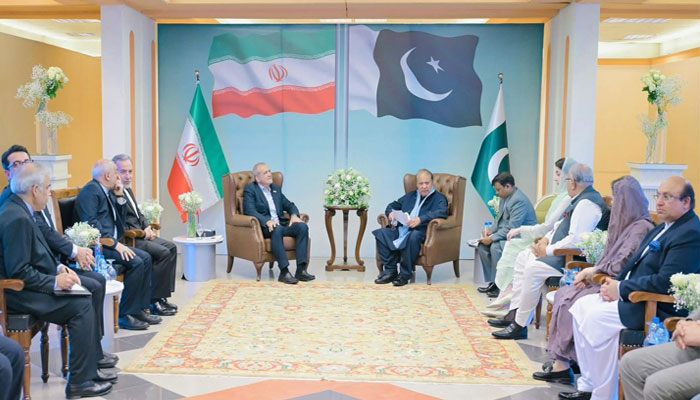

The recent visit of Iran’s newly elected President, Dr. Masoud Pezeshkian, to Pakistan was more than just a ceremonial diplomatic engagement. It came against the backdrop of a rapidly evolving political, economic, and strategic landscape in South Asia. Yet, what stood out most was not just the arrival itself, but the presence of a key figure at Lahore Airport to welcome him—former Prime Minister Nawaz Sharif.
For a man considered politically dormant for the past few years, Nawaz Sharif’s personal reception of the Iranian President, alongside Punjab Chief Minister Maryam Nawaz Sharif, was not just symbolic—it was deeply telling. It raised a fundamental question: was this merely protocol? Or was it a calculated move pointing towards future political and diplomatic realignments?
Nawaz Sharif’s political career has seen dramatic highs and lows, but his recent posture has largely been one of silence and restraint. His appearance at the airport—rather than leaving it to government officials—coupled with the warmth in his body language, sent a message far beyond the confines of the runway. It was a quiet assertion that “Nawaz Sharif is still here, and still relevant.”
Equally notable was the presence of Chief Minister Maryam Nawaz, standing beside her father. This was not a coincidental appearance. It signified a broader strategy—one that speaks to political continuity and generational transition. Maryam is increasingly active not just in provincial matters, but also in engaging with regional and international stakeholders. Her growing exposure to foreign dignitaries hints at an effort to establish her own diplomatic profile on the world stage.
In the wider context of shifting geopolitical realities, Pakistan’s ties with countries like Iran, China, Saudi Arabia, and Turkey are no longer shaped solely by religious or ideological affinity. Today, they are grounded in economic interests, energy cooperation, and regional security imperatives. In this environment, leadership with experience, continuity, and diplomatic acumen becomes critical. The joint presence of Nawaz Sharif and Maryam Nawaz at such a high-profile reception may suggest a coordinated foreign policy approach underpinned by political stability.
Whether or not President Pezeshkian’s visit proves historically significant, one fact remains clear: Nawaz Sharif’s personal welcome was no ordinary gesture. It could be the beginning of a renewed political narrative, a strategic repositioning or perhaps a signal of a broader comeback.
In politics, symbols often carry more weight than official statements. This reception might just have been one of those powerful symbols subtle in appearance, but profound in implication.
By: Asif Iqbal



Comments are closed, but trackbacks and pingbacks are open.